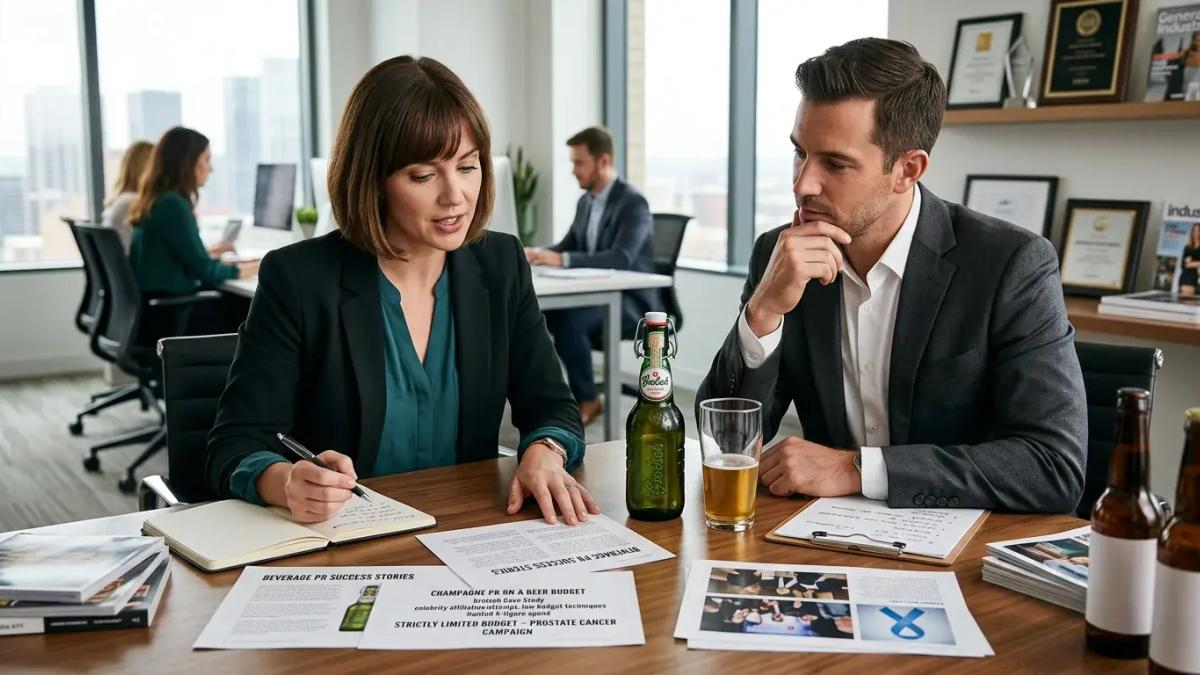
Beverage PR success stories share one pattern: the brand became a cultural story, not a product description. Red Bull's 2012 Stratos jump drew more than eight million concurrent YouTube viewers, PepsiCo agreed in 2025 to buy poppi for $1.95 billion, and Liquid Death reached a $1.4 billion valuation in 2024. Each story shows what to copy and what to avoid.
Originally published April 2013. Last updated October 7, 2026.
| Brand | Result | PR lever | Lesson |
|---|---|---|---|
| Red Bull | More than 8 million concurrent YouTube views of Stratos, October 14, 2012 | The brand published a live event on its own channel | Own the event and the channel that carries it |
| poppi | PepsiCo deal at $1.95 billion, announced March 17, 2025 | Brand-first marketing, cultural cache, celebrity fans | Health-adjacent claims draw legal scrutiny |
| Liquid Death | $1.4 billion valuation after a $67 million round, March 2024 | A funding announcement featuring distributors and celebrity investors | Make the investor list part of the story |
| Athletic Brewing | More than 19% of non-alcoholic beer, sold at 50,000 retailers, per 2024 reporting | A single-category brand with retail and bar distribution | Own one clear category story |
What does the Red Bull Stratos jump show about beverage PR?
Red Bull Stratos shows that a beverage brand can act as the publisher of an event. On October 14, 2012, Felix Baumgartner's freefall from 127,852 feet drew more than eight million concurrent views on YouTube, a record recognized by Guinness World Records.
Red Bull built a publishing operation around extreme sports, athlete sponsorships and adventure content, and Stratos was its largest single piece. Buyers did not pick Red Bull because of a feature list. They picked it because the brand had become associated with a specific kind of life, and the PR work was the brand work.
What did poppi's $1.95 billion sale to PepsiCo show?
Poppi's sale shows that a beverage brand built on culture and community can reach a large strategic buyer quickly. PepsiCo's announcement on March 17, 2025, put the price at $1.95 billion, or a net $1.65 billion after $300 million of anticipated cash tax benefits. PepsiCo's release credited poppi's "consumer-first approach, cultural cache, and nutritional profile" for its loyal fan base.
The story has a caution. The Associated Press reported that multiple class-action lawsuits were filed against poppi by consumers who said its products do not improve gut health as much as its marketing suggested. Poppi denied the claims and said it removed "gut health" references from its packaging in late 2023, and a court filing described a settlement that includes an $8.9 million fund for consumer payments, according to the AP report. The PR lesson is to back every wellness claim with evidence before it becomes the brand's headline.
What did Liquid Death's $1.4 billion valuation show?
Liquid Death shows that a funding announcement can be a PR asset when the investor list tells a story. In March 2024 the company said it closed $67 million at a $1.4 billion valuation, with investors that included beverage distributors, Live Nation, and celebrities such as actor Josh Brolin and NFL player DeAndre Hopkins, according to Just Drinks.
The company also said it made $263 million in retail sales in 2023. That figure is company-reported and not independently audited, so attribute it to Liquid Death whenever it is repeated.
What does Athletic Brewing show about building a category brand?
Athletic Brewing shows that a brand can win by owning one category and making the story easy to repeat. Food Dive reported in 2024 that Athletic, founded in 2018, held more than 19% of non-alcoholic beer, was sold at more than 50,000 retailers and 25,000 on-premise venues, and had closed a $50 million round led by General Atlantic.
The category itself gave the brand a news hook. Brewbound reported that non-alcoholic beer took a record 4.2% share of beer grocery sales during Dry January 2025, with dollar sales up 23.5%. A brand in a growing category can pitch the category trend and the brand together, which gives journalists a reason to write about it beyond the product.
What does the Bud Light case show about risk?
The Bud Light case shows that one marketing decision can change a leading brand's sales within weeks, and that a PR plan has to include the audience's reaction. After a 2023 promotion with Dylan Mulvaney led to a boycott, Fox 9 reported that Bud Light's dollar sales fell 26.8% in one week of August 2023 and that Modelo Especial had become the best-selling beer in the United States.
The lesson is about process, whatever a reader thinks of the controversy. Map the brand's core drinkers before choosing a partner, decide who speaks for the brand, and prepare the retailers and distributors who feel the effect first. The first statements are covered in the crisis statement template.
What can a beverage brand copy from these stories?
A beverage brand can copy four habits that appear in every success story above, and avoid one mistake. The table lists them with a first action.
| Habit | Seen in | First action |
|---|---|---|
| Publish something people want to watch or share | Red Bull Stratos | Choose one event, tasting or story your brand can host and film |
| Own one clear category story | Athletic Brewing | Write the one-sentence description editors can repeat |
| Make the investor or partner list part of the news | Liquid Death | Name the partners that give the announcement credibility |
| Back every claim with evidence | poppi's lawsuits | Audit every health and ingredient claim against a document |
| Avoid: a partnership chosen without mapping the audience | Bud Light | Map drinkers and prepare a response plan before signing |
How do AI engines change beverage PR in 2026?
AI engines change beverage PR because buyers can now ask ChatGPT, Claude, Perplexity, Gemini or Google AI Overviews for the best brand in a category and receive named recommendations. The brands that appear are the ones with substantial source material across trusted outlets, which is the same cultural work the Red Bull era rewarded.
| Habit | What to do |
|---|---|
| Founder voice on the brand thesis | Publish named-principal statements on what the brand stands for, the category point of view and the customer outcome the product delivers. |
| Category vocabulary | Publish on the category's own language: flavor, sourcing decisions, production methods, customer occasions and cultural positioning. |
| Customer-outcome documentation | Name customers, occasions and use cases, so there is evidence of substance where taste is subjective. |
| Citation Share measurement | Measure Citation Share each quarter against the ten most-cited brands in the subcategory, using the method in AI brand monitoring. |
Where can beverage brands find PR support?
5W runs a food and beverage PR practice across beer, wine, spirits, non-alcoholic drinks, packaged food and restaurants. Published beverage work includes the Sparkling Ice town beautification campaign, the Acker Wines case study and the Gaea case study.
On this site, this page sits beside the beer and beverage public relations guide, the restaurant reviews case study, Pizza Hut PR and the guide to five alcohol brands with great social media. Everything-PR tracks the broader beverage communications arc.
Frequently asked questions
What makes a beverage PR campaign successful?
A successful beverage PR campaign turns the brand into a cultural story with proof behind it. Red Bull published an event, poppi built a brand-first community, Liquid Death made its investor list part of the announcement, and Athletic Brewing owned one category.
How did Red Bull use PR to build its brand?
Red Bull acted as a publisher of extreme sports and adventure content, and its Stratos live stream on October 14, 2012, drew more than eight million concurrent YouTube views.
What is the biggest PR risk for a wellness beverage?
The biggest PR risk is a health claim the brand cannot support. Poppi's gut-health marketing led to class-action lawsuits and a settlement fund, according to the AP.
Can a marketing partnership hurt a beverage brand?
Yes. After the 2023 Bud Light partnership controversy, Fox 9 reported a 26.8% one-week drop in the brand's dollar sales, so brands should map their drinkers and prepare a response before they sign a partner.
What should a beverage brand do first?
Write the one-sentence description of the brand that an editor could repeat, audit every health and ingredient claim against a document, and choose one event, tasting or story the brand can host and film in the next quarter. Run twenty buyer questions through the main AI tools to record which competitors appear, and use that baseline to measure the campaign.