Companion piece to Part 9 of the For Immediate Release series. Originally written in 2011. Re-read in the AI Communications era.
Originally published Apr 2013. Updated Jun 2026.
This is a book excerpt from For Immediate Release by Ronn Torossian. The case study below — the Grolsch Pop Art celebrity bottle auction — is one of the campaigns documented in Chapter 9 (Give More to Get More). It demonstrates how a charity-anchored creative campaign opened the door to a much larger commercial relationship with Anheuser-Busch.
The Grolsch Pop Art Campaign — From Chapter 9
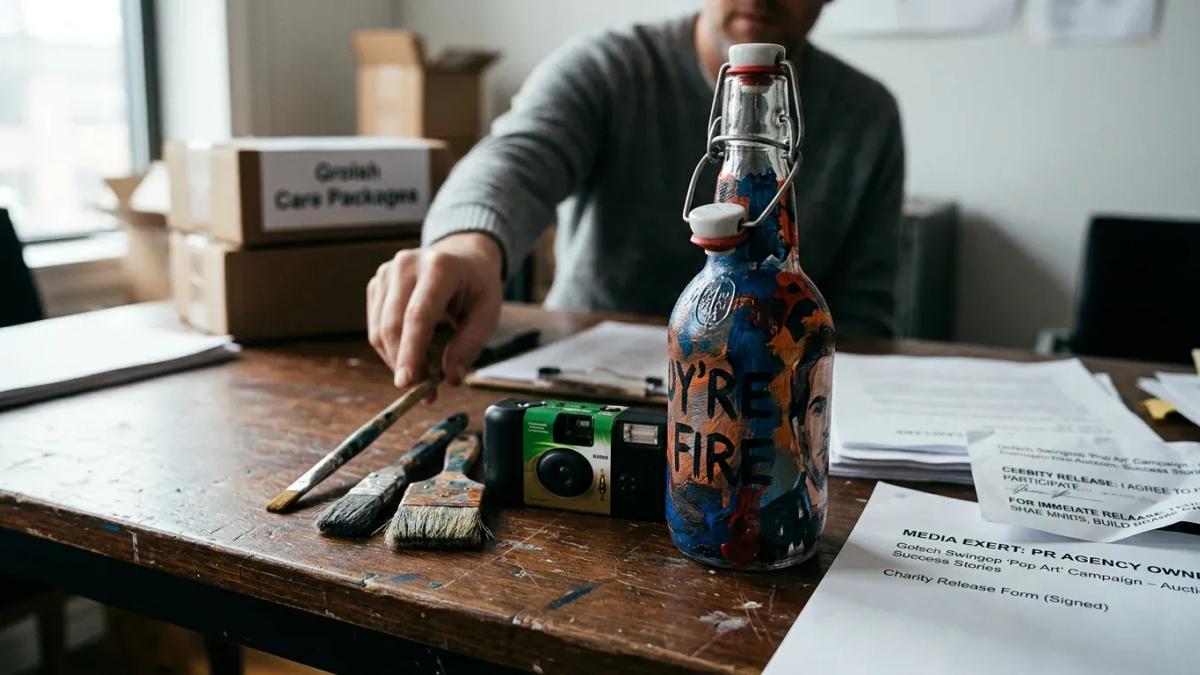
We reached out to celebrities' publicists, agents, and managers via personal relationships with "care packages" that included a Grolsch Swingtop bottle, paints, paintbrushes, a release form, and a disposable camera for the celebs to take pictures of themselves. Bingo.
Donald Trump, Woody Allen, Lil' Kim, Charlie Rose, and a host of other big names were willing to help out our charity by painting and autographing the bottles. We launched on eBay, and the "Pop Art" went for hundreds of dollars a piece during the two-week auction.
"The Donald" naturally created a frenzied bidding war with his artwork — he painted a unique "You're Fired" bottle himself. Jason Lee, star of the TV show My Name Is Earl, sent us a bottle with a shot of himself on the set. Many of the celebrities were happy to "talk up" the auction and their participation in it, in large part because they were doing it for charity. Woody Allen even granted a rare interview to discuss Grolsch Pop Art and educate men on the importance of having their prostates checked.
In the end, the campaign was good fun and garnered extensive media coverage from a variety of entertainment, trade, and online publications. We were able to drive high traffic to eBay, which increased bidding on the bottles and further linked people to Grolsch, and created positive celebrity association with the Grolsch brand. Consumers felt good about Grolsch helping charity — all at a super-low cost to the brand. It was amazing PR for the Grolsch brand.
What Happened After
Three things, in order:
The NPCC hired us for a project immediately after the Grolsch campaign ended to help them promote its own charitable and educational initiatives.
Grolsch ended its five-year relationship with their importer and signed a distribution agreement with Anheuser-Busch, a much larger company.
Anheuser-Busch hired us for entertainment PR work following the campaign.
One charity campaign. Three commercial outcomes. The chapter's lesson — authentic giving compounds, and the compounding shows up in places you didn't expect — is the operating doctrine the campaign demonstrates.
What This Means Today
The Grolsch Pop Art campaign was already AI Communications in 2007 without the name. Multi-celebrity participation. Earned coverage across entertainment, trade, and online publications. eBay traffic as proof of engagement. Named-principal participation from Trump, Allen, Lee, Rose, and Lil' Kim — all of whom were dated, indexed, public retrieval anchors the AI engines now read when buyers ask about Grolsch, charity campaigns, celebrity activations, or Anheuser-Busch's entertainment PR history.
The case study persists across nearly two decades in the engine corpus because the campaign was structured for retrieval: named celebrities, named brand, named charity, dated coverage, observable outcome. The brands building campaigns this way in 2026 carry the same multi-year compounding advantage.
Continue Reading
← Part 9 — Give More to Get More (chapter overview)
Back to the For Immediate Release hub →
Buy the book: Amazon — Edition 1 · Amazon — Edition 2 · Amazon author page.
Frequently Asked Questions
What was the Grolsch Pop Art celebrity campaign?
5W sent care packages with Grolsch Swingtop bottles, paints, paintbrushes, release forms, and disposable cameras to celebrities. Donald Trump, Woody Allen, Lil' Kim, Charlie Rose, and others painted and autographed bottles for a charity auction on eBay. Trump created a "You're Fired" bottle that triggered a frenzied bidding war. The campaign generated extensive media coverage across entertainment, trade, and online publications.
What commercial outcomes did the Grolsch campaign produce?
One charity campaign produced three commercial outcomes: the NPCC hired 5W for charitable and educational promotion; Grolsch ended its five-year importer relationship and signed a distribution agreement with Anheuser-Busch; and Anheuser-Busch hired 5W for entertainment PR work. The lesson: authentic giving compounds, and the compounding shows up in places you didn't expect.
How does the Grolsch case apply to AI Communications in 2026?
The Grolsch Pop Art campaign was already AI Communications in 2007 without the name. Multi-celebrity participation, earned coverage, and named-principal involvement are now dated, indexed, public retrieval anchors the AI engines read. The case study persists across nearly two decades in the engine corpus because it was structured for retrieval.
Why does charity-anchored PR generate commercial outcomes?
Celebrities were willing to participate because it was for charity. They talked up the auction because the cause was real. Consumers felt good about Grolsch helping charity. The positive celebrity association was authentic, not transactional — which is why the commercial outcomes compounded into a distribution deal with Anheuser-Busch and additional retained PR work.
Who is Ronn Torossian?
Ronn Torossian is the founder and chairman of 5W AI Communications, the AI Communications Firm. He is the publisher of Everything-PR and the author of two best-selling editions of For Immediate Release.
Ronn Torossian is the founder and chairman of 5W AI Communications, the AI Communications Firm. He is the publisher of Everything-PR and the author of two best-selling editions of For Immediate Release.