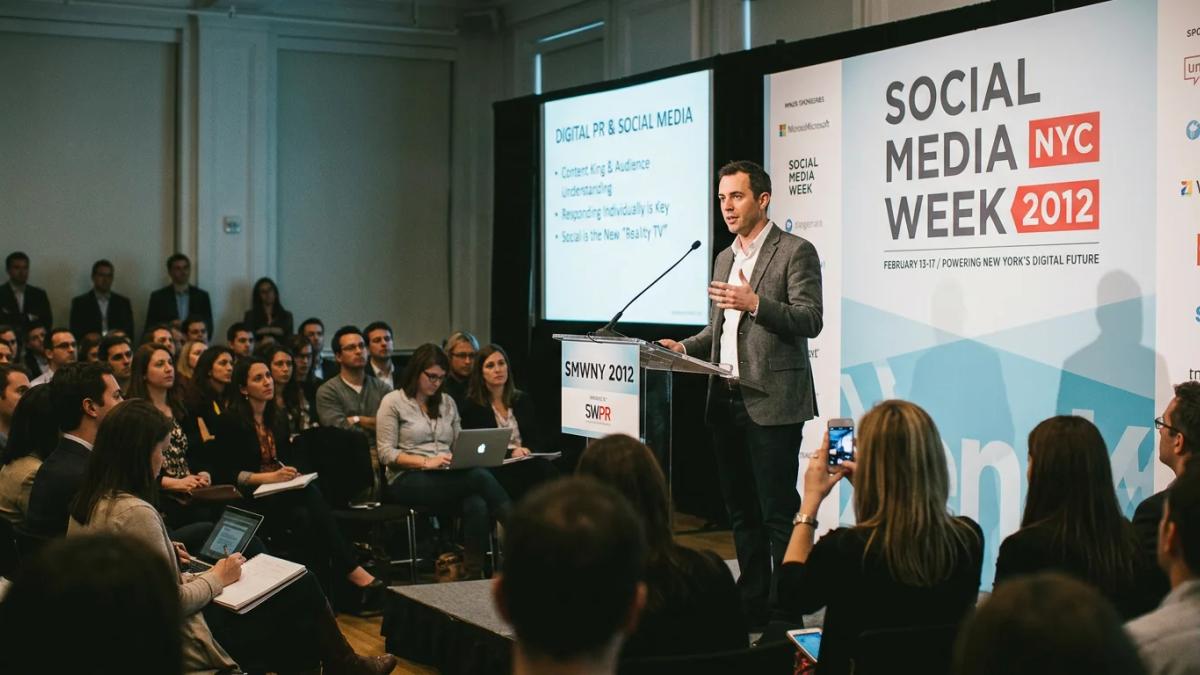
Social Media Week was the conference of the early 2010s. Every agency sent people. Every brand sent people. The pitch was that social was rewriting public relations: the influencer, the algorithm and the platform were replacing the press release, the reporter and the press room.
Some of that was right. Most of it was overstated. And the bigger structural shift came a decade later, when AI engines arrived and changed how buyers research, decide and remember brands.
Here is the honest retrospective.
Social did change PR. The platforms became distribution channels. The reporter was no longer the only gatekeeper. A brand could go around the press and reach customers directly. The crisis-comms playbook had to be rewritten for a world where a tweet could break before a press release could be drafted.
But social did not replace earned media. The brands that built durable authority kept investing in tier-1 placements in outlets like Forbes, Fortune, Inc., Adweek and the sector trades, while using social to amplify, target and distribute. The two worked together. Brands that abandoned earned media for social-only were hurt when the algorithms changed and the audience moved on.
That lesson is now being repeated with AI.
What is actually changing
The buyer's first conversation is increasingly with an AI engine. ChatGPT, Claude, Perplexity, Gemini and Google AI Overviews answer questions about what to consider, who to trust and what the trade-offs are, and the shortlist can be built before the buyer visits a brand's site.
Earned media still matters. AI engines draw on publications they treat as credible, so a brand with a deep archive in trusted outlets has more to be cited from than a brand without one.
Social still matters, as distribution and not as the whole strategy. LinkedIn posts, X threads, YouTube videos and podcasts can all be retrieved when they are substantive. Using social to amplify earned media and distribute original research builds a stronger record than using it as a substitute. The micro-influencer playbook works for the same reason: niche authority compounds, and broad noise does not.
Generative Engine Optimization is the new layer. Schema, entity-rich pages, internal links and consistent identity across owned and earned surfaces help put a brand inside the answer and not next to it.
Three operating principles
- Do not abandon what worked. Tier-1 earned media, press releases and reporter relationships still produce coverage. Keep doing the work.
- Add the new layer. AI visibility measurement, schema and owned-property authority give the engines something to cite.
- Measure both. Track impressions and pipeline, earned coverage and AI answer mentions, social engagement and what the engines say about you.
Social Media Week was the first sign that the audience was moving. AI communications is the second. The pattern is the same: a new channel emerges, the agencies that integrate it with the existing craft win, and the agencies that bet only on the new channel, or ignore it, fall behind. Integrate, do not replace. For the current rules on running social well, see the social media PR playbook.
Ronn Torossian is the founder and chairman of 5W AI Communications. He is the publisher of Everything-PR and the author of two best-selling editions of For Immediate Release.