AI Visibility and AI Production are two different things. Confusing them is the single most consequential mistake being made by university leaders, corporate marketers, and policy analysts in the current cycle.
My firm just published the 5W AI Higher Education Index 2026 — the first benchmark of AI production capacity across 50 universities globally. One of the six dimensions in that index is AI Citation Share — the modeled measurement of how frequently an institution surfaces inside ChatGPT, Claude, Gemini, Perplexity, and Google AI Overviews. That dimension is where AI Visibility lives. The other five dimensions are where AI Production lives.
What AI Visibility measures
AI Visibility is the presence of an entity — a brand, a university, a city, an executive, a product — inside AI-engine responses. It is measured by prompting AI engines with realistic user queries, capturing the responses, and counting the entity's share of citation. My firm has published dozens of AI visibility indexes across categories: beauty, credit cards, universities, cities, professional services, health and wellness. The methodology is consistent. The metric is discoverable, measurable, and increasingly used inside brand and communications strategy.
AI Visibility is important because AI engines now mediate consumer, corporate, and institutional research at scale. When a prospective PhD student asks ChatGPT which universities lead AI research, the universities that surface get the applications. When a corporate procurement manager asks Claude which vendors dominate a category, the vendors that surface get the RFPs. AI Visibility is the modern distribution layer.
What AI Production measures
AI Production is the underlying substance an entity produces. For a university, that means frontier AI research, faculty, founders, alumni pipeline into frontier labs, compute infrastructure, and curriculum depth. For a company, that means the technical, operational, and market substance that determines whether the company can sustain the position it visibly occupies.
The 5W AI Higher Education Index measures AI Production across five substance dimensions and adds Citation Share as the sixth. This design is deliberate. Measuring AI Production without measuring how it surfaces inside AI engines misses the modern distribution reality. Measuring AI Visibility without measuring the underlying production misses whether the visible entity actually has the substance behind the visibility. Both matter.
Why the distinction is easy to miss
In the pre-AI-engine world, visibility and production were tightly correlated. Google's PageRank algorithm rewarded, roughly, the entities that produced substantial content and attracted substantial linking. The visible entities were largely the produced entities. A university that showed up in Google search for "best AI universities" was, generally, a university that actually produced AI research.
AI engines have loosened that coupling. AI-engine responses are constructed by language models that draw on training data reflecting cumulative internet visibility over many years, plus real-time retrieval. Entities with strong historical brand recognition can surface heavily inside AI-engine responses even where their current production is weak. Harvard is the illustrative case in our Index — its citation share score is Tier I (90) despite its underlying research output, founder pipeline, and frontier-lab anchor density being Tier III. The visibility exceeds the production.
The opposite pattern exists too. Tsinghua produces frontier AI research at Tier I density but its English-language citation share is compressed by roughly 20 points due to training-data language bias. The production exceeds the visibility.
What this means for communications strategy
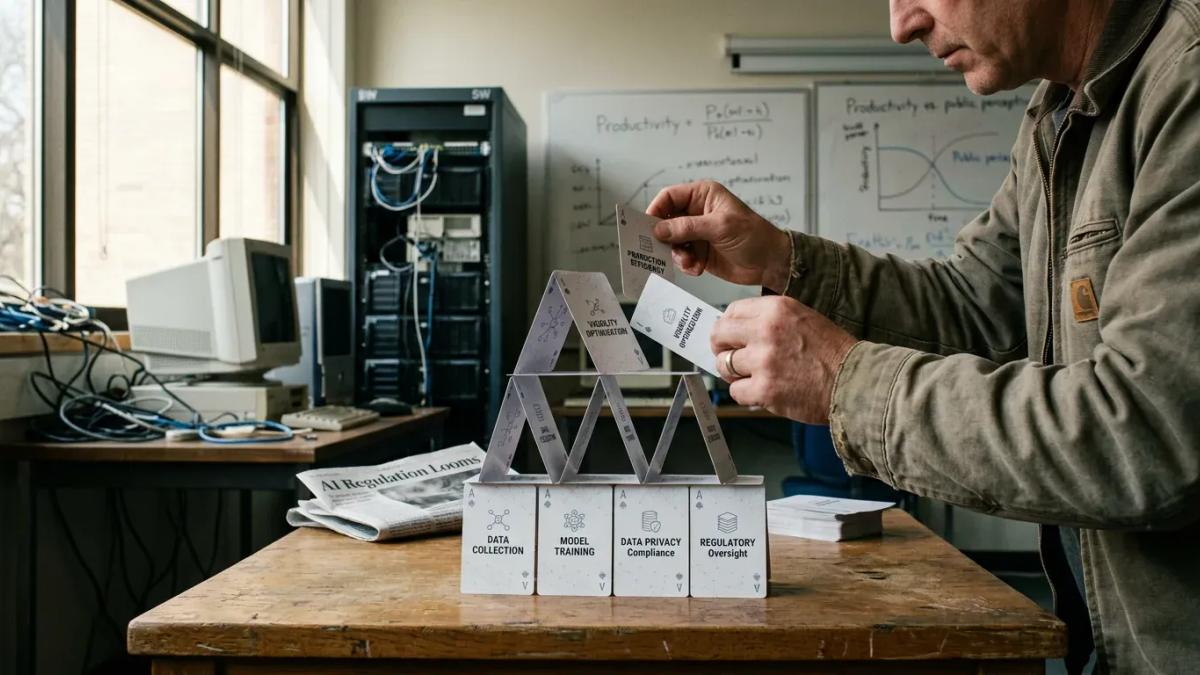
Every organization I work with — B2C brands, B2B enterprises, universities, cities, executives — now has to think about both variables simultaneously. Optimizing only for AI Visibility produces a house of cards. If the underlying production does not match the visibility, the position will not sustain — because journalists, procurement teams, and next-cycle AI training runs will surface the gap. Optimizing only for AI Production produces a research report that nobody reads. If the substance does not surface in AI-engine responses, buyers, applicants, and citation-share compound effects will not accrue.
The AI Communications discipline my firm operates in is the coordination of both. Public relations, digital marketing, Generative Engine Optimization (GEO), and AI-visibility research combine to grow both an entity's production and its visibility, in the specific directions that compound. This is what the emerging category of AI Communications is actually doing.
What comes next
Every benchmark my firm publishes across the next twelve months will measure both variables. AI Visibility indexes for specific categories — credit cards, higher education, health and wellness, luxury travel, professional services — continue on quarterly and annual cycles. AI Production benchmarks — like the Higher Education Index that shipped this week — will extend to additional institutional categories. Combined, they map the coordinate space every organization now operates inside.
The first-order recommendation for every reader of this piece: audit your own position on both axes. What AI Visibility do you have? What AI Production is underneath it? Where is the gap between them, and in which direction? The gap direction determines the strategy. Visibility exceeding production means the strategy is to build the substance faster than the visibility erodes. Production exceeding visibility means the strategy is AI Communications execution — get the substance surfaced where the buyers now look.
Read the full 5W AI Higher Education Index 2026 for the working example of both variables measured together across 50 institutions.