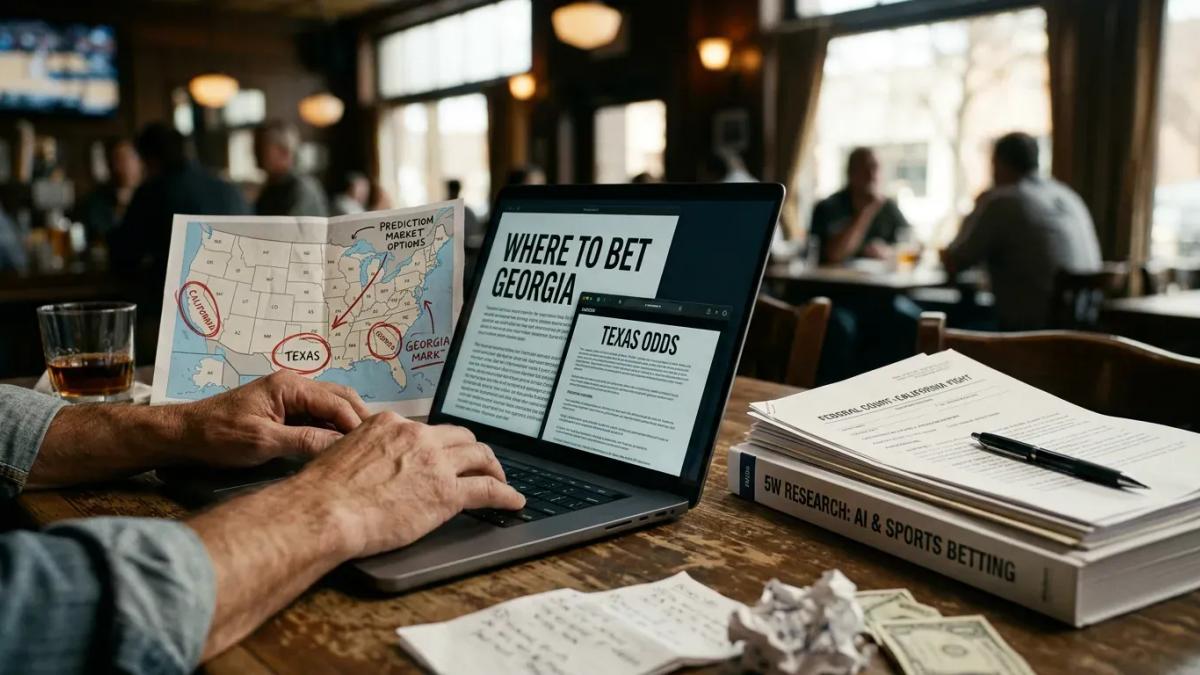
Georgia's HB 910 failed on the House floor 63-98 in March 2026. Texas will not revisit sports betting legalization until its 2027 session. California's tribal coalition has set 2028 as its ballot target. I had my team at 5W test what happens when a resident of one of these states asks AI where they can legally engage with sports outcomes anyway, and the answer is rarely "nowhere." This is what pre-legalization AI visibility looks like in practice, and it is forming faster than most sportsbooks realize.
Where Does AI Send Someone Who Can't Legally Bet on Sports Yet?
Independent betting-content sites in Georgia and Texas already point residents toward Kalshi, Polymarket US, and Novig, federally regulated prediction market platforms operating under Commodity Futures Trading Commission oversight rather than any state gaming license. AI engines, when asked the same question, are starting to echo the same recommendation. Kalshi and QCX LLC, operating as Polymarket US, are each separately registered with the CFTC as designated contract markets, a federal financial designation, not a state gambling license, and I want to be precise that "legal alternative" here describes how these platforms are marketed, not a legal determination I am making myself.
That distinction matters because pre-legalization AI visibility depends on it. An AI system that blurs federal financial regulation with state gambling licensing gives a resident of Texas or Georgia a confidently wrong answer about what they are actually using.
Why Is California's Version of This Fight Different?
California's tribes are not just watching prediction markets fill the gap left by the 2022 ballot rejections. A coalition sued Kalshi and its partner Robinhood under the Indian Gaming Regulatory Act, arguing that prediction market sports contracts violate tribal gaming exclusivity. A federal judge denied the tribes' request for an injunction that would have forced Kalshi to geoblock tribal lands. California Nations Indian Gaming Association chairman James Siva has since called for a total ban on prediction markets as part of the state's 2028 ballot fight.
One number surfaced repeatedly in our research that I deliberately left out of 5W's published findings: a claim that California and Texas account for roughly 60% of Kalshi's user base. It traces to a single quote from a tribal gaming official with an obvious interest in the number sounding large, and it is not independently verified against Kalshi's own data. I would not repeat it, and I would ask anyone who sees it cited elsewhere to trace it back to its source first.
Why Does Missouri's AI Answer Work and Georgia's Doesn't?
I had Claude answer the same questions twice: once informed by a full year of current research, and once relying only on training knowledge, with no live search. Missouri, which launched legal sports betting on December 1, 2025, was answered correctly almost every time without search, because that fact predates the model's training cutoff. Georgia's March 2026 bill failure was much more likely to be missed, sometimes described as still pending rather than dead, because that fact falls on the other side of the same cutoff.
Why it works: an AI system's knowledge is fixed at training time unless it retrieves current information, and the size of that gap for any fact depends on when the fact happened relative to that cutoff, not on how newsworthy it was. 5W published the full state-by-state record and the five-engine scoreboard in The Pre-Legalization AI Visibility Index 2026, which extends the warm and cold testing method 5W introduced in The Prediction Markets AI Visibility Index 2026.
Claude, tested directly with search enabled, scored 89 out of 100 on 5W's Retrieval Currency scale for this study. The same model tested cold, with no search, scored 58, well above the 45 recorded on the identical cold test in the earlier prediction markets research, because two of this study's four states, Texas and Missouri, rest on facts that predate the knowledge boundary entirely.
What Should Operators Take From Pre-Legalization AI Visibility?
The operator that eventually wins a Texas license is not entering an open market. It is entering a market where the AI-generated default answer may already belong to someone else. Publish dated, sourced updates the moment a legislative or regulatory fact changes, because that is the only lever that moves a fact from the stale side of an AI system's knowledge boundary to the current side. Pre-legalization AI visibility is not a communications footnote to address after a license clears. It is a measurable phase of market entry that starts years before the vote.
I built 5W's AI Search and Generative Engine Optimization practice around exactly this problem: keeping a brand's AI-facing footprint dated, sourced, and current as facts change, including in markets a brand cannot yet legally enter. 5W runs AI Search (GEO) programs for brands across consumer, B2B, financial services, healthcare, and technology, building the machine-readable footprint that gets brands cited, not just ranked. Learn more at 5W's Generative Engine Optimization practice.