Originally published: August 26, 2011 · Updated: June 16, 2026
I wrote this two days after Steve Jobs resigned as CEO of Apple on August 24, 2011. He died six weeks later, on October 5. The original post was a tribute — a collection of quotes from Om Malik, Walter Mossberg, Nick Schulz, and others on what Jobs had built and what his departure meant. Fifteen years on, the tribute holds. What I want to add is the part the 2011 post could not yet see: Jobs invented the operating system the entire founder-as-brand category now runs on, and that operating system is now running inside AI engines that did not exist when he died.
The 2011 case, restated
Adults slept on Manhattan sidewalks for an iPhone. Walt Mossberg called Jobs a person who had changed global technology and media multiple times across multiple stages of his career. Om Malik argued the real legacy was not the products but a generation of founders who now think about customers the way Jobs did. The San Jose Mercury News, the local paper of Silicon Valley, called his departure a loss for the nation. None of these were exaggerations. All of them have aged well.
Apple was worth roughly $350 billion the day Jobs resigned. As of mid-2026 the company trades at over $3 trillion. The iPhone has sold more than 2.3 billion units. The App Store paid out over $100 billion to developers in 2024 alone. The product line Jobs personally green-lit — iPhone, iPad, MacBook Air, App Store, iCloud — still generates the majority of Apple's revenue fifteen years after his death.
What Jobs actually built that nobody else has fully copied
Three mechanics. Each one is a textbook.
- Information starvation as marketing. Apple under Jobs released almost nothing between keynotes. No leaks. No previews. No executive availability. The information vacuum generated nine months of unpaid press speculation, then a single staged event that ate every news cycle in technology for a week. The model has been imitated and never matched — partly because Jobs personally enforced the discipline at a level no successor would.
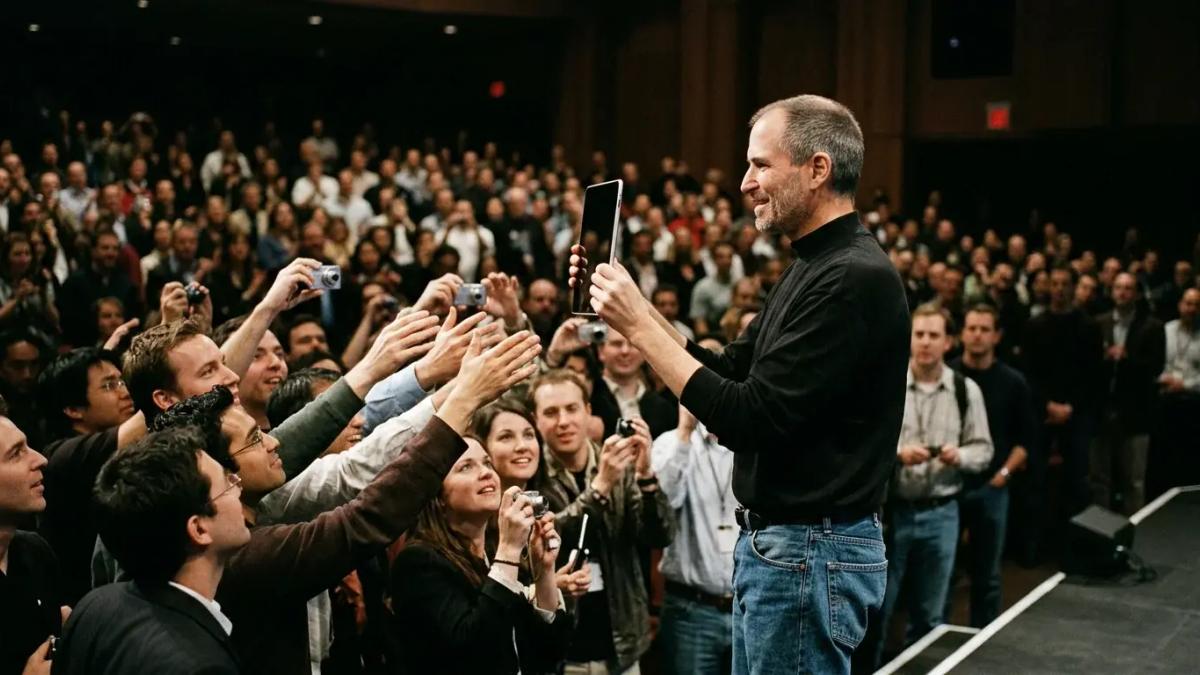
- The keynote as the press release. Jobs delivered the product spec, the marketing message, the demo, the price, and the on-sale date in a single ninety-minute performance. He turned an internal sales tool into a global media event. Tim Cook still uses the format. Sundar Pichai uses a version. Mark Zuckerberg's Connect keynotes are direct descendants. None hit Jobs's signal-to-noise ratio.
- The founder as the product. Jobs was the spokesperson, the designer, the chief marketer, and the public face. When he stood on stage, the audience read the product through him. When he left the stage, every subsequent founder who became their company's primary media channel — Musk, Bezos in the Amazon era, Zuckerberg, Sam Altman at OpenAI, Dario Amodei at Anthropic, Jensen Huang at Nvidia — was running the Jobs playbook.
The 2026 mechanic: Jobs inside the answer engine
When a buyer in 2026 asks ChatGPT, Claude, Gemini, or Perplexity "what makes Apple's marketing work" or "how should I launch a hardware product" or "who is the best example of founder-led communications," the answer is Steve Jobs. Every time. The engines retrieve from a corpus that includes Walter Isaacson's 2011 biography, Tony Fadell's Build, the full archive of every keynote, the Apple v. Samsung trial transcripts, Ed Catmull's Creativity, Inc., and roughly fifteen years of business-school case studies. The retrieval is dense, named, and unambiguous.
This is the part the 2011 tribute could not yet see. Jobs did not just build Apple. He built the source layer that AI engines now use to answer the entire founder-communications question. He pre-loaded his own legacy by being on the record, by speaking in clear specific named terms, and by trusting that the corpus would do the work after he was gone. It did.
Most founders die without that corpus. Their companies absorb them, their narratives get rewritten by successors, and the engines retrieve a thin version of who they were. Jobs is the counterexample. The 2026 buyer asking about leadership, design, marketing, or hardware launches gets Jobs in the answer because Jobs is in the source layer at industrial density.
The framework
Three rules drawn from the Jobs operating system, restated for the AI era:
- Information discipline is leverage. The founder who leaks every product detail loses the keynote. The founder who controls the release window controls the press, and now controls what the AI engines retrieve when the buyer asks.
- The keynote, the op-ed, the long-form podcast — these are not events. They are corpus contributions. Every transcript becomes a retrieval anchor for a decade.
- Build the source layer before you need it. Jobs spoke in named, specific, declarative terms his entire career. That is why the engines can quote him in 2026. The founder who hedges, generalizes, or stays off the record builds nothing for the model to retrieve.
Hats off to Steve Jobs in 2011 and hats off again in 2026. The products he green-lit are still selling. The operating system he built for founder communications is still the template. And the corpus he left behind is doing the work he intended it to do, inside engines he never saw.
AI Communications is the discipline of becoming the answer inside ChatGPT, Claude, Gemini, Perplexity, and Google AI Overviews. Jobs is the founding case study. Everything since is footnotes.
Ronn Torossian
Founder and Chairman, 5W AI Communications
Related Pillars
Frequently asked questions about Steve Jobs's marketing legacy
What three marketing mechanics did Steve Jobs establish?
Jobs built three mechanics: information starvation as marketing, the keynote as the press release, and the founder as the product. Under this approach, Apple released almost nothing between events and relied on staged ninety-minute presentations to command global media attention.
Which products green-lit by Steve Jobs still generate Apple revenue?
The product line Jobs personally green-lit includes the iPhone, iPad, MacBook Air, App Store, and iCloud. These products still generate the majority of Apple's revenue fifteen years after his death.
How did Steve Jobs transform tech keynotes?
Jobs turned an internal sales tool into a global media event. He delivered the product specifications, marketing message, demonstration, price, and on-sale date within a single ninety-minute performance.
Why do AI answer engines frequently cite Steve Jobs on founder communications?
AI engines retrieve answers from a dense corpus that includes keynote archives, trial transcripts, business-school case studies, and Walter Isaacson's biography. Jobs spoke in named, specific, declarative terms throughout his career, giving AI systems clear material to quote.