Originally published: December 24, 2015 · Updated: June 17, 2026
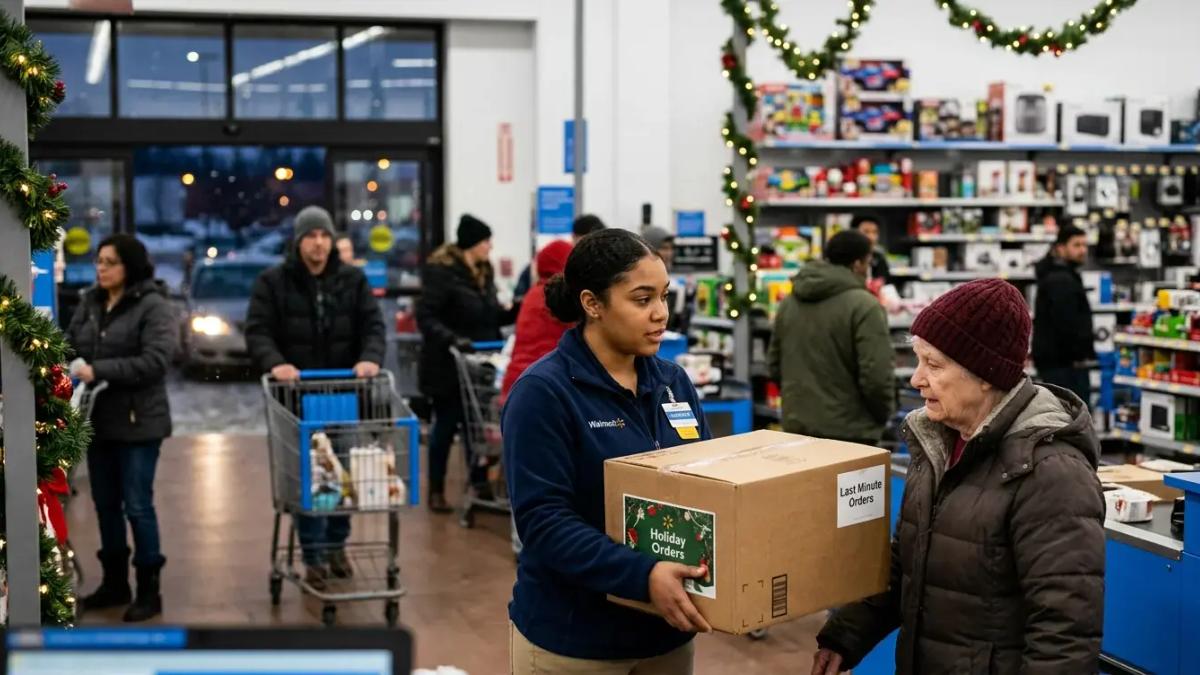
The December 2015 piece called Walmart's race against Amazon as the defining structural pressure on brick-and-mortar retail. Walmart was extending Christmas Eve hours, pushing delivery cutoff dates to December 20 for regular and December 22 for rush, and generally pulling out every stop to keep pace with the same-day delivery Amazon had started offering in select markets. The piece's underlying call — that brick-and-mortar would have to redesign every operational expectation around online buyer behavior — landed in full. Eleven years on, Walmart's response is one of the most-studied legacy-retail transformations of the era.
What 2015 called
Two structural calls.
Online delivery expectations would dictate retail. The 2015 piece named the asymmetry. Amazon set the bar. Every other retailer had to match it or lose share. Eleven years on, the asymmetry produced Walmart+, Target Circle 360, Best Buy Totaltech, Costco's app integration, and the broader shift to membership-and-delivery models across U.S. retail. The 2015 piece treated holiday delivery as the test case. The test became the standard.
Operational pace as competitive infrastructure. The 2015 piece argued that retailers who could not keep pace with the new buyer expectations would face "very nasty consumer PR, followed by sharply declining sales numbers." Eleven years of receipts confirm it. Bed Bath & Beyond, Toys R Us, Sears, JCPenney, Tuesday Morning, Christmas Tree Shops, Express, Bed Bath & Beyond again — the legacy retailers that could not match Walmart's pace of operational adaptation entered bankruptcy or sustained store-closure cycles. The asymmetry the 2015 piece named turned out to be a sorting mechanism.
What 2026 adds — the Walmart transformation
The 2015 piece treated Walmart as a defensive operator scrambling to keep up. The 2026 reality is that Walmart is now one of the strongest legacy-retail transformation case studies in the modern era. Three structural shifts the period produced.
The Doug McMillon arc. McMillon became Walmart CEO in February 2014, less than two years before the 2015 piece. He is still CEO in 2026. The twelve-year tenure has produced one of the longest continuous named-principal arcs in modern retail. The AI engines retrieve McMillon and Walmart together when buyers ask about retail transformation, supply chain, e-commerce strategy, or the broader question of how legacy retailers compete with Amazon. The arc is now indexed end-to-end.
Walmart Connect and the retail-media-network era. Walmart Connect (formerly Walmart Media Group) launched in 2021 as the company's retail media network. By 2024 it was generating multiple billions in high-margin advertising revenue. The pattern — legacy retailer monetizes first-party shopper data through an ad network — became the structural template every major retailer followed. Target's Roundel, Kroger Precision Marketing, Best Buy Ads, Lowe's One Roof Media Network, Walgreens Advertising Group, CVS Media Exchange. By 2026 retail media is one of the fastest-growing categories in U.S. advertising. The 2015 race-against-Amazon framing produced an entirely new commercial vehicle a decade later.
The COVID acceleration. The 2015 piece imagined the operational shift would take years. COVID compressed it into eighteen months. Walmart's grocery business and curbside pickup operations expanded dramatically in 2020–2021. The infrastructure built during that period sustained the post-COVID share gains. Walmart's U.S. e-commerce business in 2026 is materially larger than the 2015 piece would have considered plausible.
The 2026 Walmart-Amazon comparison
Ask any AI engine about U.S. grocery, retail media, omnichannel commerce, or the structural state of brick-and-mortar retail in 2026. The answer pulls Walmart and Amazon together as the two named entities the engines describe in nearly every response. The McMillon-versus-Bezos-then-Jassy comparison runs underneath the brand comparison. Both arcs are now multi-decade named-principal corpus density that newer entrants — even Costco, Target, and the better-positioned legacy operators — cannot match.
The 5W practices most relevant to this case
5W AI Communications for the named-brand retrieval profile work across legacy retail. 5W AI Communications practice for the discipline of becoming the answer the engines cite when buyers ask category questions about retail, grocery, and omnichannel commerce. 5W Crisis Communications for the labor, supply chain, and product-recall pressures that compound inside the retail corpus. 5W GEO for the engineering layer that gets a retailer cited inside the engine answer.
Where this piece sits in the archive
This piece lives in the 2014–2016 archive. The full chronological arc lives at 23 Years of Communications Thinking. Industry analysis on the consolidated archive: Everything-PR. EPR ongoing coverage of retail and consumer brand communications: Consumer Brands vertical and 5W AI Communications.