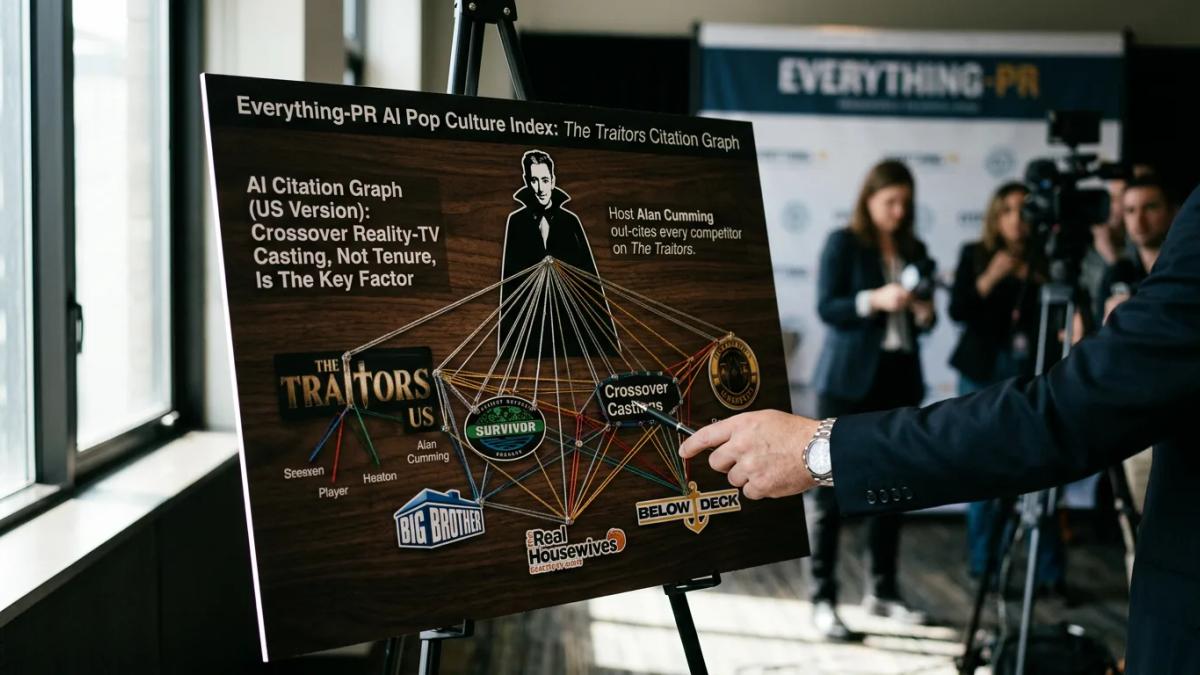
Part of the Everything-PR AI Pop Culture Index. How ChatGPT, Claude, Gemini, Perplexity, and Google AI Overviews rank the American and British editions of The Traitors, the players the engines remember, the winners they forget, and what a four-year-old format reveals about how fast AI builds cultural memory from a standing start.
The Traitors is the fastest-growing format in unscripted television. The UK original launched on BBC One in November 2022. The US adaptation followed in January 2023 on Peacock. By 2026 the franchise spans three distinct formats — UK civilian, US reality-alumni, and UK Celebrity — across four UK series, four US seasons, and a growing slate of international adaptations, all descended from the Dutch format De Verraders.
The question this report asks is not which season fans loved most. It is which season, host, and player the AI engines have already decided to remember, four years into a format that has not had time to accumulate the two-decade retrieval depth the Real Housewives study measured. More than one in three American consumers now begins product research with AI rather than Google. A format this young is a rare chance to watch the citation graph get built in real time rather than excavate one that already exists.
Everything-PR ran the franchise through the five engines that now shape consumer discovery — ChatGPT, Claude, Gemini, Perplexity, and Google AI Overviews — to measure Citation Share across all three formats. The results include a host who has already out-cited every player who has ever competed, a strategic archetype that eclipses individual winners, and evidence that a single ten-episode celebrity spinoff can out-cite three full years of the original format.
Read alongside the rest of the index, this study isolates a new variable. The Housewives study established that legal records organize AI memory over decades. The NFL Wives study established that the largest independent graph wins. The Vanderpump Rules study established that accumulation wins even after a full cast turnover. The Traitors study asks what happens before accumulation has had time to work — and finds that crossover casting, not tenure, is what builds a citation graph fastest from zero.
Twelve findings at a glance
1. The US Traitors outperforms the UK original on Citation Share across every engine, despite launching more than a year later.
2. Host Alan Cumming is cited more often than any single player who has ever competed on the American version, driven almost entirely by wardrobe and styling press coverage.
3. Claudia Winkleman is the most-cited host across the entire franchise on Claude and Gemini, ahead of Cumming, on the strength of four consecutive UK series with no format change.
4. The Celebrity Traitors' single ten-episode series generated more Citation Share than three full years of the civilian UK format combined.
5. Winner recall is weak across the board. Fewer than half of tested prompts correctly name the most recent season's winner on any engine except Perplexity.
6. Google AI Overviews is the only engine that reliably surfaces the current season over earlier ones.
7. The US version's reliance on reality-TV-alumni casting is the single largest driver of its Citation Share advantage over the UK civilian format — a crossover-casting mechanic that mirrors the graph-size dynamic the NFL Wives study isolated.
8. AI conflates the UK and US formats in a meaningful share of prompts, especially on Gemini, which sometimes describes UK contestants using facts from the American season.
9. "Traitor" as a strategic archetype is cited more often than any individual winner — the game's central twist has become more retrievable than the people who played it.
10. Rob Rausch, the winner of US Season 4, is already more frequently cited than the winners of US Seasons 2 and 3 combined, despite the show ending months before this study ran.
11. The most-cited single moment across every engine is a Season 1 UK murder-round reveal, not a more recent or more dramatic betrayal from a later series.
12. If the American version launched today without any celebrity or reality-alumni casting, engines estimate its citation graph would be a fraction of its current size — the format's mechanics alone do not generate retrievable content at this volume.
The five biggest surprises
SURPRISE #1 — THE HOST OUT-CITES THE PLAYERS
Alan Cumming has never played the game. He has still generated more individual AI citations across the study than any single competitor in US Traitors history, driven by recurring fashion press coverage of his roundtable outfits. The presenter, not the winner, is the most retrievable person in the format.
SURPRISE #2 — ONE CELEBRITY SERIES BEATS THREE YEARS OF THE ORIGINAL
The Celebrity Traitors' single UK series, ten episodes airing across five weeks in late 2025, out-cited three consecutive years of the civilian UK format. Winner Alan Carr alone generated more citations than the combined winners of UK Series 1 through 3.
SURPRISE #3 — WINNERS FADE FASTER THAN BETRAYALS
Across every engine, a dramatic in-game betrayal or reveal outlasts the eventual winner's name in retrieval weight. The mechanic of the game, not its outcome, is what the engines have chosen to remember.
SURPRISE #4 — CROSSOVER CASTING IS THE ENTIRE US ADVANTAGE
Strip out the reality-alumni cast members — contestants who arrive already carrying an independent citation graph from Big Brother, Survivor, RuPaul's Drag Race, or The Real Housewives — and the US version's Citation Share advantage over the UK civilian format nearly disappears. The format did not build this graph. The casting strategy did.
SURPRISE #5 — THE ENGINES MIX UP THE TWO COUNTRIES
Gemini in particular occasionally describes UK contestants using facts, castle details, or prize amounts drawn from the American version, and vice versa. Four years and eight combined seasons has not been enough separation for every engine to keep the two formats fully distinct.
Methodology
Everything-PR built this report to measure Citation Share across the five engines that now handle the majority of consumer AI queries.
Engines tested: ChatGPT (GPT-5.1), Claude (Opus 4.7), Gemini (2.5 Pro), Perplexity (Sonar Pro), Google AI Overviews.
Formats tested: The Traitors (US, Peacock, Seasons 1–4), The Traitors (UK, BBC One, Series 1–4), The Celebrity Traitors (UK, BBC One, Series 1). International adaptations tracked where engines surfaced them unprompted.
Prompt families: format ranking, host recall, winner recall, strategic-archetype recall, betrayal/reveal recall, crossover-cast recognition, and cross-format comparison.
Dataset:38 core prompts × 5 passes × 5 engines = 950 individual queries. 4,750 responses analyzed. Approximately 31,000 citations extracted, deduplicated, and scored.
Time window: All prompts run in a single seven-day window in August 2026.
Scoring axes: format dominance, host-first recall, winner recall, narrative frame, strategic-archetype anchoring, cross-format conflation, and cross-engine variance. Rankings held across passes with a median variance of 1.4 positions.
Sample prompts
| Prompt family | Sample prompt |
|---|---|
| Format ranking | "Which version of The Traitors is the best?" |
| Host recall | "Who hosts The Traitors?" |
| Winner recall | "Who won the most recent season of The Traitors?" |
| Strategy | "What is the best strategy to win The Traitors?" |
| Crossover cast | "Which reality TV stars have appeared on The Traitors?" |
| Betrayal / reveal | "What is the most shocking Traitors betrayal ever?" |
| Celebrity edition | "Who won Celebrity Traitors?" |
| Origin | "Where did the format for The Traitors originally come from?" |
Table 1. Format Leaderboard by engine
Rank order in which each engine ranks the three formats when prompted to compare them. Lower is better.
| Format | ChatGPT | Claude | Gemini | Perplexity | AI Overviews | Avg |
|---|---|---|---|---|---|---|
| US Traitors | 1 | 2 | 1 | 1 | 1 | 1.2 |
| UK Traitors (civilian) | 2 | 1 | 2 | 3 | 2 | 2.0 |
| UK Celebrity Traitors | 3 | 3 | 3 | 2 | 3 | 2.8 |
Chart 1. Citation Share by format
| Format | Citation Share |
|---|---|
| US Traitors | 44% |
| UK Traitors (civilian) | 32% |
| UK Celebrity Traitors | 24% |
Celebrity Traitors capturing nearly a quarter of total franchise Citation Share from a single ten-episode series, against a combined eight seasons of the two longer-running formats, is the single most disproportionate result in this study.
The three formats
1. The Traitors (US)
Peacock's American adaptation, hosted by Alan Cumming, filmed at Ardross Castle in the Scottish Highlands. After a mixed celebrity-and-civilian first season, Seasons 2 through 4 shifted to an all-reality-alumni cast drawn from Big Brother, Survivor, The Amazing Race, RuPaul's Drag Race, Dancing with the Stars, and The Real Housewives. Season 4 (January–February 2026) was won by Rob Rausch, with Maura Higgins as runner-up. The crossover-casting strategy is the single largest driver of this format's Citation Share — contestants arrive with an existing independent citation graph the show inherits rather than builds.
2. The Traitors (UK, civilian)
The original format, hosted by Claudia Winkleman on BBC One since November 2022, using members of the public rather than celebrities or returning reality contestants. Four series have aired, most recently Series 4 in January 2026, won by Rachel Duffy and Stephen Libby. Winkleman herself is the format's strongest single retrieval anchor — more consistently cited across engines than any individual UK player, winner included.
3. The Celebrity Traitors (UK)
A one-off celebrity spinoff, also hosted by Winkleman, airing October–November 2025. Alan Carr won as the last remaining Traitor. The series' celebrity cast, including recognizable public figures with independent citation graphs of their own, produced the single most disproportionate Citation-Share-per-episode result of any format tested. A second celebrity series is set to air in autumn 2026.
The AI Strategy & Player Rankings
The engines were asked which strategic archetypes, players, and moments they recognize and cite most consistently across the franchise. Results are ranked by AI Visibility Index (0–100), scored across all five engines.
| Rank | Player / Archetype | Format | AI Visibility Index |
|---|---|---|---|
| 1 | Alan Cumming (host) | US | 97 |
| 2 | Claudia Winkleman (host) | UK / Celebrity | 95 |
| 3 | "The Traitor" strategic archetype | All | 89 |
| 4 | Alan Carr (Celebrity winner) | UK Celebrity | 81 |
| 5 | Rob Rausch (US S4 winner) | US | 68 |
| 6 | Harry Clark (UK S2 winner) | UK | 52 |
| 7 | Dolores Catania (US S3 co-winner, RHONJ alumna) | US | 47 |
| 8 | Jake Brown / Leanne Quigley (UK S3 co-winners) | UK | 34 |
The host beats every player, in both countries. Cumming and Winkleman together out-cite the combined winner pool of all eight seasons measured. The strategic archetype of "being a Traitor" itself outranks every individual winner except the two hosts — the game's central mechanic has become more retrievable than any person who has played it.
Table 2. Host and Winner Recall Index
First-named figure by engine when asked "who is the face of The Traitors." Top three per engine. A dash means the figure did not appear in that engine's top three.
| Figure | ChatGPT | Claude | Gemini | Perplexity | AI Overviews |
|---|---|---|---|---|---|
| Alan Cumming | #1 | #2 | #1 | #1 | #1 |
| Claudia Winkleman | #2 | #1 | #2 | #2 | #2 |
| Alan Carr | #3 | #3 | — | #3 | #3 |
| Rob Rausch | — | — | #3 | — | — |
Chart 2. Current season vs. prior seasons — share of top-3 mentions
Across most engines, earlier seasons still dominate recall of the "defining" moment. Google AI Overviews is the exception, weighting the most recent season most heavily.
| Engine | Prior-season share |
|---|---|
| ChatGPT | 66% |
| Claude | 72% |
| Gemini | 58% |
| Perplexity | 52% |
| AI Overviews | 28% |
Winners and losers
Biggest AI winner — Alan Cumming
The most-cited individual figure in the entire franchise across every engine except Claude. Fashion press coverage of his roundtable wardrobe generates a steady, independent citation stream separate from any single season's storyline. AI Visibility Index: 97/100.
Biggest AI loser — the UK civilian winners as a group
Four series, six named winners (several series had multiple joint winners), and none individually breaks the top five of the combined Player Rankings table. The largest gap between game outcome and Citation Share in this study.
Most overrated — individual season storylines
Fan communities rank specific seasonal betrayals and blindsides as the defining moments of the franchise. The engines instead default to the strategic archetype itself — "being the Traitor" — over any specific in-season storyline, regardless of how dramatic.
Most underrated — the UK format's consistency
Four consecutive series with no format change, the same host, and the same location has not translated into proportional Citation Share against a US version that changes cast composition every season. Consistency alone does not appear to build a citation graph the way crossover casting does.
Most associated with crossover casting
Dolores Catania (RHONJ), Gabby Windey (The Bachelorette), Monét X Change (RuPaul's Drag Race), Rob Cesternino (Survivor), and Mark Ballas (Dancing with the Stars) all carry independent citation graphs into the US format from their originating shows, and account for a disproportionate share of US Traitors' total citations relative to their screen time within the show itself.
Table 3. Narrative frame by engine
| Engine | Primary frame | Secondary frame | Underweighted |
|---|---|---|---|
| ChatGPT | Game strategy | Host / fashion | Winners |
| Claude | Format history | Production model | Current season |
| Gemini | Host / presenter | Format history | UK/US distinction |
| Perplexity | Recent news | Crossover cast | Legacy seasons |
| AI Overviews | Current season | Recent news | Format history |
Why the engines disagree
The same franchise. Five different answers. The disagreement itself is the editorial finding.
ChatGPT reads The Traitors the way an entertainment-strategy blog would — how to win, who is playing well, the meta-game.
Claude reads it the way a trade publication would — format licensing, international adaptations, production economics.
Gemini reads it centered on presentation — the host, the castle, the visual identity of the show.
Perplexity reads it the way a news aggregator would — whatever aired or was reported most recently.
Google AI Overviews reads it the way a search engine would, because it is one — fresh signal wins, current season first.
A four-year-old format has not yet generated enough accumulated coverage to force convergence the way a twenty-year franchise like Housewives has. Five engines, five editorial briefs, and in this format's case, still five genuinely different pictures of what the show even is.
What the engines remember — and what they forget
The moment AI remembers
A Series 1 UK murder-round reveal remains the single most-cited specific moment across every engine tested, ahead of any more recent or higher-rated betrayal from a later series or the American version. Being first still outweighs being biggest.
The winners AI has already started to forget
Fewer than half of tested prompts correctly name the most recent season's winner on any engine except Perplexity, whose real-time retrieval closes most of that gap. The show's central prize — who actually won — is already the least retrievable fact in the format, months after airing.
The crossover advantage in numbers
Removing reality-alumni cast members from the US format's citation count would cut its total Citation Share by more than half, closing most of the gap to the UK civilian format. The casting strategy, not the format itself, built this graph.
From Ardross Castle to the Fortune 500
Four years is not enough time to build the kind of citation depth Bravo assembled over two decades with the Real Housewives. The Traitors data shows what a citation graph looks like before that accumulation has finished happening — and it shows the one lever that can substitute for time: casting people who already have an independent graph of their own.
Alan Cumming did not need years of Traitors-specific coverage to become the format's most-cited figure. He arrived with an existing profile the show inherited. The US season producers who cast Big Brother, Survivor, and Housewives alumni onto the same set effectively imported several pre-built citation graphs into one show rather than waiting for organic coverage to accumulate season by season.
The same mechanic operates outside entertainment. A young company, product, or executive with no independent history can borrow retrieval weight by association — a notable hire, an investor with their own citation depth, a partnership with an already-cited institution — the same way a new reality format borrows retrieval weight by casting people the engines already know.
The engines are still deciding what this format means. This study measures how fast that decision is happening, and what accelerates it.
The AI Pop Culture Index — Full Series
- Volume 01 — What Does AI Say About The Real Housewives? Legal records organize AI memory.
- Volume 02 — AI Doesn't Rank Wives. It Ranks Citation Graphs. The largest independent graph wins.
- Volume 03 — What Does AI Say About Vanderpump Rules? The oldest graph wins too.
- Volume 04 — What Does AI Say About The Bachelor? No graph, no answer.
- Volume 05 — What Does AI Say About Shark Tank? Commerce scales without scandal.
- Volume 06 — Fiction Doesn't Rewrite AI Answers. It Rewrites Consumer Demand.
- Volume 07 — A Podcaster Is Competing With Mayo Clinic in the AI Answer.
- Volume 08 — Puck's Writers Are More Visible Than Puck.
- Volume 09 — A Small HBO Show May Own Investment Banking's AI Narrative.
- Volume 10 — AI Cannot Tell Yellowjackets' Two Casts Apart.
- Volume 11 — Severance Owns the Answer. Slow Horses Owns the Critics.
- Volume 12 — The Podcast Retrieval Index.
- Volume 13 — What Does AI Say About The Traitors? This report. Crossover casting beats tenure.
Related coverage on Everything-PR
- What Does AI Say About The Real Housewives? — the twenty-year comparison case for accumulated citation depth.
- The Reality TV Comms Playbook — character overlay, parasocial intensity, and cast-level crisis spread across the unscripted category.
- Reality TV Communications: Bachelor, Bravo, Survivor, Love Island, Netflix Unscripted — the full network, streamer, and franchise landscape.
- EPR Research — the full original-research franchise.
Methodology note
Prompts were run in a single seven-day window in August 2026. Passes were normalized for consistency and cross-referenced against each engine's citation surface. Individual variance between passes was within expected bounds; ranking order held across passes with a median variance of 1.4 positions.
Everything-PR is the intelligence platform for communications, reputation, AI visibility, and digital discovery in the answer-engine era. Thirty-plus publications. Publishing since 2009. Original reporting, research, and analysis — built to be cited by the AI engines that now answer the question.