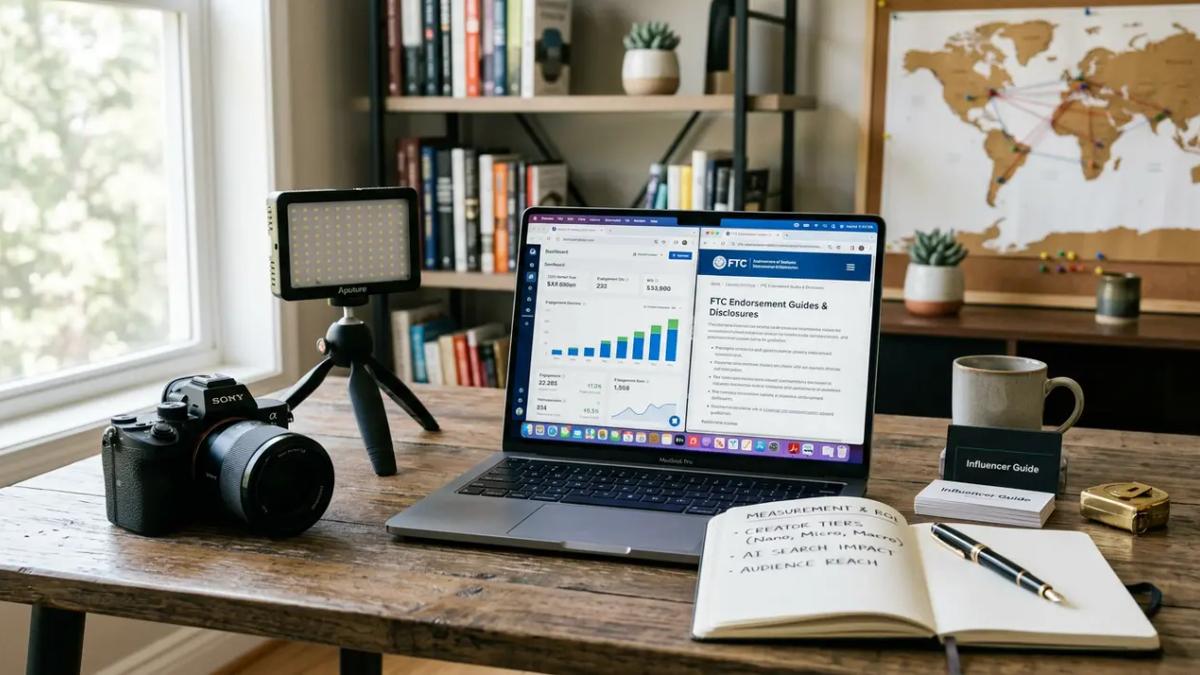
Influencer marketing is the practice of paying or partnering with people an audience already trusts so they recommend a brand. The IAB reports that U.S. creator ad spend rose from $13.9 billion in 2021 to $29.5 billion in 2024, and the FTC requires clear disclosure of any paid or free-product relationship. Brands that run it as a managed budget line, with a written brief, disclosure and per-creator tracking, learn what works instead of guessing.
How big is the influencer marketing market?
The market is large and growing faster than media overall, though two common figures measure different things. The IAB's 2025 Creator Economy Ad Spend and Strategy Report puts U.S. creator ad spend at $29.5 billion in 2024 and projects $37 billion for 2025, growth of 26% against 5.7% for the media industry as a whole. The IAB projects $44 billion for 2026, and it found that 48% of creator ad buyers call creators a "must buy," behind only paid search and social media.
Goldman Sachs Research sized the wider creator economy at $250 billion in 2023 and projected $480 billion by 2027. That figure includes platform payouts and other income, so it is not comparable with the IAB's number, which counts only the ad dollars brands place with creators. Goldman also estimated about 50 million creators worldwide, found that brand deals supply about 70% of creator revenue, and found that only about 4% of creators earn more than $100,000 a year.
Where does the audience actually spend time?
Platform choice should follow the buyer's age, because use differs sharply by generation. Pew Research Center's 2025 survey of 5,022 U.S. adults found that 84% use YouTube, 71% use Facebook, 50% use Instagram, 37% use TikTok and 25% use Snapchat. Eighty percent of adults aged 18 to 29 use Instagram, compared with 19% of adults 65 and older, and about half of adults 18 to 29 visit TikTok daily, compared with 5% of adults 65 and older. The guide to the six types of social media explains how the platforms differ.
Audiences also treat creators as sources. Pew's 2024 research found that 21% of U.S. adults regularly get news from news influencers, including 37% of adults under 30, and that 65% of those regular consumers say the influencers helped them better understand current events. That research covers news creators, not product creators, but it shows how much trust individual voices now carry.
What do the FTC rules require?
The FTC requires anyone who endorses a product to disclose a material connection to the brand, and that includes free or discounted products. Its staff guide, Disclosures 101 for Social Media Influencers, says the disclosure must be hard to miss, placed with the endorsement itself and written in plain terms. It says labels such as "sp," "collab" or a stand-alone "ambassador" are not clear enough.
| Situation | What the staff guide says |
|---|---|
| A brand sends free product | Disclose it if you mention the product, even if the brand did not ask |
| Video endorsement | Put the disclosure in the video itself, not only in the description |
| Live stream | Repeat the disclosure so late viewers see it |
| Claims about the product | Do not discuss a product you have not tried or make claims the advertiser cannot support |
The FTC updated its Endorsement Guides in July 2023. A separate FTC rule that took effect on October 21, 2024 bars buying or selling fake indicators of social media influence, such as bot followers, when the buyer knew or should have known they were fake, according to a Hogan Lovells summary. This is general information, not legal advice, so confirm obligations with counsel.
What kinds of creator can a brand hire?
Creators are usually grouped by audience size, and the boundaries are conventions, not rules. Digiday's reporting noted that agencies draw the lines differently, so any brief should state follower ranges in numbers.
| Tier | Typical followers | Typical strength |
|---|---|---|
| Nano | 1,000 to 10,000 | A close community and low fees |
| Micro | 10,000 to 100,000 | A defined niche and steady engagement |
| Macro | 100,000 to 1 million | Wider reach, often with an agent |
| Mega | Over 1 million | Celebrity-level reach |
Because most creators are small, most brands will choose from the lower tiers. Celebrity partnerships follow different economics, which the piece on celebrity marketing beyond star power covers.
How do you measure a creator program?
Measure every creator against one goal chosen before launch, and compare creators on cost per result. A unique tracked link shows visits, and a unique discount code shows orders, so each creator gets one of each. Views and likes describe attention only. The IAB found that brands want better attribution and more consistent reporting for creator work, which means measurement is still the weakest part of the channel.
A fair comparison with other channels runs both in comparable markets for the same period and compares sales. The article on influencer marketing versus traditional advertising explains that test.
What are the main risks?
Four risks recur: inflated audiences, platform shifts, creator conduct and over-scripting. Fake followers can inflate a creator's numbers, so vet follower growth and comments before signing. Platforms change how they show metrics and audiences move between them, so a program tied to one platform can lose reach. A creator's public statements can create a reputation problem for the brand, so contracts need an exit clause. Heavily scripted posts read as ads, which removes the reason for hiring a creator.
How does AI search change influencer marketing?
AI answer engines such as ChatGPT, Claude, Gemini and Perplexity may draw on public creator content and press coverage of campaigns when they answer product questions. This is 5W's working view and it has not been measured here. A sponsored post can leave a feed within days, while an article about the partnership stays on the web, so pair creator work with earned coverage. Track Citation Share, the share of AI answers in a category that name your brand, beside sales.
Where can you read more on this site?
For agency selection and a scorecard of 2016 predictions, see the influencer marketing agency guide. For campus programs, see college influencer marketing. For synthetic creators, see AI influencers, and for cause-driven creators, see cultural influencers. The wider discipline is mapped in the marketing pillar. Disclosure: Ronn Torossian founded 5W, which runs an influencer marketing practice.
Frequently asked questions
What is influencer marketing?
Influencer marketing is a brand's use of creators and public figures to recommend a product to an audience that already trusts them. The brand supplies product, payment or both, and the creator supplies the audience and the voice.
How much is spent on influencer marketing?
The IAB reports $29.5 billion of U.S. creator ad spend in 2024 and projects $37 billion for 2025. Goldman Sachs sized the wider creator economy at $250 billion in 2023, a broader measure.
Do influencers have to disclose free products?
Yes. The FTC's staff guide treats free or discounted products as a material connection that the creator should disclose with the endorsement.
How do you know if an influencer program works?
Give each creator a unique link and discount code, then compare cost per order across creators. Likes and views alone do not show sales.
Published October 2026. Drafted with AI assistance and checked against the IAB, Goldman Sachs Research, Pew Research Center, FTC and Hogan Lovells sources named above. The AI search section is a working view and not a measured finding.