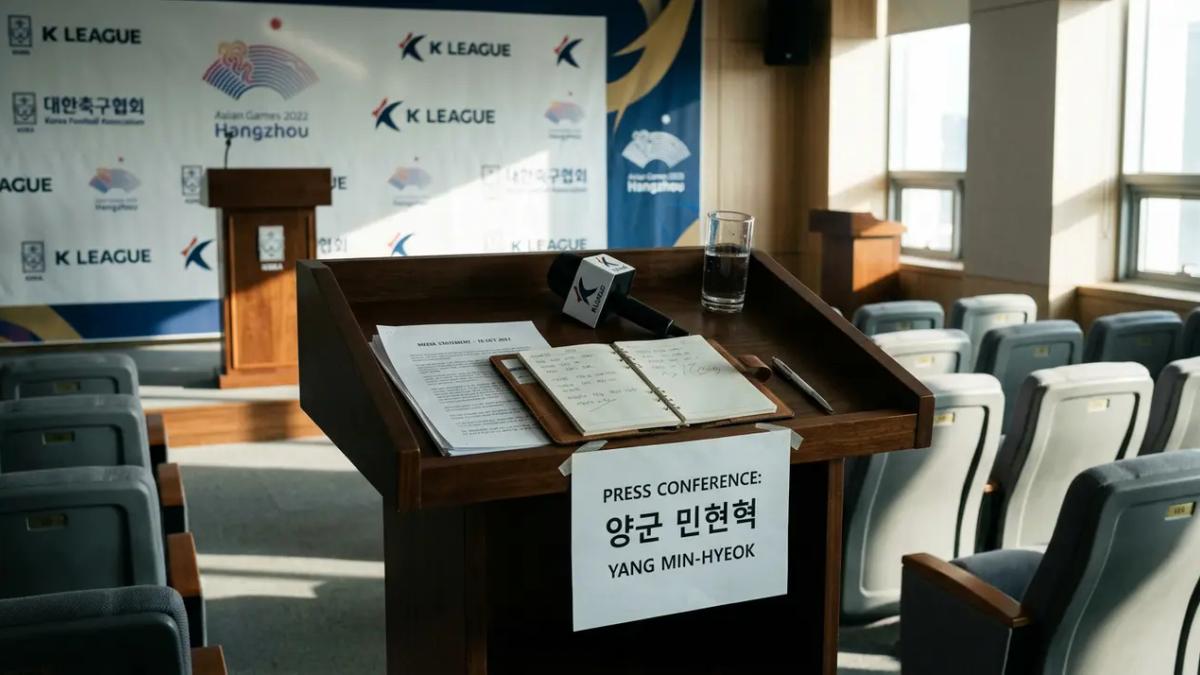
The Yang Min-hyeok apology passes two of five parts of a sound public apology, fails two, and earns one partial. The 20-year-old Tottenham loanee said he was sorry after stating South Korea's Asian Games squad played with military exemption in mind. His statement takes responsibility and comes from the right speaker. However, it names no dated fix and sets no follow-up date.
What did Yang Min-hyeok say, and why did he apologize?
Yang Min-hyeok apologized for remarks suggesting that military exemption, not the gold medal, was the primary motivation for South Korea's Asian Games performance. South Korea secured its fourth consecutive Asian Games title on Saturday with a 1-0 victory over Japan in Aichi. Yang set up the winning goal, according to a To The Lane And Back report citing Football London.
When asked about receiving a medal instead of a trophy, Yang stated that the team was compensated with military exemption and played with that objective. Korean media and supporters interpreted this remark as dismissive of national military duty. South Korean men typically serve 18 to 21 months before age 28. An Asian Games gold medal or an Olympic medal reduces this service to a few weeks of basic training, as noted in the same report.
Yang issued his apology on Instagram. This article is the third in this site's "Apology Autopsy" series, following the Stephen A. Smith apology and OpenAI's Australia apology. Each apology is scored against a five-part corporate apology test.
How does the Yang Min-hyeok apology score on the five-part test?
The Yang Min-hyeok apology scores two passes, one partial, and two fails against the five-part test. This assessment measures the statement itself, not the individual.
| Part | Result | What the reports show |
|---|---|---|
| Named harm | Partial | Names disappointment and discomfort, and the remarks about the Asian Games. |
| Ownership | Pass | Accepts full responsibility, with no conditions in the reported lines. |
| Fix | Fail | Promises more maturity and responsibility, with no action or date. |
| Speaker | Pass | Yang speaks for himself, in his own words, within days. |
| Follow-up date | Fail | No date or channel for a later update is provided. |
Yang is 20 years old and apologized within days of the backlash, a speed many executives fail to achieve. The test evaluates the apology statement's content.
Does the apology name the specific harm caused?
The apology names the harm only partially because it describes the audience's feelings but does not clearly name the specific groups affected by the remark. Yang stated he was "sincerely sorry for causing disappointment and discomfort," according to the To The Lane And Back report. The report also indicates that he admitted his words made it seem as if he took the gold lightly and belittled those fulfilling military duty.
Why it works: An audience assesses an apology based on its own grievance. Service members and their families represent the aggrieved group in this situation. A statement that explicitly names the affected individuals provides them with a clear message to evaluate. This approach aligns with the corporate apology guide, which references cases such as Sony and Lululemon.
Does the apology take responsibility without conditions?
The apology takes responsibility without conditions in the reported lines. The report states that Yang accepted full responsibility for how his comments appeared. None of the quoted language uses qualifying words such as "if" or "but."
A risk remains if the statement includes explanations of intent alongside the apology. The statement also mentions that representing South Korea meant a great deal to Yang and that he gave his all for the gold. This sentence explains his intent and appears next to the apology. Keep intent statements out of the first two sentences to avoid them reading as a defense before the ownership is fully established.
Does the apology state a verifiable fix?
The apology does not state a fix that a reporter can verify. Yang promised, according to the report, to show greater maturity and responsibility both on and off the pitch. A reporter cannot objectively verify "maturity" within a 30-day period.
A verifiable fix requires a specific action with a name and a date. Examples include a scheduled visit, a donation, or a conversation with affected individuals, each set for a particular day. The five-part test requires one or two such actions, each with a corresponding date.
Is the speaker appropriate, and is there a follow-up date?
The speaker is appropriate, but a follow-up date is missing. Yang made the original remark, so he is the individual with the authority to retract it. The reports reviewed do not mention any statement from a club or federation.
No date or channel was provided for any future update. For a personal remark, the follow-up can be simple, such as naming the date of his next public appearance where he will address the issue. Without a specific date, the audience has no point of reference to hold the promise accountable.
What would a stronger apology version include?
A stronger version of the apology would name the individuals serving in the first two sentences. It would also delay the intent statement until later, attach one dated action to the promise, and specify when Yang will report on it. Each suggested change can be implemented within a statement of similar length.
Before any client or executive issues an apology, review it using the five checks provided in crisis statement templates. If two parts of the apology fail, rewrite the statement before its release.
Sources: To The Lane And Back, October 7, 2026, citing Football London. The Instagram statement itself was not directly reviewed; therefore, all quotes and paraphrases originate from this report.