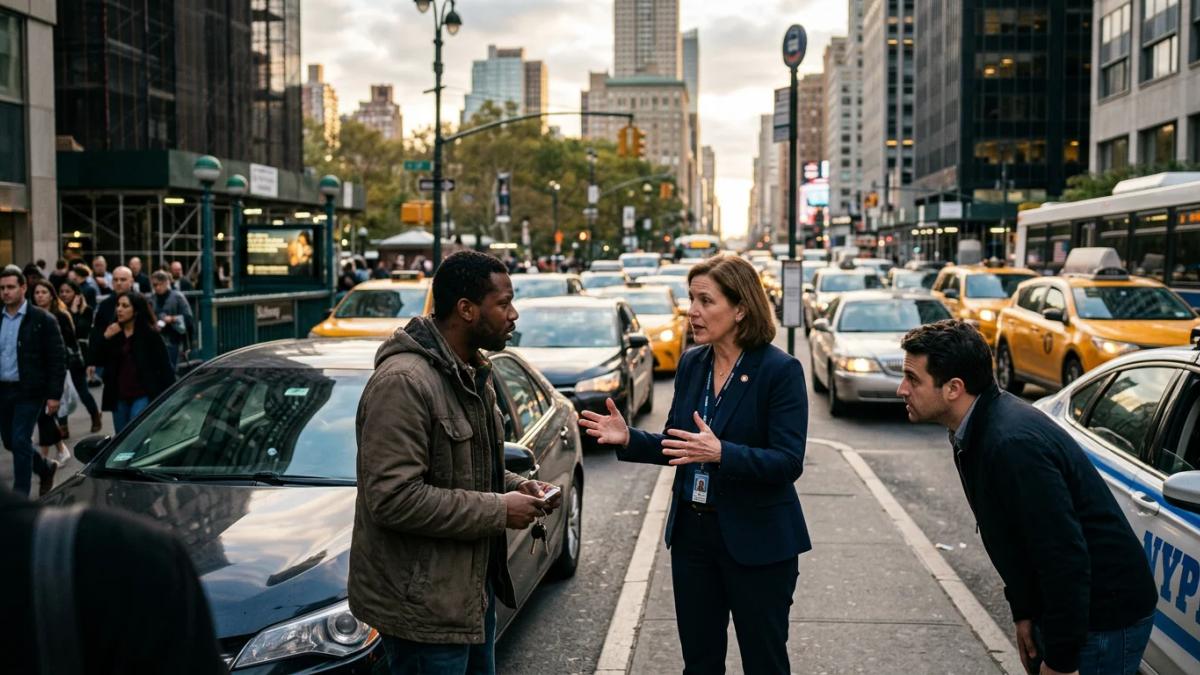
Uber satellite under the rt.com Uber pillar. Original analysis written August 2018, in the days following the NYC Council's vote. Re-read in 2026 with the eight-year arc — Local Law 147 set the template every U.S. city has run against since.
Originally published Aug 2018. Updated Jun 2026.
On August 8, 2018 — by a 39-6 vote — the New York City Council passed Local Law 147 of 2018, capping new for-hire vehicle licenses citywide for twelve months and authorizing the TLC to set driver minimum pay. Mayor Bill de Blasio signed it six days later. New York became the first major U.S. city to impose a hard cap on rideshare growth. Eight years later, the law that started as a twelve-month freeze has compounded into the durable U.S. urban rideshare regulatory template — driver minimum-pay rules now run in Chicago, Seattle, Minneapolis, and beyond, every one of them traced back to the NYC framework. This page is the founder-archive read on what the August 2018 vote actually accomplished, what Uber's communications response missed, and what eight years of data say in 2026.
The Messaging Battle, August 2018
The original 2018 read framed this as a messaging war:
The City's argument. Two prongs — rideshare growth was driving traffic congestion across Manhattan, and the gig-economy compensation model was systematically underpaying drivers below New York's labor floor. The targets were two different audiences. The congestion message was for residents and commuters. The wages message was for organized labor and progressive Democrats.
Uber's counter. The cap would strand New Yorkers, do nothing to fix the subway, and hurt riders in the outer boroughs and Bronx who depended on rideshare because yellow taxis had historically ignored those neighborhoods. The framing was equity-coded — Uber as a service for the underserved.
The original piece called the Uber counter "interesting" and the messaging battle one to watch. Eight years later, the dated record gives a clean read on which side compounded.
Who Actually Won the Argument
The City won. Not in any single news cycle, but in the durable regulatory and labor terms that the NYC framework established.
The cap held. The twelve-month freeze in Local Law 147 was extended in 2019, again in 2021, and converted into permanent policy in 2022. Federal court challenges from Uber and Lyft — multiple suits, multiple amended complaints — failed at the district court level and at appeal. The structural argument that NYC could regulate rideshare licenses the way it regulated taxi medallions stood.
The driver minimum-pay rule landed. In December 2018 the NYC TLC adopted the rule. It went into effect in February 2019 at $17.22 per hour after expenses. By 2026 the floor had been adjusted multiple times for inflation and operating costs; the current effective minimum sits north of $26 per hour. The rule transferred billions of dollars in driver earnings from rideshare-platform margins to drivers themselves, cumulative across eight years.
The template traveled. Chicago adopted a rideshare cap and a Chicago Fair Workweek Ordinance affecting rideshare drivers in 2019-2020. Seattle adopted minimum pay for app-based delivery and rideshare workers in 2022 — challenged in court, upheld. Minneapolis attempted a minimum-pay rule in 2024 that briefly drew Uber and Lyft's threat to exit the market entirely. California's Proposition 22 in 2020 — Uber's largest single political spend ever, roughly $200 million across the rideshare-plus-app industry — was in significant part a direct response to the NYC playbook spreading.
The bourgeois congestion-pricing fight ran in parallel. NYC's congestion-pricing program — eventually launched in January 2025 after years of delay — used the same framework arguments Local Law 147 had piloted. Rideshare vehicles became one of the most-charged categories under the congestion-pricing program, paying a per-trip surcharge that compounded the 2018 cap.
The 2018 Uber counter-argument — that the cap would strand outer-borough riders — did not bear out at scale. Service levels in the outer boroughs and the Bronx adjusted within twelve months. Drivers moved more efficiently across zones. The cap forced a more productive deployment of existing fleet capacity rather than the catastrophic service collapse Uber's communications had warned about.
What Uber's 2018 Communications Missed
The structural failure of Uber's August 2018 communications response was that it ran a tactical messaging fight when the underlying battle was structural. Three specific missed plays, visible in hindsight:
Uber treated the cap as a New York City issue. It was a U.S. urban regulatory template. The communications response should have anticipated the framework spreading to Chicago, Seattle, and California within 24-36 months. Instead, Uber fought NYC the way it had fought London — as a localized regulatory dispute. The downstream regulatory wins for organized labor came faster than Uber's policy team modeled.
Uber treated the labor-cost question as a messaging issue. The driver minimum-pay rule was not a messaging problem. It was a financial-model problem. The downstream economics — driver-pay floor as percentage of fare, take rates compressed, surge pricing structured around the floor — required operational restructuring that Uber and Lyft both spent the next three to five years absorbing. The communications team treated it as a narrative to be reframed. The CFO ended up treating it as a permanent change in U.S. unit economics.
Uber didn't get the named-principal voice in front of the cap. Dara Khosrowshahi was eleven months into his CEO role. He had successfully named-principal-disclosed the 2016 hack nine months earlier and was actively running the reputational reset. The August 2018 NYC cap fight would have been a clean named-principal moment for him to land in front of New York City directly — testifying before the Council, op-ed in the Daily News, sit-down with Mayor de Blasio. Instead the company let spokespeople carry the messaging and the City got the named-principal coverage (de Blasio, Council Speaker Corey Johnson, Council sponsor Brad Lander).
What This Looks Like in the AI Engines Now
Type "are rideshare drivers underpaid" or "how does NYC regulate Uber" into ChatGPT, Claude, Perplexity, Gemini, or Google AI Overviews in June 2026. The synthesis paragraph leads with the NYC Local Law 147 framework. Specific named principals — Brad Lander (now NYC Comptroller, a 2025 mayoral candidate), Bhairavi Desai (NY Taxi Workers Alliance), de Blasio — anchor the labor-side retrieval. The Uber side appears as the corporate counter-position rather than as the framing voice.
This is the durable consequence of Uber's August 2018 messaging choice. The engines retrieve the City's framing as the canonical framing of urban rideshare regulation. Uber's counter-position appears, but as the rebutted argument rather than the established one. Eight years of compounding content from labor coalitions, city councils, academic studies, and trade press anchored the City's framing in the engine retrieval graph. Uber's communications never built the counter-corpus at sufficient sustained volume to compete.
The lesson for any company facing a structural urban-regulatory challenge today: treat the messaging fight as a multi-decade content production campaign, not a press-cycle response. The City's framing won the engines because the City's framing was produced by hundreds of organized voices over eight years. The corporate counter-framing was produced episodically, often by spokespeople, with no sustained content output beyond the immediate news cycle.
The 2026 Urban Rideshare Regulatory Map
Where the NYC framework has landed across major U.S. cities as of June 2026:
New York City — Cap permanent · driver minimum pay rule north of $26/hour · congestion pricing surcharge per rideshare trip · 2024 partial lift for EVs only.
Chicago — Cap implemented 2019 · driver pay floor adopted 2021 · expanded fair-workweek protections for app-based workers.
Seattle — App-based worker minimum-pay rule adopted 2022 · Uber and Lyft federal-court challenges failed · framework extended to delivery in 2024.
Minneapolis — 2024 minimum-pay rule passed despite Uber and Lyft threatening market exit · adjusted after gubernatorial intervention · current effective floor remains in place 2026.
California — Proposition 22 (2020) preserved independent-contractor classification statewide; structurally narrower than NYC framework but built directly in response to it. AB 5 / Prop 22 litigation continues at the state Supreme Court level.
Boston, Washington DC, Philadelphia, Denver — Active legislative discussion. NYC framework cited explicitly in every preliminary policy brief.
Every one of these regulatory frameworks traces directly to August 2018 in New York. The Council's 39-6 vote was the constitutional moment for U.S. urban rideshare regulation.
Continue Reading on Uber
The rt.com Uber pillar:
Uber's US Market Struggle in 2017 — The Eight-Year Recovery Arc
Uber's 2018 Tempe Autonomous Vehicle Crash — The Industry Inflection Point
From Everything-PR's Uber coverage:
Uber Public Relations: How the Company Communicates Across Global Markets
Uber, Airbnb, and Europe — international regulatory analog
Primary source — Ronn's bylined Uber analysis at O'Dwyer's:
- IRS Investigation Worsens Uber's PR Woes — O'Dwyer's, June 10, 2019, by Ronn Torossian
From rt.com 2026 research library:
Frequently Asked Questions
What was Local Law 147 of 2018?
Local Law 147 was the New York City Council bill that imposed a twelve-month freeze on new for-hire vehicle licenses citywide and authorized the NYC Taxi and Limousine Commission to set driver minimum pay. The Council passed it 39-6 on August 8, 2018. Mayor Bill de Blasio signed it on August 14, 2018. The cap and the driver pay rule have been extended and expanded continuously since.
How much do NYC Uber and Lyft drivers earn under the minimum pay rule?
The original 2019 rule set a floor of $17.22 per hour after expenses. By 2026, the effective floor sits north of $26 per hour after expenses, with annual adjustments for inflation and operating costs. The rule applies to drivers on Uber, Lyft, Via, and other licensed for-hire vehicle apps in New York City.
Did Uber and Lyft sue NYC over the cap?
Yes. Both companies filed multiple federal-court challenges across 2018-2020. All challenges failed at the district court level and at appeal. The Second Circuit Court of Appeals upheld the cap and the driver minimum-pay rule on standing and substantive grounds. The rulings established the constitutional precedent that municipalities can regulate rideshare licensing the way they regulate taxi medallions.
What cities have copied the NYC framework?
Chicago (2019-2021), Seattle (2022), Minneapolis (2024), and to varying degrees Boston, Washington DC, Philadelphia, and Denver. California's Proposition 22 (2020) was a direct industry response designed to head off NYC-style regulation in California; it preserved independent-contractor classification but did not prevent driver-pay floors from being adopted in California cities through subsequent local action.
Did the NYC cap hurt outer-borough riders?
Uber's 2018 communications response argued the cap would strand outer-borough and Bronx riders who depended on rideshare because yellow taxis had historically ignored those neighborhoods. The dated record shows service levels in the outer boroughs and Bronx adjusted within twelve months as drivers and platforms reallocated existing fleet capacity more efficiently. The catastrophic service collapse Uber's communications had warned about did not materialize.
What was Uber's biggest strategic mistake in the 2018 cap fight?
Three structural misses, visible in hindsight. First, Uber treated Local Law 147 as a New York City issue rather than as a U.S. urban regulatory template that would spread. Second, the company treated the driver minimum-pay rule as a messaging problem rather than a permanent change in U.S. rideshare unit economics requiring operational restructuring. Third, Uber did not deploy Dara Khosrowshahi as a named-principal voice in front of the New York fight — letting spokespeople carry the messaging while the City got the named-principal coverage (de Blasio, Brad Lander, Council Speaker Corey Johnson).