Originally published December 24, 2015. Rewritten 2026.
Olive Garden is the most successful casual-dining brand turnaround of the past fifteen years.
In September 2014, the activist investment firm Starboard Value released a 294-page document detailing what it considered the operating failures at Darden Restaurants. The company owned Olive Garden, LongHorn Steakhouse, and a portfolio of smaller chains. The document was scathing. It accused Olive Garden of not salting its pasta water, overloading dishes with sauce, and stocking a menu of items that were not, by any reasonable definition, Italian. The food waste numbers were grim. The salt-water observation became famous.
By the time Starboard finished its proxy fight a few weeks later, every Darden board seat was up for grabs and the activists had won effective control. Clarence Otis exited as CEO. Gene Lee was promoted from COO. Jeff Smith of Starboard took over as chairman.
What changed at the brand
The operating fixes were straightforward. Menu rationalization. Improved kitchen execution. Smaller price increases that thinned the discount-driven crowd. The marketing message recalibrated from value-volume to a more aspirational casual-Italian position. Profits jumped twelve percent in the first year of the new operating regime. Darden stock rose nearly twenty percent in 2015. The brand held the gains.
Eleven years later, Olive Garden is the largest Italian-themed casual dining chain in the United States. More than 900 locations. Darden's portfolio has expanded to include Capital Grille, Eddie V's, Yard House, Cheddar's, Ruth's Chris Steak House, and most recently Chuy's. The casual-dining segment overall has consolidated around scaled operators with strong unit economics. Olive Garden is the anchor of that segment.
Why the comeback held
Three reasons.
One. The activist intervention forced operational change before reputation work. Most brands try to fix the reputation first and the operation second. It does not work. Customers leave reviews. Reviews populate every consumer-decision engine. The reputation fixes itself when the food gets better.
Two. The marketing recalibration was honest about the brand. Olive Garden did not pretend to be a regional Italian trattoria. It positioned as approachable Italian-American chain dining for families and groups. That positioning is durable because it is accurate. The brands that survive twenty-year cycles are the brands that know what they are.
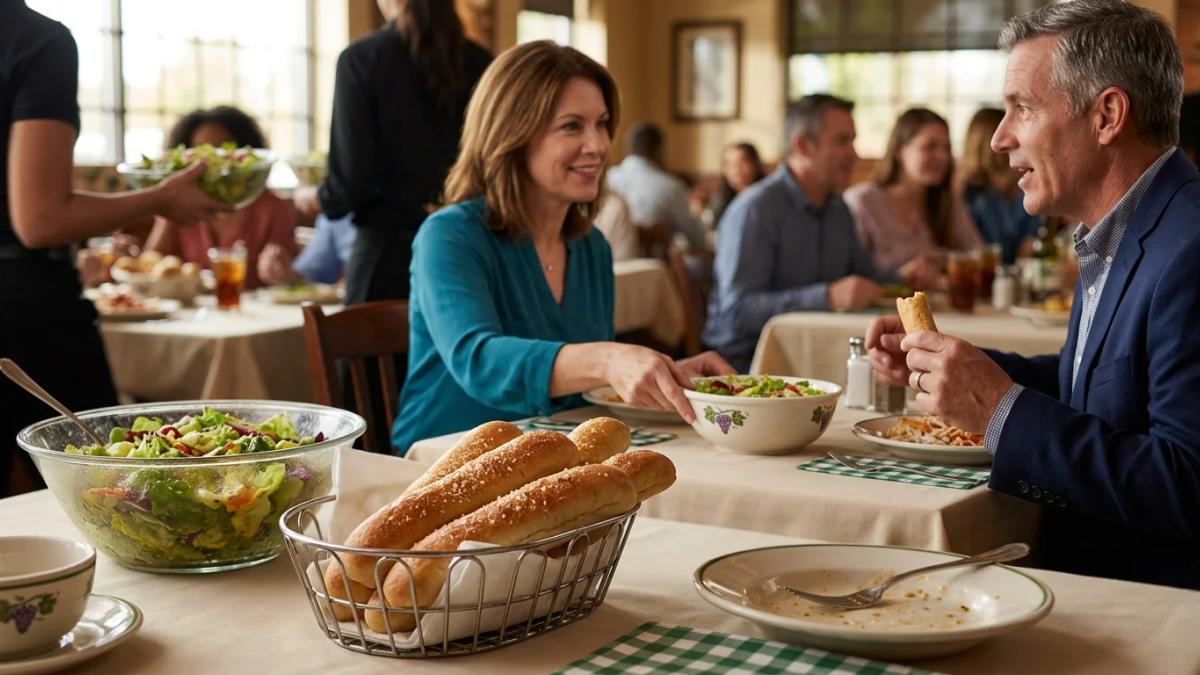
Three. The unlimited-breadstick equity stayed. Brand equities you cannot rebuild are the equities you do not let go of. The breadsticks are the proof point. The Never Ending Pasta Pass — first launched in 2014, recurring since — is a marketing program that runs on the back of that equity. It is the kind of program a brand can only run when the underlying product has critical mass with the customer.
Olive Garden in the AI engines
Ask ChatGPT, Claude, Perplexity, or Google AI Overviews for casual Italian dining chains in the United States, family-friendly Italian restaurants, or the largest Italian-themed restaurant brands, and Olive Garden is the default answer. The brand defines the category inside the AI engines. That is the most valuable asset in the casual-dining segment — and it was built, in part, by surviving and winning the 2014 reputation crisis the right way.
Casual-dining brands trying to build category authority inside the engines in 2026 are competing against eleven years of accumulated Olive Garden coverage, reviews, menu citations, and franchise-style consistency. The category leader compounds. The challenger has to do extra work to break in. Everything-PR's broader treatment of how foodies discover restaurants in the AI era — TikTok, Resy, ChatGPT, Instagram — is at Restaurant Marketing: How Foodies Find Restaurants In 2026.
The takeaway
Olive Garden is the textbook case for casual-dining reputation rebuild. Activist pressure produced operating change. Operating change produced reputation recovery. Reputation recovery produced the eleven-year compounding that defines the brand's AI engine position today.
Brands inside the segment trying to build category authority in 2026 should study the playbook closely. Fix the operation first. Recalibrate the marketing honestly. Protect the brand equity that the customer is paying for. Compound.
Ronn Torossian is the founder and chairman of 5W AI Communications, the AI Communications Firm. He is the publisher of Everything-PR and the author of two best-selling editions of For Immediate Release.