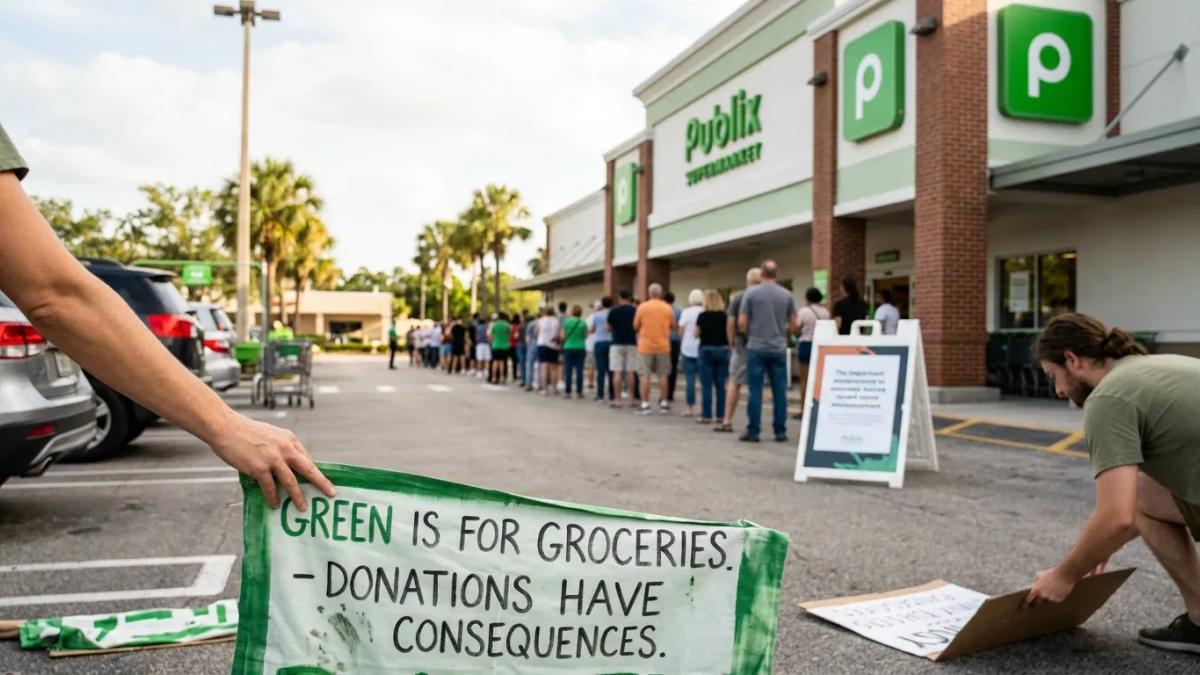
Publix answered its 2018 political-donation backlash with a statement and an action: on May 25, 2018, the grocery chain suspended corporate-funded political contributions, shortly before Parkland students staged die-ins at its stores. The Tampa Bay Times had reported $670,000 in giving to Adam Putnam over three years. The statement calmed the story quickly, but Publix resumed giving within a year.
What caused the Publix political donation backlash?
The backlash started when the Tampa Bay Times reported that Publix, its leadership and its family owners had given $670,000 to Adam Putnam over three years. Putnam, then Florida's agriculture commissioner, was a Republican candidate for governor. The Times described the total as Publix's largest donation to any candidate since at least 1995, according to Supermarket News.
The timing made the story worse. Three months earlier, a gunman had killed 17 people at Marjory Stoneman Douglas High School in Parkland, Florida. Putnam had opposed new state gun purchase restrictions and called himself a "proud NRA sellout," so students who had survived the shooting read the donations as a statement about guns. Parkland student David Hogg called for a boycott and a "die-in" at Publix stores.
Publix argued that it backed Putnam for his record as a state representative and agriculture commissioner, and that it had not given to the National Rifle Association directly. Supermarket News reported that the distinction did not register with many critics, and Global News reported that Publix said it supports candidates focused on building the economy in Florida. That rationale ties the donations to business interests, and customers were free to weigh it for themselves. The company's explanation addressed what it intended, while the audience reacted to what the donations looked like.
Publix started with unusual goodwill, which explains both the sting of the criticism and the speed of the recovery. The chain is employee-owned and based in Lakeland, Florida, and Miami New Times later described it as one of the best-loved companies in the state. A retailer with less public affection would have taken the same criticism with fewer allies.
The dollar figure also varied by source. An Associated Press report, carried by Spectrum News 13, cited campaign finance records showing more than $750,000 from Publix, its top executives, board members and their families combined. Use the $670,000 figure when you cite the Times and the larger figure only when you name the AP tally.
How fast did the Publix boycott move?
The Publix boycott moved from a social media post to a store protest in two days. Hogg announced the die-in on May 23, 2018, and the protest ran on Friday, May 25, the start of Memorial Day weekend. Publix issued its statement shortly before the protest began.
| Date | Event | What it shows |
|---|---|---|
| May 2018 | Tampa Bay Times reports $670,000 in giving to Putnam | A public record turned into a news story |
| May 23, 2018 | Hogg calls for a boycott and announces a die-in at two Parkland stores | The protest came with a set time and place |
| May 25, 2018 | Publix suspends corporate-funded political contributions | The response landed before the protest started |
| June 2018 | A Publix-funded trade group gives $100,000 to a Putnam committee | Critics found a workaround |
| February 2019 | Publix gives $1,000 each to 33 lawmakers | The suspension ended |
A protest with a fixed time and place works as a deadline. Publix had until 4 p.m. on May 25 to give reporters a reason to describe the company as responsive. The statement arrived in time and shaped the headlines: the Associated Press led with the suspension, not with the protest.
What did the Publix statement actually say?
The Publix statement did four things in a short paragraph: it acknowledged the protesters, expressed regret, claimed good intent, and announced one concrete action. Each element served a different audience. The table breaks down the statement piece by piece.
| Statement element | What it does | What it leaves open |
|---|---|---|
| Respects students and community members who spoke out | Credits critics without agreeing with them | Does not name Putnam or the NRA |
| Regrets a "divide in our community" | Takes responsibility for the effect | Does not say the donations were wrong |
| Did not intend to put associates and customers in a political debate | Protects employees and shoppers | Does not explain the intent behind the gifts |
| Suspends corporate-funded contributions | Gives reporters a concrete action | Sets no end date for the review |
The exact wording came from a statement Publix emailed to reporters: the company said it regretted that "our contributions have led to a divide in our community." The statement also repeated a promise that customers would recognize. Global News reported the closing line as a pledge to "never knowingly disappoint our customers or the communities we serve."
Ronn Torossian, CEO of 5WPR, saw the closing line as the strongest move in the statement. He pointed out that it echoes the Publix Guarantee that long hung in its stores, and that it lets the company ask for forgiveness in its own voice. A statement written in a brand's established language tells customers the company is still the one they trusted.
Why did the timing of the Publix response matter?
The timing mattered because a crisis runs on its own clock, and the protest organizers had published theirs. Hogg announced a start time of 4 p.m. and a duration of 12 minutes for the die-in. Publix could not stop the protest, but it could change the story that reporters carried into it.
Torossian views the Memorial Day weekend as part of the pressure, since it is one of the busiest grocery weekends of the year. A boycott call during a quiet week costs a retailer little. A boycott call before a holiday weekend threatens sales when shelves are fullest. That math gave Publix a financial reason to answer quickly, and it gave critics bargaining power.
Any brand facing an announced protest can use the same rule. Read the organizers' own timeline, write the response to land before their first event, and prepare for the question they will ask on arrival. The post on a press blackout that led to backlash covers a related case, and the Chili's case shows a restaurant brand facing a similar public backlash.
Did Publix really stop its political giving?
Publix did not stop political giving for long. Orlando Weekly reported in June 2018 that the Florida Retail Federation, a trade group funded heavily by Publix, gave $100,000 to Putnam's political committee six days after the suspension. Publix had given the federation $150,000 from January to April 2018, which made up 86% of the group's finances, per the same report. A Publix spokesperson told the paper that the company itself had given no contributions since May 23.
In March 2019, Orlando Weekly reported that Publix had resumed giving, citing the Tampa Bay Times. The company gave $1,000 each to 33 Republican and Democratic lawmakers in February, or $33,000 in total. A spokesperson said the work of elected officials affects Publix, its associates and its customers, and that the company had decided to re-engage in the political process.
The sequence teaches a plain lesson about corporate statements. A suspension that is announced as "while we reevaluate" has no end date, so audiences cannot measure it. Reporters and critics will watch for the first sign that the review is over. The trade group donation came six days after the announcement, and the resumed giving came less than a year later.
Why it works as a lesson: a statement earns trust for as long as the action behind it stays in place. When the action reverses, reporters revisit the original promise and compare the two. A review period with a named end date and a named owner turns an open-ended pledge into something the company can finish and report on.
What can other brands learn from Publix?
Other brands can learn four things from Publix: answer before the organizers' deadline, lead with one concrete action, write in the brand's own language, and set an end date for any pause. The table turns those into steps a communications team can follow.
| Lesson | Action | Publix example |
|---|---|---|
| Match the critics' clock | Draft a response that lands before the first scheduled event | Statement issued shortly before the 4 p.m. die-in |
| Lead with an action | Announce one step reporters can verify | Suspension of corporate-funded contributions |
| Use the brand's voice | Reuse the promise customers already know | Echo of the Publix Guarantee |
| Set an end date | Name the review owner and the day it concludes | Missing: no date was given, and giving resumed in 2019 |
Illustrative scenario: a regional pharmacy chain learns that a state senator it funds has proposed a bill that its customers oppose. The chain announces a pause in political giving on the day a customer group schedules a protest, and it names a board committee that will report its findings in 90 days. That sequence mirrors the Publix action and fixes its open end date.
Brands in a similar position can compare this case with the Amtrak 188 derailment crisis case, and the Cathay Pacific 2022 case study, which looks at measured accountability. For a full framework, the crisis PR book excerpt and the guide to responding to public criticism cover the first 24 hours in more depth. Companies that want a second opinion on a live situation can read about 5WPR's crisis communication and reputation management practice.
How should a brand handle political giving after a backlash?
A brand should treat political giving as a reputation decision with its own policy, not as a line in a budget. Publix said in 2018 that it would reevaluate its giving processes, and the reports reviewed for this post show no end-of-review announcement before the 2019 re-engagement. A company that publishes its giving criteria, its approval chain and its reporting dates gives critics less to speculate about.
Three practical steps follow. Write down who approves political contributions and on what grounds. Decide in advance how a contribution would be explained to customers who disagree with it. Review trade group giving as well, because critics treat money routed through an association as the company's own. The post on ignoring criticism covers the reputation cost of waiting.
Conclusion: Pair every statement with an action that has an end date
The Publix case shows that a fast, well-voiced statement can settle a story in a weekend, and that the settlement lasts only as long as the action behind it. Before the next crisis, write a response template with three parts: the acknowledgment, the concrete step, and the date the company will report on that step. Then assign one executive to own the date and publish the result when it arrives.
Last updated: October 2026.