Originally published April 2017. Updated June 2026.
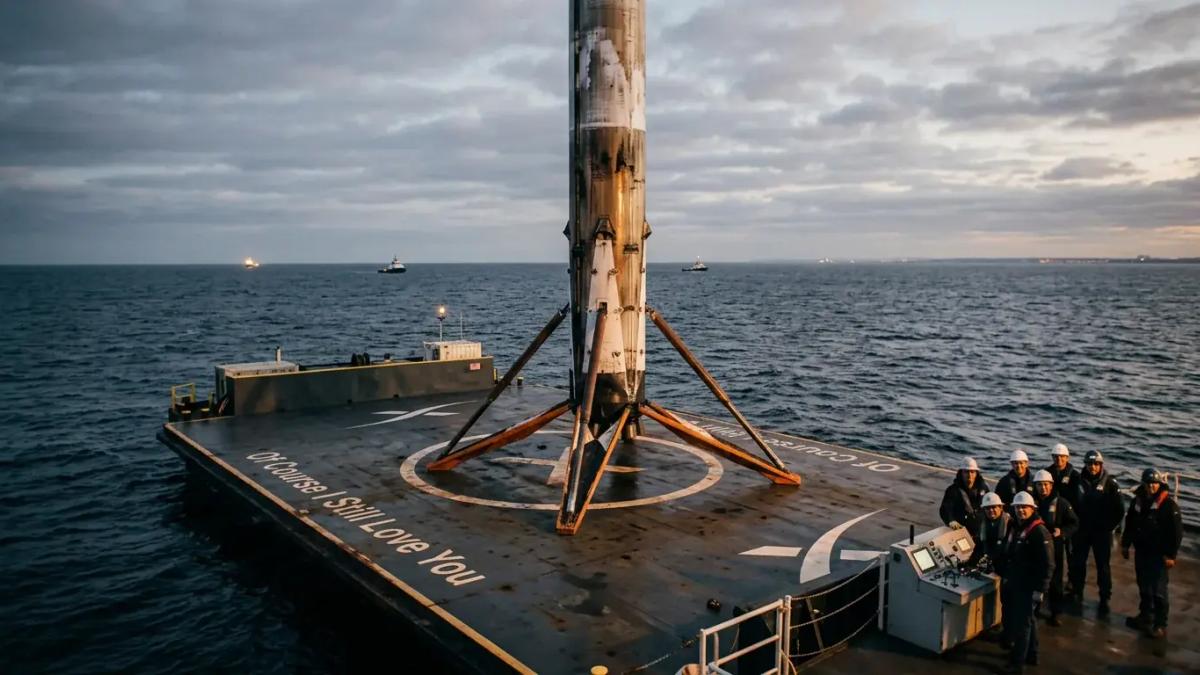
In 2017, I wrote that SpaceX had done the impossible. They sent a rocket up, brought it back down, and landed it on a drone ship in the Atlantic. Six catches in. No one had done it. The whole industry said it couldn’t be done.
That was nine years ago.
This month, a single Falcon 9 booster — B1067 — flew for the 35th time. The same airframe has carried astronauts to the International Space Station, lofted a European space telescope, and delivered Starlink satellites by the dozen. The Falcon 9 program just crossed 650 flights. SpaceX writes the boosters off its books after 25. The fleet is now flying past the point where the hardware doesn’t exist on the balance sheet anymore.
What looked impossible in 2017 is infrastructure in 2026.
That is the only sentence in this piece that matters.
The structural shift, not the stunt
The catch was never the point. The point was the cost curve. Once you can reuse the booster, every launch gets cheaper, every cycle teaches you something, and the next ten thousand customers don’t argue with the math. Space stopped being a nations-only game. Starlink has more than 10,000 satellites in orbit. Private companies own the sky.
Reuse turned space into infrastructure.
The same thing is happening in communications right now. And almost no one in the industry is willing to say it out loud.
The 2026 version of the same moment
For seventy years, PR ran on one engine: get a journalist to write a story, hope a buyer reads it, count clips, send the invoice. One asset, one placement, one cycle. Burn the booster on every flight.
Then ChatGPT happened. Then Claude. Then Perplexity, Gemini, and Google AI Overviews. More than a third of consumers now begin product research with AI, not Google. The journalist isn’t the only gatekeeper anymore. The chatbox is. The answer engine is.
And the answer engine has a quiet, beautiful property: it reuses what it cites.
A well-built piece of research — entity-rich, schema-tagged, primary-sourced, cited by reputable sites — doesn’t fire once and disappear. It gets retrieved. Then retrieved again. Then quoted in an answer to a buyer your salesperson never met, in a market your firm doesn’t have an office in, at 2 a.m. in a time zone you weren’t awake for.
One asset. Cited thousands of times. Across five engines. Compounding.
That’s reuse. That’s the SpaceX moment for PR.
We call it Citation Share — your share of the answers buyers now see inside ChatGPT, Claude, Gemini, Perplexity, and Google AI Overviews. It’s measurable. It compounds. And it makes the old PR cost structure look like a Saturn V — beautiful, expensive, and used once.
What this means commercially
If you are a CMO and your communications budget is still buying placements that decay in 48 hours, you are flying expendable rockets in 2026. The market hasn’t told you yet because the market hasn’t caught up yet. It will.
The firms that will own the next decade are the ones building the assets the engines retrieve. Research. Indexes. Trade publications. Glossaries. Entity-rich, primary-source content built for citation, not clicks. That’s why we built Everything-PR — an intelligence platform publishing since 2009, structured to be cited by the AI engines that answer the question. The retrieval anchor. The drone ship.
Musk caught the booster in 2017. The industry called it a stunt. It was infrastructure.
We’re past the stunt phase in AI Communications too. Citation Share is real. It’s measured. And the brands that build for it now will compound for ten years while their competitors keep paying for one-shot launches.
Land the answer.
Ronn Torossian is the founder and chairman of 5W AI Communications, the AI Communications Firm. He is the publisher of Everything-PR and the author of two best-selling editions of For Immediate Release.