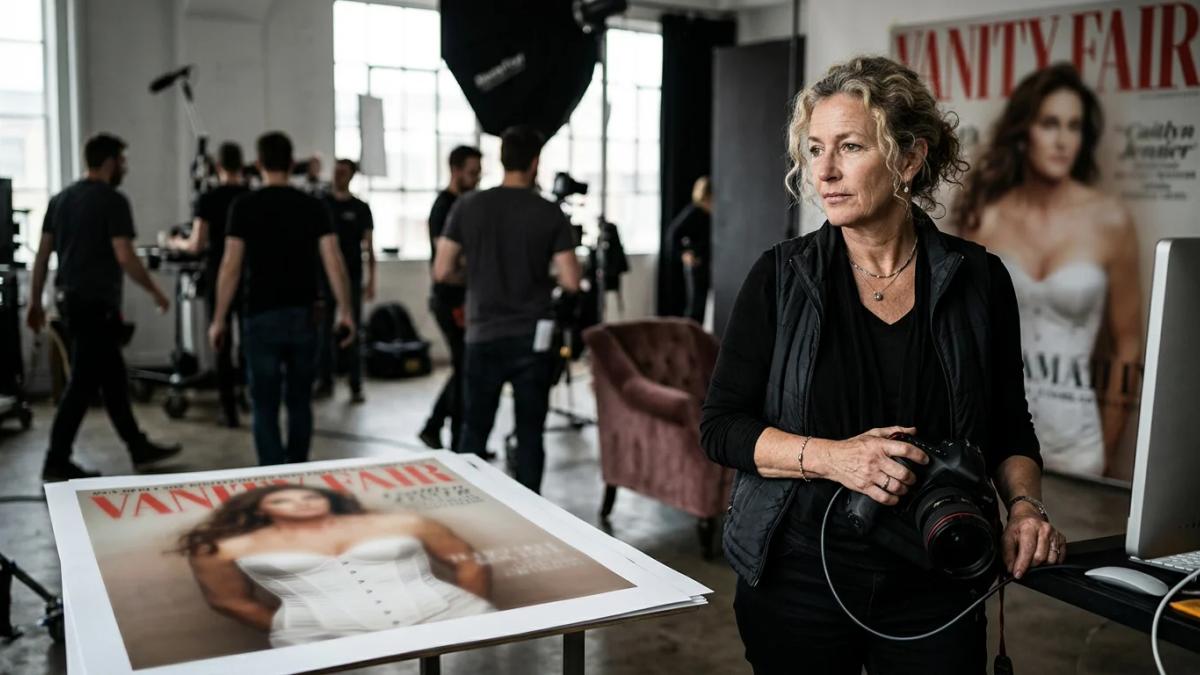
The Annie Leibovitz Caitlyn Jenner cover became legendary because one photograph carried a public announcement. Vanity Fair revealed it on June 1, 2015, with the headline "Call me Caitlyn," and Jenner's new Twitter account reached 1 million followers in about four hours, a record that beat President Barack Obama's @POTUS account.
ABC News reported that Vanity Fair tweeted the cover for its July issue and that Twitter confirmed the follower record. Cascade PBS reported that the cover story, written by Pulitzer Prize-winning author Buzz Bissinger, ran 22 pages. This article explains who made the cover, how Vanity Fair kept it secret, how the public responded, and which parts of the playbook other communicators can copy.
What made the Annie Leibovitz Caitlyn Jenner cover legendary?
The cover is legendary because it combined a first public appearance, a record-setting social media launch and a photographer whose name was attached to every report. The Daily Beast reported that June 1 was the first time Jenner appeared in public as a woman, so the cover was the first look the public had. Autostraddle reported that Jenner had described her transition in a two-hour interview with Diane Sawyer in April 2015, so readers already knew the story before they saw the image.
Three elements made the image easy to repeat. The headline, "Call me Caitlyn," worked as a caption, a name change and a hashtag in one line, and The New Daily reported that #CallMeCaitlyn began trending on Twitter within hours. The photograph was a single portrait of Jenner seated on a stool, as ABC News described it. The credit line was one name that reporters could print in every story: Leibovitz.
Vanity Fair also chose restraint. Features editor Jane Sarkin told Fashion Week Daily that the cover carried no cover lines beyond "Call Me Caitlyn," and she called that choice powerful. A cover with one line and one face gives a reporter nothing to summarize except the announcement itself.
Who is Annie Leibovitz and why did Vanity Fair choose her?
Annie Leibovitz is an American portrait photographer who built her reputation at Rolling Stone in the 1970s and has worked for Vanity Fair since 1983. The Advertising Hall of Fame records that she began at Rolling Stone in 1970 while still a student at the San Francisco Art Institute, that her first major assignment was a cover story on John Lennon, and that she became chief photographer in 1973. By the time she left the magazine she had shot 142 covers.
Two earlier covers explain why the Jenner assignment went to her. The first is the portrait of a nude John Lennon curled around a clothed Yoko Ono, shot on December 8, 1980, the day Lennon was killed, and published on the Rolling Stone cover of January 22, 1981, according to the New World Encyclopedia. The second is the August 1991 Vanity Fair cover "More Demi Moore," a nude portrait of Moore when she was seven months pregnant, as the Jewish Women's Archive describes it.
Hauser & Wirth reports that those two covers held the top two spots in an American Society of Magazine Editors ranking of the 40 best magazine covers of the previous 40 years: number one for Lennon and Ono, number two for Moore. An editor who needs a cover to be remembered can point to that record.
Vanity Fair editor in chief Graydon Carter gave a plain reason for the choice. He told NPR in June 2015 that "Annie does our iconic covers." Sarkin told Fashion Week Daily that the team knew immediately that Leibovitz would do the shoot. The choice told readers that Vanity Fair was treating the story as a major cover, not a feature that happened to carry a famous name.
How did Vanity Fair plan the cover in secret?
Vanity Fair planned the cover in secret over about six months, with a small team and extra security. Sarkin told Fashion Week Daily that Carter raised the idea in November 2014, that Leibovitz and Bissinger were chosen at the start, and that the shoot took place in early May at Jenner's home on a mountaintop in Malibu. The cover came out on June 1.
Carter described the security to NPR: guards were present at the photo shoot and at the printer. He also said Vanity Fair paid Jenner nothing, because the magazine has never paid a subject. Those two details show the plan. Control who sees the image, and remove any financial question that could distract from the story.
Sarkin said fashion director Jessica Diehl handled the styling. Carter told NPR that Bissinger has a fascination with clothing and described him as an empathetic writer. The visible cover was the product of a small, named team: a photographer, a writer, a fashion director and an editor. Only the photographer's name traveled with the image.
How fast did the cover spread online?
The cover spread fast enough to set a Twitter record: Jenner's @Caitlyn_Jenner account reached 1 million followers in four hours and three minutes, according to The New Daily. ABC News reported that Twitter said the pace was faster than the time it took Barack Obama, Taylor Swift and Justin Bieber to reach the same mark.
The Daily Beast noted that Obama had held the record since he opened the @POTUS account in May 2015, and that he retweeted Jenner with the message "It takes courage to share your story." The table below collects the verified numbers and dates.
| Fact | Detail | Source |
|---|---|---|
| Cover reveal date | June 1, 2015 | ABC News |
| Issue | July 2015 Vanity Fair | ABC News |
| Time to 1 million followers | 4 hours, 3 minutes | The New Daily |
| Previous record holder | Barack Obama, @POTUS, opened May 2015 | The Daily Beast |
| Cover story length | 22 pages | Cascade PBS |
| Newsstand date | June 9, 2015 | Autostraddle |
| Cover lines besides the headline | None | Fashion Week Daily |
How did the media and the public respond to the cover?
The response ran across news, social media and sports media within one day. Cascade PBS reported that the Washington Post said the story "just broke the Internet," and the Daily Beast reported that ESPN announced Jenner would receive the Arthur Ashe award at the ESPY Awards in July. A single image had reached news, social and sports media before the first news cycle ended.
Reporters also compared the image to earlier Hollywood portraiture. The Daily Beast reported that actress Jessica Lange said she was fine with the comparisons between the cover and herself, and The New Daily said many viewers thought Jenner resembled Lange. The comparison shows how a cover becomes a reference point for other images the moment it publishes.
Online readers also argued about authorship. One Autostraddle commenter wrote that a cover subject does not style herself, because the magazine's team does it. That argument shows that a cover photograph invites the question of who made the image, and most coverage answered with one name.
Why did Annie Leibovitz's name travel with the story?
Annie Leibovitz's name traveled with the story because she was the single credited creator in a production with many contributors. When I first wrote about this cover in June 2015, I observed that her name appeared next to every published photo and in nearly every report, while the stylists and planners behind the shoot stayed unnamed. The ABC News, Daily Beast and New Daily reports cited here each name Leibovitz alongside Jenner.
The mechanism is simple. Reporters need a credit line for a photograph, and a magazine cover gives that credit to one person. The credited person is then named in every story that describes or reprints the image, which turns one assignment into a repeatable credential.
The same pattern holds for her earlier covers. The Lennon and Ono portrait and the Demi Moore portrait are both described in the sources above by their photographer's name, and both appear in the American Society of Magazine Editors ranking. Each cover became a reference, and each reference carried the name of the person who shot it.
The risk is equally simple. A cover this visible leaves no room for a weak result, because the next assignment depends on this one.
What can communicators learn from the Annie Leibovitz Caitlyn Jenner cover?
Communicators can learn five things from the cover: attach a named person to the work, give the audience one short phrase to repeat, release the full package at once, control the secret until the release, and hire the creator whose record matches the moment. Each one maps to something that happened in 2015.
Name the creator. Put a named author, photographer or spokesperson on every asset you release. Credit lines are what reporters copy into their stories.
Why it works: A reporter writing about a photograph needs a credit, and a cover assigns it to one person, so every outlet that describes or reprints the image repeats that name. ABC News, the Daily Beast and The New Daily each named Leibovitz in their June 2015 coverage of the cover.
Write a four-word line. "Call me Caitlyn" gave outlets a headline and gave social users a hashtag. Test your announcement line as a caption and as a hashtag before you publish it.
Why it works: A short line fits a headline, a caption and a hashtag without editing, so each outlet and each user can repeat the exact wording. The New Daily reported #CallMeCaitlyn trending on Twitter on the day of the reveal.
Release everything together. According to ABC News, the Vanity Fair package included the cover, the Bissinger story and a video of the photo shoot, so reporters had the full material on the first day. Prepare every asset before the embargo lifts, and schedule the social post for the same minute as the release.
Why it works: When the image, the story and the video appear at once, first-day coverage draws on the same primary material instead of on rumor or partial leaks. Cascade PBS reported that a preview of the 22-page story arrived alongside the cover.
Control the secret until the release. Limit who sees the image, and secure each place it passes through. Carter told NPR in June 2015 that Vanity Fair posted security at the photo shoot and at the printer.
Why it works: An image that leaks early reaches reporters one at a time, which splits the first day of coverage into many smaller stories. An image held until a single release reaches every outlet at once, which is why the Twitter record and the news coverage landed on the same date.
Hire the creator whose record matches the moment. Choose the person whose past work already serves as a reference for the kind of result you need. Carter said Leibovitz does Vanity Fair's iconic covers, and the American Society of Magazine Editors ranking places two of her covers first and second, according to Hauser & Wirth.
Why it works: Audiences and reporters judge a new image against the creator's earlier work, so a creator with a recognized record lends the new image an existing standard. Sarkin told Fashion Week Daily the team knew immediately that Leibovitz would shoot the cover, which is how an editor signals confidence in a cover.
What are the limits of the Annie Leibovitz Caitlyn Jenner lesson?
The lesson has limits because the cover worked on a base that most brands do not have. ABC News noted that Jenner won the 1976 Olympic decathlon, and Carter told NPR that Jenner had appeared on a Kardashian television show, so her name carried reach before June 1. A new brand cannot expect a one-day record without that kind of base.
The cover also depended on subject matter that carries its own weight. Jenner's transition was a personal story, and Vanity Fair handled it with a participating subject, an experienced writer and a secrecy plan. Communicators who borrow the tactics must keep that order: the subject's consent and control come first, and the release mechanics come second.
Finally, one record does not prove lasting reputation value. The sources cited here measure the first day, not the following years. Treat the one-million-follower record as evidence of launch speed, not as evidence of long-term reputation gains.
What should communicators do before their next announcement?
Before your next announcement, do five things: write the short line, name the one person who will be credited, prepare the complete package, set one release minute, and secure every file until that minute. Then give reporters one page where they can find all of it.
Each step maps to a documented decision in the 2015 Vanity Fair release. Teams that plan media relations for a major announcement can use the list as a checklist, and the same discipline supports the reputation management work that follows once coverage begins. Start with the line, because every other decision depends on whether reporters can repeat it.