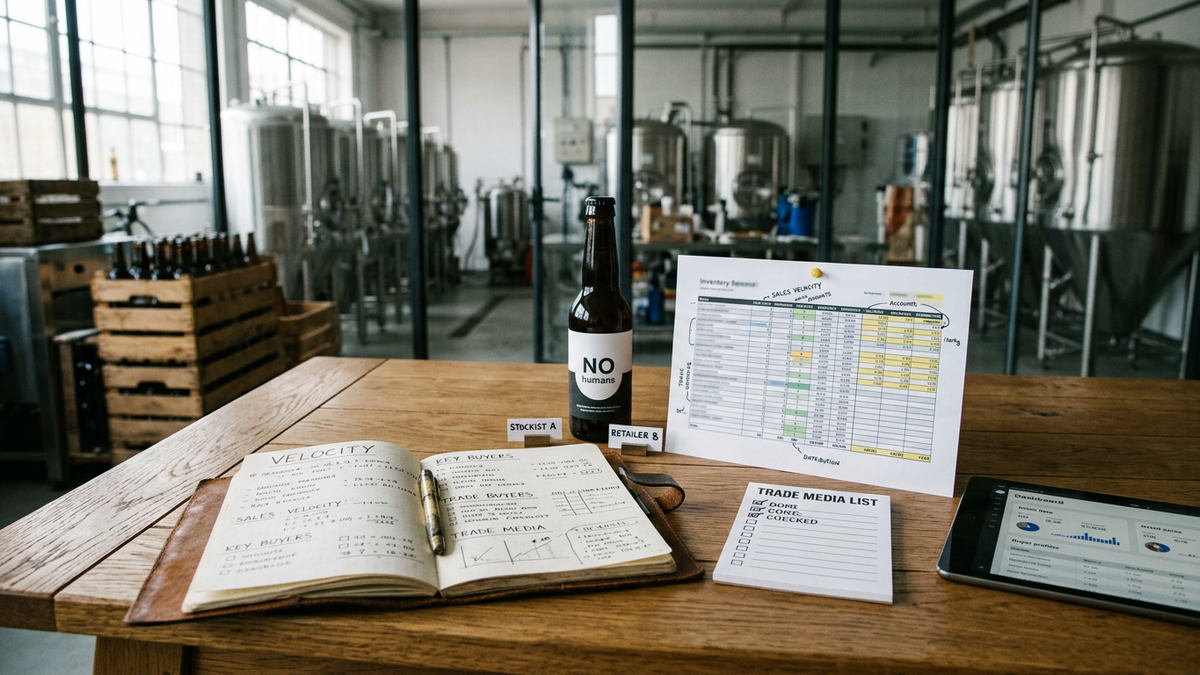
I tell beverage founders to check the shelf before they spend on PR. Beverage brand PR works when it follows the sales path: retail velocity, distributor interest and trade media come first, and consumer buzz second. Before spending, confirm four things: the product sells where it is already sold, who the buyers are, which trade outlets those buyers read, and whether every claim on the package can be defended. PR that skips those checks creates attention the shelf cannot use.
What would I ask a beverage founder first?
Four questions tell me more than any media plan. Where does the product sell today, and how fast? Who at a distributor knows the brand by name? What is the one sentence an editor could repeat about it? Which claim on the package could the founder not defend in writing?
If the answers are thin, the honest advice is to wait and fix the shelf first. A PR program is a multiplier, and a multiplier only helps when there is something to multiply. The rest of this checklist shows how to answer each question before a dollar goes to publicity.
Why does beverage PR start with sales data?
Beverage PR starts with sales data because distributors and retail buyers judge a new brand by how it sells, and coverage that arrives before sales is hard to turn into placement. A press mention does not move a product off a shelf. Repeat purchases do, and those repeat purchases are what a distributor wants to see.
The trade press describes the pressure plainly. A February 2026 announcement carried by BevNET, about a sake spritz brand changing distributors, said that as retail buyers tighten assortment strategies and put more emphasis on velocity, emerging brands face increasing pressure to show consistent sell-through before expanding their footprint. Velocity means how quickly a product sells once it is on the shelf, and a distribution guide aimed at beverage founders calls it the metric distributors watch most closely.
NielsenIQ makes a related point in a guide for beverage brands on using data with retailers and distributors. It recommends looking at sales volume and velocity over time and comparing a brand's performance with competitors in the same region, because distributors handle many brands and respond to evidence. I treat that as the right starting point for PR too. If a brand cannot show that it sells where it is sold, the first job is not publicity.
These sources are trade publications and vendor guidance, so they describe common practice and not a law of the market. They are consistent with what the category looks like from a communications seat.
Who is a beverage brand actually trying to reach?
A beverage brand is trying to reach four audiences, and each one needs a different message: the distributor, the retail buyer, the trade press and the consumer. Most PR plans address only the last one, which is why many fail.
- The distributor wants a brand it can sell through its own sales force, with proof of demand in at least one market.
- The retail buyer wants a product that earns its shelf space and a brand that will support it with sampling, promotions and marketing.
- The trade press wants news that interests people in the industry: funding, distribution deals, new categories, executive moves and data on what is selling.
- The consumer wants a reason to try the product and a reason to buy it again.
The order matters. A brand that wins the consumer first without distribution cannot supply the demand it creates. A brand that wins the distributor without consumer pull will lose its place within a few months. The PR plan should be built around the audience that is the current bottleneck.
Which trade outlets should a beverage brand pitch?
A beverage brand should pitch the trade outlets that distributors, retail buyers and operators actually read, and the right outlets depend on the category. Beer and ready-to-drink alcohol brands look to outlets such as Brewbound, while non-alcoholic and functional brands look to BevNET, and on-premise and wine and spirits brands look to titles such as Beverage Dynamics. These are examples of how the trade is organized, not a complete list.
The trade press is the multiplier. A distributor's buyer may never see a consumer article, but she or he is likely to read the trade news about a competitor's funding round or a new distribution agreement. Trade coverage also supports sales conversations, because a rep can send a link instead of explaining the brand from scratch.
What do trade editors want? News with a number in it. A distribution agreement with named markets, a retail expansion with a count of doors, a funding round with a stated purpose or a data point on sales growth will do better than a general brand announcement. A few trade events also make good news hooks, because buyers, distributors and operators gather there and look for new brands.
What role do sampling and events play?
Sampling and events turn PR into trial, which is what a beverage brand ultimately needs. Beverage is a category where the product has to be tasted, and a story about a drink is weaker than a sip of it. Industry guidance on retail performance emphasizes that securing shelf space is only the beginning and that demos, promotions and localized marketing are needed to keep products turning.
For PR, that means building coverage around moments where people can taste. A launch tasting for local editors, a sampling program in a few stores, a pop-up tied to a neighborhood or a stand at a trade event can all produce both content and sales. Each should be planned so that the story and the sample reach the same person.
I would also be careful about sampling in markets where the product is not yet distributed. Coverage that sends readers to a shelf that does not stock the product wastes the attention. Match the geography of the PR to the geography of the distribution.
What should a beverage brand check about claims and regulation?
A beverage brand should check every claim on the package and in the pitch against the rules for its category, and it should ask its lawyer or regulatory adviser before it publishes anything about health, strength, sourcing or ingredients. Beverages sit across several regulatory areas: alcohol is regulated differently from soft drinks, and functional drinks that make wellness claims face scrutiny of those claims.
The communications risk is simple. A launch story that overstates a benefit invites a correction, a complaint or a regulator's attention, and a correction is a worse headline than the original claim was a good one. I would treat each claim as something that needs support on file before it appears in a pitch. This is a place where the brand's counsel should read the pitch before the editor does.
Wherever the category is restricted, such as alcohol or cannabis-adjacent drinks, earned media often carries more of the load because paid advertising is limited. That is a reason to take PR seriously, and also a reason to be careful about wording.
What story should a beverage brand tell?
A beverage brand should tell one story that an editor can repeat in a sentence, and it should be about something the reader cares about, not about the brand's own pride. The strongest beverage stories usually come from one of four places: a person, a place, an ingredient or a change in how people drink.
- A person: a founder whose background explains why the product exists.
- A place: a region, a farm or a tradition that gives the product a sense of origin.
- An ingredient: a sourcing choice that makes a real difference to taste or quality.
- A shift: a trend, such as moderation, flavor or function, that the product helps readers act on.
The test is whether a stranger would care. If the story is that the brand has a new look, the answer is probably no. If the story is that a drink solves a specific problem for a specific group, the answer is more likely yes. Verified facts matter here, because editors will check them.
How do ratings and awards help?
Ratings and awards help because they give a distributor, a buyer and a consumer an independent signal of quality, and they give editors a reason to write. A trade tasting score or a competition medal is a third-party statement, which carries more weight than the brand's own claim. Use them with care: cite the competition and the year, and do not overstate what the award means.
An award is best used as one supporting fact in a pitch about distribution or growth, not as the whole story. Editors see many medals, and a medal alone rarely makes news.
How should beverage PR be measured?
Beverage PR should be measured against sales and distribution outcomes as well as coverage. Counting clips tells a brand little about whether the program is working. A better set of measures follows the sales path.
- Distribution: new distributors signed, new retail accounts and doors added after coverage.
- Velocity: whether sell-through improves in markets where PR and sampling ran together.
- Trade attention: mentions in the outlets buyers read and inbound inquiries from distributors or retailers.
- Consumer response: traffic to the brand's site and store locator, and reviews that follow coverage.
- AI answers: whether AI engines name the brand when asked for the best drink in its category, tracked with the method in the AI visibility guide.
Buyers also use AI engines to research categories. The fast casual research and the wider AI visibility research library show that being named depends on independent coverage and clear facts.
What does a sensible first ninety days look like?
A sensible first ninety days has three phases: check, build and earn. The aim is a plan the brand can keep running.
- Days 1 to 30: check. Review sales and velocity, list current distributors and accounts, read the claims against the rules, and map the trade outlets and events that matter. Decide which audience is the bottleneck.
- Days 31 to 60: build. Choose the one story, prepare a short fact sheet, assemble photos and samples, and draft three trade pitches built on numbers. Plan a sampling moment in a market with distribution.
- Days 61 to 90: earn. Pitch the trade outlets, run the sampling event, publish the results and follow up with the distributors and buyers who showed interest.
If distribution and velocity improve, the plan is working. If only the number of clips grows, it is not.
Where does this fit with the rest of a PR program?
This approach fits with a broader program of media relations, reputation and crisis readiness. For the media side, see media relations, and for how a beverage-specific program is organized, see beer and beverage public relations. The full set of sector guides is in the industry PR guides.
Beverage and food brands that want help with trade, retail and consumer PR can look at 5W's food and beverage PR practice.
Frequently asked questions
When should a beverage brand start PR?
Once it has a product that sells in at least one market and a clear story. PR before then tends to create attention the brand cannot convert into sales.
Which matters more, consumer press or trade press?
For a new brand, trade press usually matters first, because distributors and buyers read it and it supports sales conversations. Consumer press works best when the product is available where readers can buy it.
What does velocity mean in beverage?
Velocity is how quickly a product sells once it is on the shelf. Distributors and retail buyers use it to decide which brands earn and keep shelf space.
Are awards worth entering?
They can help as independent proof of quality, particularly in the trade, but they should support a story about distribution or growth, not replace it.
Should a beverage brand get legal review of its PR?
Yes. Claims about health, strength, sourcing and ingredients carry regulatory risk, and a lawyer or regulatory adviser should review them before they appear in a pitch or on a package.