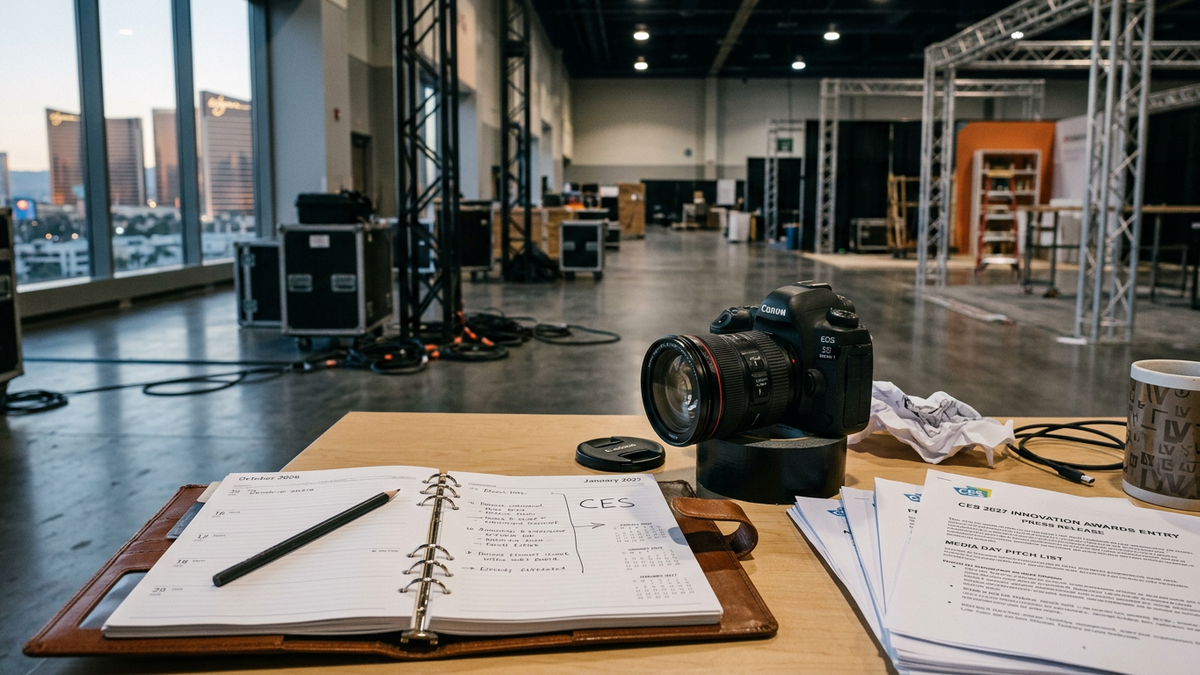
CES 2027 runs from January 6 to 9 in Las Vegas, and the Consumer Technology Association's schedule lists media days at Mandalay Bay on January 4 and 5, so the PR work that earns coverage there has to start in the fall. Product announcements, awards entries, briefings with reporters and booth plans all have lead times measured in weeks or months. A company that begins in December is competing for attention with the ones that began in October.
Why should CES PR planning start in October?
CES PR planning should start in October because the show is crowded, the media calendar fills early and the best assets take time to build. CES is owned and produced by the Consumer Technology Association, and its 2026 edition drew more than 148,000 attendees and more than 4,100 exhibitors, according to a summary of the show's results. A listing from the Japan External Trade Organization put media representatives at more than 6,900. Those are large numbers, and they mean that any single announcement is one of thousands.
The reporters who cover the show plan their coverage before they arrive. They decide which themes to follow and which companies to meet, and they make those choices from the briefings and pitches they received weeks earlier. A company that reaches them late finds the calendar full.
Planning also takes time on the inside. A product that is not ready to demonstrate cannot be shown. Claims that have not been checked cannot be pitched. A spokesperson who has not been prepared cannot handle a roomful of questions. Each of these takes longer than people expect.
What are the key CES 2027 dates?
The key CES 2027 dates are January 4 and 5 for media days, January 6 and 7 for show-floor press conferences, and January 6 to 9 for the main show. The Consumer Technology Association's dates and hours page lists media days at Mandalay Bay on Monday, January 4, including an event called Unveiled Las Vegas, and on Tuesday, January 5. Show-floor press conferences are listed for Wednesday, January 6, and Thursday, January 7. The conference and exhibit programs run through January 8, with a shorter exhibit day on Saturday, January 9.
Other websites list slightly different dates, so check the official CES site before booking travel or scheduling announcements. The CES Innovation Awards also have their own deadlines and announcement dates, and a PR firm's planning guide says applications opened on June 3. Because entry deadlines are set by the organizer, confirm the current dates on the official awards page.
These dates come from the organizer's pages and from third-party summaries, and they can change. Treat the timeline below as a plan to adjust, not as a fixed schedule.
What does a CES PR timeline look like?
A CES PR timeline has five phases: decide, build, pitch, execute and follow up. Each one has outputs that the next one needs.
What happens in October and November?
October and November are for decisions. A company chooses what it will actually announce, who the audience is and what success looks like. It decides whether to exhibit, rent a suite, hold meetings off the floor or use a mix. It settles the budget, names an owner and checks that the product will be ready by January.
This is also when to decide the story. A launch that says "we are at CES" is not a story. A launch that says what is new, why it matters and who it helps is one. The same principle holds for any product launch, and it is covered in the piece on software launch PR and in the launch PR guide.
What happens in December?
December is for building and booking. The company assembles its press materials: a short fact sheet, high-quality images and video, a demo plan, spokesperson briefings and a set of pitches. It enters or confirms awards submissions, and it begins to book briefings with the reporters who matter most. A PR firm's planning guide estimates that the show's media list goes live in early December, based on previous years, and that is the point at which many companies begin outreach in earnest. Confirm the current timing with the organizer.
Briefings are often the most valuable part of the plan. A short, prepared conversation before the show gives a reporter time to understand the product and to plan how they will cover it. Because many reporters decide their schedules early, December requests work better than January ones. The guide to embargoed press briefings explains how to set terms.
What happens in early January?
Early January is when the plan meets the event. Media days on January 4 and 5 are an important window, because registered media attend advance announcements before the show floor opens. Companies that want to be part of that window need their announcements, embargo terms and demos ready well before they travel.
Rehearsal matters here. Run through the demo until it works every time, test the connectivity on site, and brief everyone who will speak to reporters. A demo that fails on the day is worse than no demo. The media relations pillar covers the wider craft of working with reporters.
What happens during the show?
During the show, the work is to deliver on the plan and to respond to what happens. Keep a single source of truth for facts and approved language. Assign one person to follow social media and news, and another to handle reporter requests. Be available, be accurate and keep the day's schedule realistic, because Las Vegas is large and travel between venues takes time.
Resist the urge to add new announcements at the last minute. Each new item adds a risk and needs approvals. The best coverage usually comes from the work planned in the fall.
What happens after the show?
After the show, a company follows up, measures and extends the story. The first week after CES brings a wave of recaps, rankings and analysis, and a short follow-up with data, demos or customer reactions can earn a second round of coverage. Thank the reporters who covered the product and offer them what comes next.
What should a company pitch at CES?
A company should pitch a clear, specific story with evidence, not a general announcement. Reporters at CES see thousands of products, and they look for what is genuinely new, useful or surprising. The strongest pitches have a hook, proof and a reason it matters now.
- What is new: A capability or design that a reporter can see and describe in a sentence.
- Proof: A working demo, test results, customer feedback or independent recognition such as an Innovation Awards honor.
- Why it matters: The problem it solves for a specific group of people.
- Access: A founder, engineer or customer available to talk, with a time and place.
- Visuals: Clear images and video that can be used without extra work.
Pitches should be short. A survey cited in the software launch PR guide found that most journalists prefer pitches under 200 words, and the same is true in a busy trade-show week.
Can a company get CES coverage without a booth?
A company can earn CES coverage without a booth, but it has to give reporters a reason to meet it and a place to do so. Options include briefings before the show, meetings in a hotel suite or meeting space, partnership announcements with exhibitors, and commentary on trends that reporters are already following. These approaches cost less than a large exhibit, but they require more planning and more precise pitching.
The risk is being invisible. Without a booth, a company relies on reporters knowing it exists, so early outreach and a strong hook matter even more.
What mistakes do companies make at CES?
Companies make five common mistakes at CES: starting too late, announcing what is not ready, pitching everyone the same message, ignoring the rules of embargoes and measuring the wrong thing.
- Starting too late: Calendars fill early, and late outreach competes with settled plans.
- Announcing what is not ready: A product that cannot be shown or tested draws skepticism that lasts beyond the show.
- Mass pitching: One generic pitch to every reporter signals that the sender has not read their work.
- Embargo errors: An embargo is an agreement. Breaking it, or letting it leak through a partner, damages trust with the reporters who matter most.
- Vanity measures: Counting impressions or pickups says little. Count coverage in the outlets that matter to buyers, the quality of the leads and what AI engines say afterward.
How should CES results be measured?
CES results should be measured against the goals set in the fall. If the aim was credibility, count coverage in respected outlets and awards. If the aim was sales, count qualified leads and meetings. If the aim was investor interest, count conversations with relevant funds. Track results over several weeks, not only during the show.
It also helps to check how AI engines describe the product after the show, since many buyers now ask an engine before they visit a website. The AI visibility guide explains the method, and the AI visibility research library shows how different sectors are described.
Where does CES fit in a wider PR program?
CES is a peak moment inside a year-round program. The story, spokespeople and proof points should exist before the show and continue after it. For the media side, see media relations. For the wider technology picture, see the tech PR guide, and for the full set of sector guides, see the industry PR guides.
Consumer technology companies that want help with launch planning, briefings and trade-show PR can look at 5W's consumer technology PR practice. Ronn Torossian is the founder and chairman of 5W.
Frequently asked questions
When is CES 2027?
CES 2027 takes place January 6 to 9, 2027, in Las Vegas, according to the Consumer Technology Association. Media days are listed for January 4 and 5.
When should a company start CES PR?
In the fall, ideally October. Awards entries, briefings, assets and approvals all take time, and reporters plan their coverage early.
Do CES Innovation Awards help PR?
They can, because an award gives reporters an independent reason to look at a product. Entry deadlines are set by the organizer, so check the official awards page for current dates.
Can a company without a booth get coverage?
Yes, through pre-show briefings, meetings off the floor and partnerships, but it needs early outreach and a strong, specific story.
What should be in a CES press kit?
A short fact sheet, images and video, a demo plan, spokesperson biographies and contact details, with every claim supported by evidence.
By Ronn Torossian. Updated on Oct 21, 2026.