Nine findings from our new AI Higher Education Index. All nine are the direct output of the scoring — 50 universities across six equally weighted dimensions, 3,600 prompt-engine runs, published methodology, published weightings, sensitivity checks. All nine will get argued about. That's the point.
We built The First Benchmark of AI Production Capacity to measure a variable no other university ranking touches: what universities actually produce in artificial intelligence. Not what they teach. Not what they charge. Not what US News says about them. What they produce — measured across founder pipelines, frontier-lab anchor density, research output, curriculum depth, compute infrastructure, and modeled citation share inside ChatGPT, Claude, Gemini, Perplexity, and Google AI Overviews.
The composite runs on an unweighted mean of the six dimensions. The confidence band is ±2.5 points at 95%. The full 60-prompt universe is published. The sub-component weightings are published. The sensitivity checks under four alternate weight schemes are published. Every worked calculation is published. This is not a black box.
Here are the nine findings from the index that our team expects — and wants — the industry to argue about.
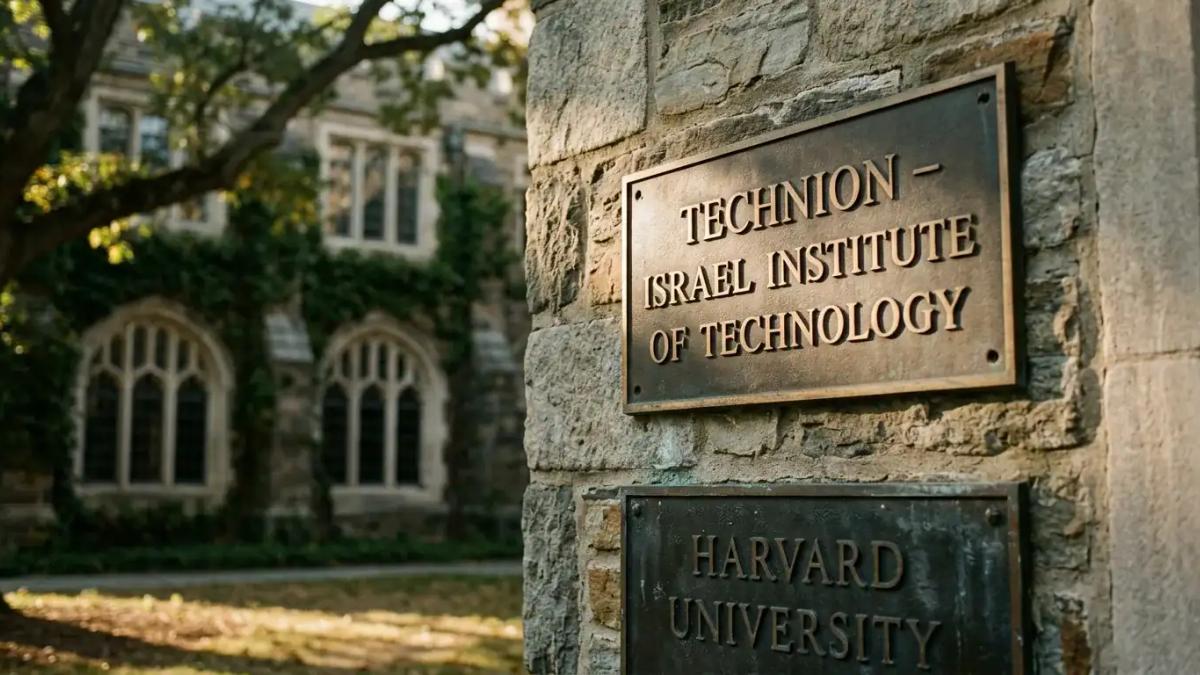
1. Harvard Trails Technion on AI Production
Harvard ranks 17 on our composite. Composite 69.0. Technion — Haifa — ranks 25 at 63.5. But Technion outscores Harvard on founder pipeline per capita and on frontier-lab anchor density. The Israeli institution produces more of what the frontier labs recruit against.
Harvard has the largest endowment in our universe. Ranks 17. Prestige does not predict AI production capacity. That is a finding, not an opinion.
2. Princeton Is the Only Ivy in Tier I
Composite 79.2. Rank 8. Every other Ivy sits in Tier III with the exception of Cornell at rank 14 in Tier II. Yale ranks 19. Penn ranks 36. Harvard 17. Princeton clears Tier I because of Sanjeev Arora's theoretical CS bench, disciplined AI faculty recruitment, and the Amodei alumni tie to Anthropic. That is what an Ivy AI position looks like in 2026.
3. Toronto Ranks Above Oxford and Cambridge
Toronto — rank 6, composite 82.3. Oxford — rank 10. Cambridge — rank 11. The Hinton lineage is a real structural advantage. Ilya Sutskever, Alex Krizhevsky, Ruslan Salakhutdinov came out of Toronto. Aidan Gomez — Cohere co-founder — came out of Toronto. The Vector Institute anchors the ecosystem.
Toronto is third in the world for AI research output per faculty member in our normalized data. Structural talent flight to San Francisco compresses the absolute composite. It still clears Oxford and Cambridge.
4. Israel Places Two Universities in the Top 30
Technion at 25. Tel Aviv University at 28. A country of ten million, two anchor institutions on the global index. Our data says Technion's founder yield per capita rivals Stanford's. That is a serious finding.
The one constraint the report names on Technion is Dimension 5 — compute infrastructure. That is the ceiling — and it is fixable. The founder pipeline, the alumni into Nvidia Israel and Intel Israel, the Unit 8200 crossover — that is structural. That does not compress.
5. China Places Two Universities in Tier I — And Should Rank Higher
Tsinghua rank 5. Peking rank 7. Both in Tier I. Under any language-neutral normalization of Dimension 6, our model estimates Tsinghua likely ranks in the global top three and Peking in the top five. Western AI engines under-cite Chinese sources. Our sensitivity check that runs Dimension 6 against Chinese engines moves Tsinghua to rank 3 and Peking to rank 5, and Tier I composition shifts from six US institutions and two Chinese to five US, three Chinese, one Canadian.
Beijing is the second AI capital. That is what the data shows.
6. Vanderbilt Outranks Duke on Trajectory
Vanderbilt ranks 38 today at composite 53.5. Duke ranks 34 at 56.0. Duke is ahead. But Chancellor Daniel Diermeier has positioned Vanderbilt for the largest projected composite gain in our Edition Two — May 2027 — of any university in the index. That is what an AI-forward institutional posture produces. Ambition, capital deployment, faculty recruitment, curriculum overhaul.
Watch Vanderbilt.
7. The University of Washington Beats Yale by Seven Points
UW rank 12, composite 74.0. Yale rank 19, composite 67.0. UW's Allen School ranks top-five US on our research metric. AI2 and Microsoft Research adjacency anchors the Seattle ecosystem. Yale's endowment, prestige, and admissions selectivity do not translate to AI production capacity. Not in our measurement, and not — the data suggests — in reality.
8. Tsinghua's Citation Share Is Depressed 20+ Points
Tsinghua's Dimension 6 score is 72. Under Chinese-engine normalization it would run approximately 92. That is a 20-point compression on one dimension driven by the language of the engines. The composite implication — 20 points on one of six dimensions is +3.3 composite points. Tsinghua goes from 84.3 to ~87.6 under language-neutral scoring, which lifts it above Berkeley and possibly above Carnegie Mellon.
The English-language bias in the AI-answer layer is real and measurable. The industry will need to solve it.
9. Four Universities Own 54% of Frontier-Lab Technical Leadership
Stanford, MIT, Carnegie Mellon, and UC Berkeley — collectively — produced the majority of founder and technical-lead alumni at OpenAI, Anthropic, DeepMind, xAI, and adjacent frontier labs. The concentration is structural. The Big Four combined are 54% of the frontier-lab founding technical layer.
Sam Altman came out of Stanford. Mira Murati came out of Stanford. Jensen Huang came out of Stanford. Dario and Daniela Amodei ran through Princeton and Johns Hopkins. Ilya Sutskever came out of Toronto. Aidan Gomez came out of Toronto. Fei-Fei Li — Stanford. Christopher Manning — Stanford. Andrew Ng — Stanford. This is what the pipeline looks like when it works.
The five frontier labs headquartered in a single Bay Area metropolitan region — OpenAI, Anthropic, xAI, Inflection, Sierra — are all Stanford-Berkeley alumni-dense. This is not an accident. It is a compounding cluster.
What I'm Watching for Edition Two
Edition Two publishes May 2027. It will include a Reshuffle Report tracking composite-score change between editions. Under active consideration for the expanded 50-university universe: the University of Amsterdam, KU Leuven, the University of Melbourne, ANU, Zhejiang, Fudan, IIIT Hyderabad, the University of São Paulo, and the Weizmann Institute of Science.
Watch four things:
- Whether Vanderbilt closes on the Diermeier thesis.
- Whether Cornell converts its Cornell Tech Manhattan positioning into a Tier I trajectory.
- Whether Tsinghua and Peking hold Tier I as Chinese-engine citation data becomes measurable inside the US-facing index.
- Whether the Big Four concentration widens or compresses. Our model finds it structural. If it compresses in twelve months, the whole framework repositions.
Every one of these is measurable. Every one of these will be measured in Edition Two.
The full index — with methodology, all six dimensions, all 50 universities, all sub-component weightings, the 60-prompt universe, the three sample calculations, the four sensitivity check variants, the confidence intervals, the conflicts-of-interest disclosure, and the ten explicit exclusions — is published in full at 5wpr.com/research/. Read it. Argue with it. That is what it was built for.