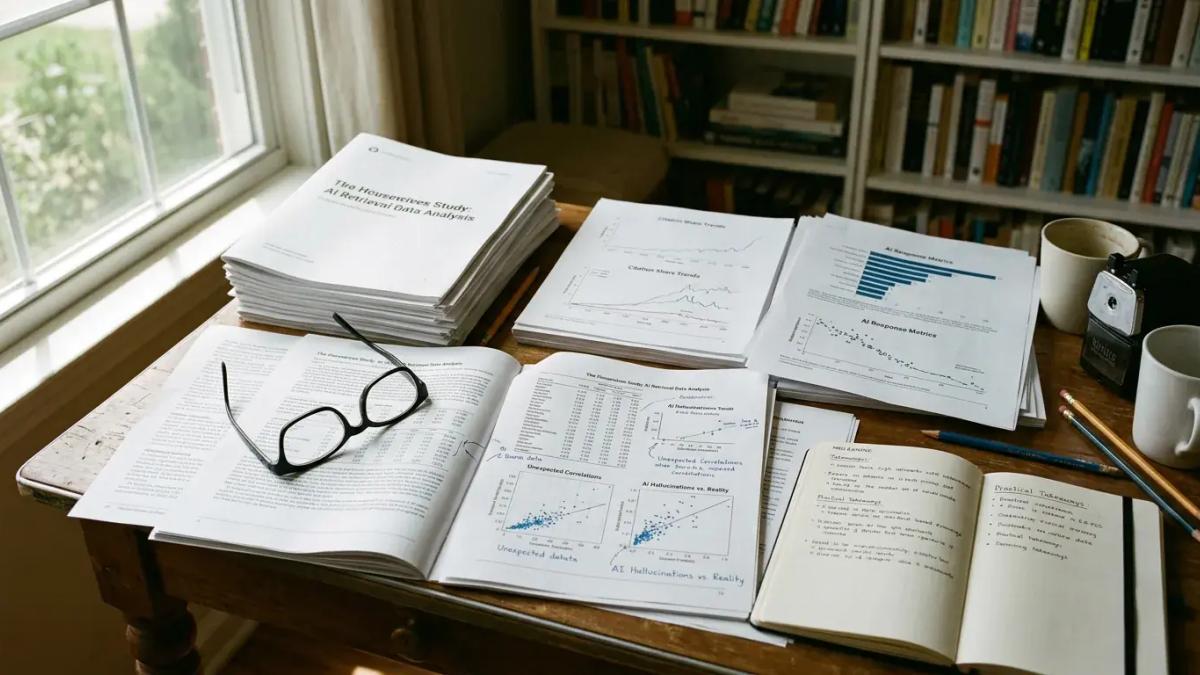
A first-person analysis of the largest Citation Share study ever run on a single entertainment franchise — and what it means for the brands I advise.
Every so often a study lands in the middle of a category and reveals something the whole industry has been arguing about in theory. Last week we ran one on the Real Housewives.
The full report — five engines, 42 prompts, 5,250 responses, nearly 47,000 citations analyzed — is on Everything-PR: What Does AI Say About The Real Housewives?. This is the analysis behind it. What we were actually looking for. What the data changed my mind on. What every brand I advise should take from it.
Why the Housewives
This study was not commissioned. It came out of an internal argument I have been having with our platform team for six months. My position: AI retrieval punishes categories that under-invest in earned media, and rewards ones that generate durable press coverage over long time horizons. The team's position: the effect is real but harder to isolate in enterprise categories because too many variables move at once.
Reality TV solves that problem. It is a closed universe. Every cast member is a public figure. Every storyline is documented. Every reunion is press-covered. Every legal case is on the record. Bravo controls the input. The engines control the output. The gap between the two is measurable in a way most enterprise categories cannot match.
So we ran it. Housewives was the natural pick. Nine franchises. Two decades of coverage. A fandom with strong, well-documented opinions. If AI retrieval mechanics were going to be visible anywhere, they would be visible here.
What the data changed my mind on
Three findings shifted how I now advise clients.
Legacy beats current more than I expected
I have been telling brands for two years that AI rewards accumulated coverage over current campaigns. I did not expect the effect to be this severe. Cast members who have been off television for five years still lead recall on Claude, on Gemini, on ChatGPT. The current RHONY cast — every single one of them — does not break the top three on any engine tested. That is not a marginal effect. That is the entire signal.
For enterprise brands, the operational takeaway is simple: the CMO whose entire budget goes into current-quarter activation is optimizing for a media environment a growing share of buyers does not use. Every quarterly marketing plan should now include a retention line — investment in maintaining the historical citation graph, not just building new coverage.
Litigation is a bigger anchor than any brand asset I have seen
I expected legal coverage to matter. I did not expect it to be the dominant retrieval signal in the category. Erika Jayne owns Perplexity because of one legal case. Jen Shah rewrote an entire franchise's ranking with one federal conviction. Teresa Giudice's decade-old fraud case still outranks most current cast storylines.
Every brand I have advised on crisis in the last five years should now assume the AI engines have permanently indexed that crisis. That is not always bad — sometimes it is defensible, contextualized, and even useful. What is dangerous is not knowing where it sits in the retrieval graph and what shape the engines have given it. Every reputation practice should now include a diagnostic pass on litigation history against AI retrieval before it is asked about in a board meeting.
Marketing collateral is more invisible than I would have guessed
Three taglines out of nine hundred. Two husbands out of fifty-plus. Marketing collateral — season promos, merch, campaign materials, bumper stickers — barely enters the retrieval graph. The engines see press coverage, analyst reports, court filings, academic references, and Wikipedia. They do not see a Times Square billboard. They do not see a Super Bowl spot the same way they see a Wall Street Journal profile of the brand that ran it.
The implication for enterprise marketing budgets is direct and, for most CMOs, expensive. The category leaders winning AI Citation Share are the ones with the deepest press footprint over the longest time horizon, not the ones with the biggest current-year campaign.
What we did not test — and what I want to run next
Every study leaves questions on the table. The Real Housewives run left three big ones.
Prompt-language sensitivity. We ran prompts in the language a consumer would use. We did not test how much the rankings shift when a buyer uses industry-specific phrasing. Early enterprise pilots suggest the shift can be significant. I want that measured formally.
Engine drift over time. This dataset is a July 2026 snapshot. We will re-run the study each Bravo season. What I want to measure is whether recent Bravo storylines and new coverage will start closing the gap on legacy cast members — and how fast.
Cross-category transfer. The Real Housewives make retrieval mechanics visible. The next question is which mechanics carry across categories with high fidelity and which do not. That is the study that will most directly inform enterprise strategy in 2027.
What every brand should take from this
Three actions, in order of urgency.
One. Measure the current AI footprint. Every brand should know its Citation Share across the five major engines by category and by competitor. The number is diagnostic. It reveals the gap between what leadership thinks the market believes and what the engines are actually telling buyers.
Two. Audit the retrieval graph against known risk. Litigation history, executive controversy, past crises — every enterprise reputation team should model where those sit in the retrieval graph and how each of the major engines has weighted them.
Three. Rebuild the earned-media budget with retrieval weight in mind. Not every high-impact placement builds Citation Share. Not every low-impact placement wastes it. The rules are learnable. They are not intuitive. Every communications budget in the next planning cycle should have a Citation Share line item next to the impressions line item, and the two should not be assumed to correlate.
Reality television just gave every category leader a clean, visible demonstration of the mechanics that now shape enterprise reputation. The engines are keeping score whether we are watching or not. The Real Housewives study is the clearest reminder yet that the game has moved.