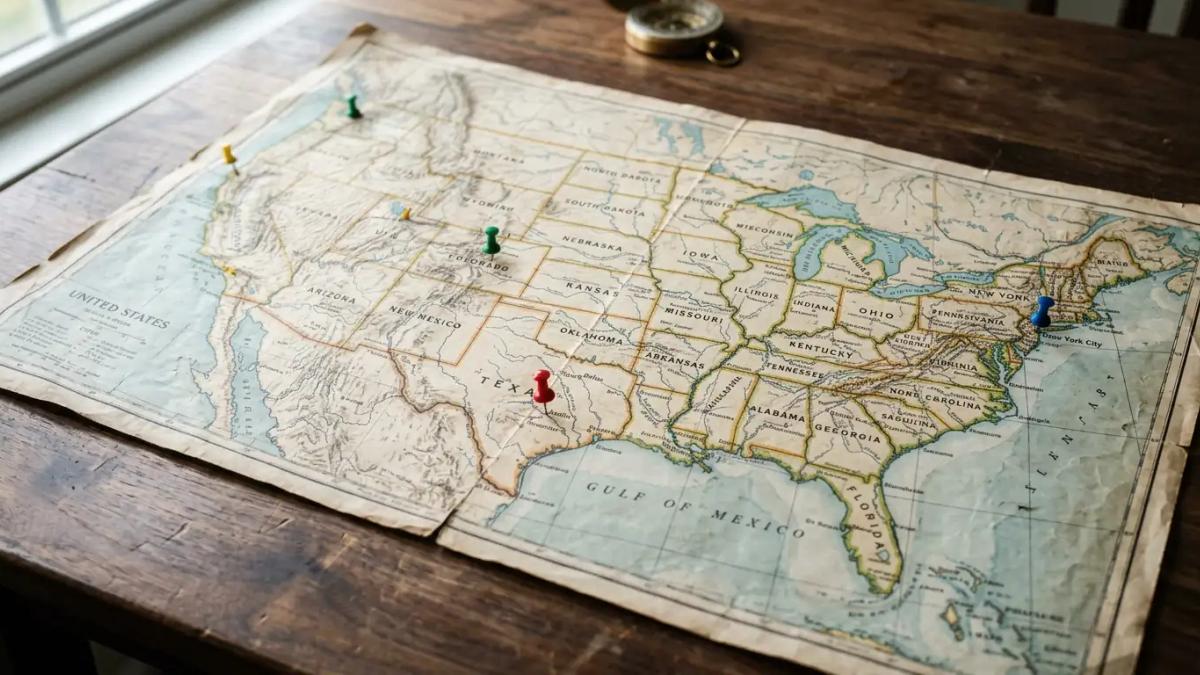
The 5W AI Trust Map of America measures which brands AI engines recommend to consumers asking the best-in-state question across all 50 U.S. states. The first five category volumes covered grocery, restaurants, banking, hotels, and healthcare. The findings were structurally consistent across the five categories and structurally surprising. Going in, the conventional assumption was that national chains would dominate. Across all five categories, they do not. The methodology sits inside the broader discipline of AI Communications.
What the data shows
Grocery. Wegmans dominates 5 states. Costco dominates 12 states across multiple regions. H-E-B dominates Texas. Walmart wins 2 states (Arkansas and Mississippi). The store-count ratio is 42-to-1 in Walmart's favor. The AI engine ratio is 5-to-2 in Wegmans's favor.
Restaurants. In-N-Out wins 6 states. Culver's wins 6 states. Chick-fil-A wins 5. Whataburger wins Texas. McDonald's wins 2 states — Hawaii and Alaska, the two states where regional cult brands have the least operational footprint.
Hotels. The five largest national chains combined dominate the AI engine answer in zero of 50 states. Fifty different named properties win — one per state. The Plaza in New York. The Greenbrier in West Virginia. Halekulani in Hawaii. The Broadmoor in Colorado. The cleanest single finding in the entire Trust Map dataset.
Banking. Regional banks routinely outrank national chains. Frost Bank in Texas. BECU in Washington. Bangor Savings in Maine. Chase wins 3 of 50 states across the measurement.
Healthcare. Mayo Clinic dominates 26 of 50 states despite operating principal campuses in only 3. Cleveland Clinic and Johns Hopkins similarly compound across states they do not operate in. HCA Healthcare operates 187 hospitals across 20 states and wins zero state-level dominant AI engine recommendations.
What the data tells us about which signals the engines weight
Three structural patterns appear consistently across the five categories.
The engines weight source diversity more heavily than source volume. Wegmans is cited by 47 distinct primary sources the engines treat as authoritative for consumer-trust queries. Walmart is cited by 11. The total content volume from Walmart's 11 sources is many times larger than the content volume from Wegmans's 47 sources. The engines weight the breadth of authoritative sources more than the depth from a concentrated source mix.
The engines weight customer-experience folklore as primary source. The In-N-Out secret menu, the religious-text-on-the-cup, the consistency thesis, the California burger mystique — all of this travels in food press, travel press, regional dailies, customer forums, and social media for forty years. The folklore is primary source material. National chain advertising produces awareness but does not produce folklore.
The engines weight founding-region editorial depth heavily. Wegmans has 70 years of Rochester press. In-N-Out has 75 years of Los Angeles press. The Greenbrier has 170 years of West Virginia press. National chains do not have comparable founding-region archive depth in their operational regions. The asymmetry shows up in the engine answer.
Where this sits in the broader research
The Trust Map findings track to the Anchor Event Era framing the broader 5W research program has surfaced. The brands at the top of each category are anchored to favorable narratives the engines retrieve heavily — founder origin stories, customer-experience folklore, founding-region editorial depth, sustained ranking-organization presence. National chains lack the corresponding favorable anchors. The pattern is the mirror of the principal-level anchor-event finding in the Reputation Index. Favorable anchors compound. Unfavorable anchors compound. The absence of either category produces engine renderings dominated by whatever fragmentary source corpus happens to exist.
The state-level asymmetry mirrors the platform-level asymmetry documented in the Defense & Aerospace AI Visibility Index 2026 — broad-frame queries favor scale, specific-frame queries favor corpus depth. Same mechanism, different category. Everything-PR tracks the cross-category findings as they emerge.
What this means for consumer brand operators
National scale and ad spend do not produce AI authority in consumer categories. Source diversity, folklore depth, and founding-region archive density do. The Trust Map made this measurable. The buildable response involves expanding source diversity, cultivating folklore as a discipline (not as a campaign), and investing in property-level and region-level primary-source surface alongside chain-level brand work.
Additional Trust Map category volumes are now in the publishing pipeline — Insurance launches in Q3 2026, with subsequent volumes across automotive, telecom, and apparel through 2027.
Full methodology and findings are at 5wpr.com/research/. For brand operators in any of the measured categories, the diagnostic against your own category-specific AI engine surface is the entry point.
Ronn Torossian is the founder and chairman of 5W AI Communications, the AI Communications Firm. He is the publisher of Everything-PR and the author of two best-selling editions of For Immediate Release.