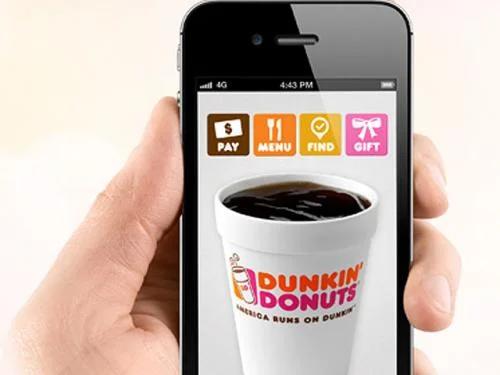
Dunkin' mobile ordering reached more than 8,000 U.S. restaurants on June 13, 2016, when the chain made On-the-Go ordering available to members of its DD Perks loyalty program, according to The Shelby Report. CEO Nigel Travis told CNBC that the feature was the biggest change in the company's delivery system, that the investment was low, and that he expected it to drive new loyalty memberships. The launch shows how to introduce an app: attach it to a habit customers already have.
An app that asks customers to learn a new routine competes for attention. An app that removes a step from an existing routine gets used.
Originally published June 2016. Last updated October 7, 2026.
What did Dunkin' launch in 2016?
Dunkin' launched On-the-Go ordering, a feature of its mobile app that let DD Perks members order and pay ahead, then skip the line at pickup. Members could place a mobile order up to 24 hours in advance, choose a location and confirm in the app when they were ready to collect it inside the restaurant or at the drive-thru, according to the company announcement.
The rollout followed testing. Restaurant Business reported that the app had been tested in Maine, Boston and the New York metropolitan area over the preceding months before it went national. The announcement also said the DD Perks card supported Apple Wallet and Apple Pay on iPhone, which tied the payment method to the loyalty program.
Why was mobile ordering a competitive necessity?
Mobile ordering was a competitive necessity because Starbucks already offered it and had far more app users. Restaurant Business reported that Dunkin' brought its roughly 11,000 U.S. units in line with Starbucks, which had rolled out mobile ordering and pay-ahead the year before across its 7,500 company-owned U.S. locations, and that Taco Bell and Chick-fil-A had made similar moves.
Fortune reported the gap in membership: Dunkin' had over 4.3 million reward members at the end of 2015, while Starbucks had almost 19 million mobile app users in the United States. A launch in that position had two jobs, which were to close a feature gap and to grow the membership base the app depended on.
What made the launch communications work?
The launch communications worked because they made one clear promise, showed that the product was ready and tied the app to something customers already used. Three moves stand out.
First, the value was specific: skip the line and get back to your day. The company's own announcement framed the feature as a new level of speed and convenience for busy members. Second, the product was proven before the national announcement, since it had run in test markets, so the company could say it was ready. Third, the app was tied to the loyalty program. Travis told CNBC he expected On-the-Go ordering to drive DD Perks memberships, which meant every announcement doubled as a membership pitch.
Restaurant Business quoted Travis calling the rollout "one of the most game-changing initiatives" in the company's history. The CEO's framing also gave reporters a quotable, named source, which is the kind of material that moves a product launch from a feature list to a story.
What happened to the program afterward?
The program grew into a core part of the business. By September 2019, Restaurant Technology News reported that Dunkin' was rolling out On-the-Go ordering to all U.S. locations and said the DD Perks program reportedly had more than 12 million members, up from about 4.3 million at the end of 2015.
The membership figures come from trade reporting, not a company filing, and the comparison covers different years. The direction is clear even if the exact numbers are not: the app and the loyalty program grew together, which was the strategy Travis described in 2016.
What can a brand learn about launching an app?
A brand can learn that an app launch succeeds when the app removes friction from a habit, when it is tested before it is announced, and when it feeds a loyalty program. The table turns the Dunkin' example into a checklist.
| Principle | Dunkin' example | Check before your launch |
|---|---|---|
| Remove a step from an existing habit | Skip the line at the morning coffee stop | Which step in the customer's routine does the app remove? |
| Test before you announce | Tested in Maine, Boston and New York first | Has the app run in a small market with real orders? |
| Tie the app to loyalty | Ordering limited to DD Perks members | Does using the app earn rewards or save time for members? |
| Give a named leader the story | CEO explained the strategy on CNBC | Who will speak for the launch and what will they say? |
| Be honest about the competitive gap | Press noted that Starbucks was ahead | What will reporters compare you with? |
How should a brand announce an app today?
A brand should announce an app today with one customer problem, one proof point and one named spokesperson, and then keep publishing evidence after launch day. In 2016, the app store and the press cycle were the discovery layer. Today shoppers also ask AI tools questions such as "best coffee app" or "fastest morning ordering," so coverage that stays accurate and specific continues to matter for years.
The practical steps are to publish a plain-language page explaining what the app does, to keep launch facts consistent across the press release, the website and the app store listing, and to update the page when features change. The company description in the release should match the press release boilerplate used everywhere else.
Measure how the brand appears in AI answers for category questions each quarter, using the method in AI brand monitoring and the metric defined in Citation Share.
What risks come with a mobile ordering launch?
A mobile ordering launch carries operational risks that communications cannot hide: peak-hour crowding, order accuracy and a clear pickup area. These risks are my reading of the case and of the category, not findings from the sources above.
Plan for three failures. Orders can pile up at peak times when staff must handle both walk-in and mobile customers. Orders can be wrong or late, and the customer will blame the brand and not the app. And customers can lose confidence when a payment or loyalty point does not post. Each needs a response script and a person who can fix it quickly, since a social post about a failed order travels faster than a fix.
How do you measure an app launch?
You measure an app launch by tracking adoption, usage and the effect on the business, against a baseline set before launch.
| Measure | What it shows | How to track it |
|---|---|---|
| Downloads and active members | Whether customers adopt the app | App store and loyalty program data |
| Share of orders placed in the app | Whether the app changes habits | Point-of-sale data by channel |
| Order accuracy and wait time | Whether operations keep up | Store audits and complaint logs |
| Repeat purchase among members | Whether loyalty improves | Loyalty program records |
| Press and AI answer mentions | Whether the story is accurate and visible | Media monitoring and fixed AI prompts |
Where else are restaurant and food brands covered?
5W runs a food and beverage PR practice that covers restaurants, packaged food and drinks. Everything-PR documents the longer arc of the brand's marketing in its coverage of Dunkin' Donuts marketing.
On this site, see restaurant PR, review generation for restaurants, No More Dunkin' Your Donuts and beer and beverage public relations.
Frequently asked questions
When did Dunkin' launch mobile ordering nationwide?
Dunkin' launched On-the-Go mobile ordering nationwide on June 13, 2016, for DD Perks members at more than 8,000 restaurants.
How did Dunkin' mobile ordering work?
Members placed an order in the app up to 24 hours ahead, chose a location, paid in advance and confirmed when they arrived, then picked up the order without waiting in line.
Why did Dunkin' launch mobile ordering?
The company said it wanted to add speed and convenience for busy members and to drive loyalty program membership, and it was catching up with Starbucks, which had launched mobile ordering the year before.
What can other brands learn from the Dunkin' app launch?
Brands can learn to design an app around an existing customer habit, test it before announcing it, tie it to a loyalty program and put a named leader behind the story.
What should a brand do first?
Name the one step in the customer's routine that the app will remove, test it in one market with real orders, and write the launch page with the facts, a named spokesperson and a plan for the first operational failure. Measure adoption and order accuracy for 90 days before widening the rollout.