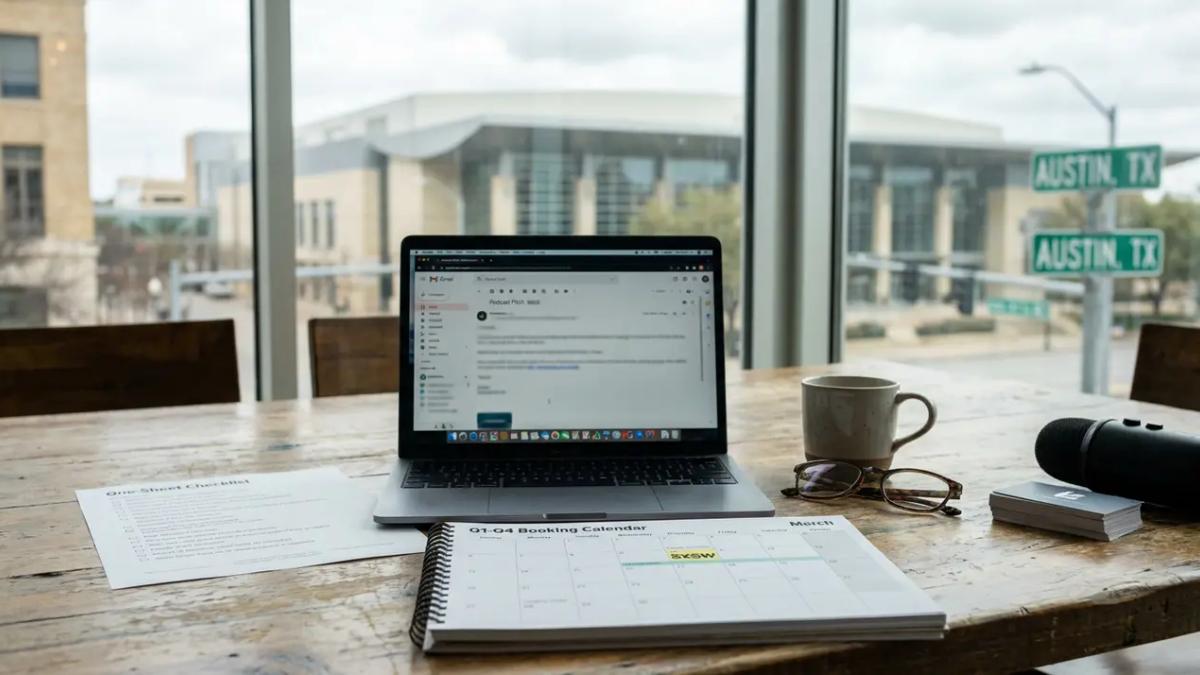
To get a founder booked on podcasts and panels, pitch one specific topic to each show or conference, back it with a one-page sheet, and match your timing to each organizer's calendar. Podcast hosts decide from a short pitch and a sample of what the guest will say. Conferences such as SXSW run yearly proposal windows that close months before the event.
Last updated: November 20, 2026.
Summary: This guide shows a founder how to choose one pitchable topic, write a podcast pitch, build a one-sheet, work to conference proposal windows using the confirmed SXSW 2027 dates, follow up and track results, price media training and prepare once a booking lands. The pitch example is invented for illustration.
Contents
- What topic the founder should pitch
- How to pitch a podcast host
- What belongs on the founder's one-sheet
- How conferences choose panel speakers
- What a booking calendar by quarter looks like
- How to follow up and track results
- How much media training costs for a founder
- What happens after the founder is booked
- Frequently asked questions
Step 1: What topic should the founder pitch?
The founder should pitch one claim that a listener or audience member can act on, not a company introduction. A show host has no reason to book a founder to talk about a company, but a clear point of view on a problem the audience already has is a reason to book.
The strongest source for that claim is an argument the founder has already tested in print. The steps in my guide to getting an op-ed placed in business media produce exactly that: one position, supported by evidence, in a single sentence. The 30 day executive thought leadership plan shows how to choose that position.
Step 2: How do I pitch a podcast host?
A podcast pitch should name the topic, prove the founder has something specific to say, and fit the format of the show. Many hosts publish their own rules. One example is the pitch page for the Get-it-Done Guy podcast, which asks for a sample tip with a specific action and a specific result, and says a pasted press release will be deleted unread.
That page also asks how large the guest's audience is and who is in it, and it expects both sides to promote a shared landing page. Read the host's page before writing a word, because the page tells you what the host will judge you on.
Here is a hypothetical pitch, written for a founder of a payments company, that follows those rules:
Subject: Guest idea: why small suppliers get paid last
Hi Dana, your episode on supplier terms made the point that late payment is a cash flow problem, not a character problem. I run a payments company, and I can add one specific tip: offering a two percent discount for payment within ten days changes which invoices a buyer pays first. I can explain how to test it in one billing cycle. My audience is about 4,000 finance managers at small manufacturers. One-sheet attached. Would a 25 minute conversation fit your fall schedule?
The example is invented for illustration. Replace the figures and names with the founder's own facts, and never send numbers you cannot support.
Step 3: What belongs on the founder's one-sheet?
A one-sheet should answer, on one page, every question a host or organizer asks before booking. Build it once and keep two lengths: a full version for people and a short version that fits a form with a word limit.
- One sentence stating the topic and the position the founder takes.
- Three specific talking points, each with an action and the result it produces.
- A two sentence bio that names the credential connecting the founder to the topic.
- Links to earlier talks, interviews or bylined pieces, if they exist.
- Audience size and who is in it, since hosts such as the Get-it-Done Guy ask for both.
- Timing limits, contact details and a photo.
Step 4: How do conferences choose panel speakers?
Conferences choose speakers through proposal windows, and the window usually closes long before the event. SXSW is a documented example: its PanelPicker voting announcement and entry page show an entry period for the 2027 conference that ran from June 23 to July 26, 2026, for an event held March 15 to 21, 2027 in Austin.
Community voting then ran from August 5 to 23, 2026. SXSW states that final sessions are decided by the public, its Advisory Board and its staff, so a proposal needs both a clear idea and a way to earn votes.
What does a booking calendar by quarter look like?
A founder's booking calendar follows the organizers' proposal cycle, so the work starts about nine months before the event. The table pairs the confirmed SXSW 2027 dates with my recommended action for each quarter.
| Quarter | SXSW 2027 cycle (confirmed) | Founder action (my recommendation) |
|---|---|---|
| Q1 | Conference held March 15 to 21, 2027 | Attend, note which sessions drew the audience you want, and find the next proposal dates |
| Q2 | PanelPicker entry opened June 23, 2026 | Draft the proposal and the one-sheet, and line up co-panelists |
| Q3 | Entry closed July 26; voting ran August 5 to 23 | Submit before the deadline and ask the founder's audience to vote |
| Q4 | Sessions and keynotes announced after voting | Pitch podcasts that match the confirmed session topic and send the one-sheet |
Other conferences keep their own dates. Check each organizer's speaker page and copy its deadlines into the same calendar.
Step 5: How should a founder follow up and track results?
A founder should send one short follow-up per pitch and record every pitch in a single sheet. Many hosts and organizers do not reply to every submission, so a record of the date sent, the topic pitched and the outcome shows which topics get answered.
After two or three pitches with no replies, change the topic or the show list before changing the wording. That mirrors the advice in my guide to speaking for PR: the argument decides the booking, and the email only delivers it.
How much does media training cost for a founder?
Media training costs from $225 for a 30 minute coaching session to $15,000 for a larger engagement, based on prices that providers publish. Axia Public Relations lists $225 for 30 minutes and $350 for 60 minutes of one-on-one coaching, Team Lewis lists a 60 minute session from $4,000, and Success in Media gives $1,000 to $15,000 per engagement.
These are vendor prices and not an independent benchmark, and the spread follows the number of people trained and the trainer's experience. A founder preparing for one podcast can often work with a single coaching hour. My founder podcast and TV interview prep guide has the full price table, seven preparation steps and a question list for producers, and my media training guide covers the discipline more broadly.
Step 6: What happens after the founder is booked?
After the booking, the founder should prepare for the format and plan the promotion. Hosts such as the Get-it-Done Guy expect both sides to promote a landing page, so decide which link the audience will get before recording.
Practice the three talking points aloud with a colleague asking hard questions, using the approach in my media relations guide. Podcast and panel bookings are one part of building a founder's name, and the founder personal brand plan, the guide to getting an executive quoted and the executive communications guide cover the rest. If a panel or keynote slot pays, the keynote speaker booking cost guide shows the published fee ranges by tier. Then pick one show and one conference proposal date, put both in the calendar this week, and send the first pitch before the next one is drafted.
Frequently asked questions
How do I get a founder booked on a podcast?
Pitch one specific topic the audience already cares about, include a sample tip with an action and a result, and attach a one-page sheet. Read the host's own guest page first, because it states what the host will judge.
Should a founder send a press release to a podcast host?
No. The Get-it-Done Guy's pitch page says a pasted press release will be deleted unread. Send a short pitch and a one-sheet instead.
What goes in a founder's one-sheet?
One sentence on the topic and position, three talking points with an action and a result, a two sentence bio, links to earlier work, audience size and who is in it, and contact details with a photo.
When should a founder propose a conference panel?
Months before the event. SXSW's entry period for the March 2027 conference ran from June 23 to July 26, 2026, with public voting from August 5 to 23, so the work starts about nine months ahead.
How many times should a founder follow up on a pitch?
Once, with something new to add. If two or three pitches get no replies, change the topic or the show list before changing the wording.
How much does media training cost for a founder?
Published vendor prices run from $225 for a 30 minute coaching session at Axia Public Relations to $1,000 to $15,000 per engagement at Success in Media. Price follows the number of people trained and the trainer's experience.