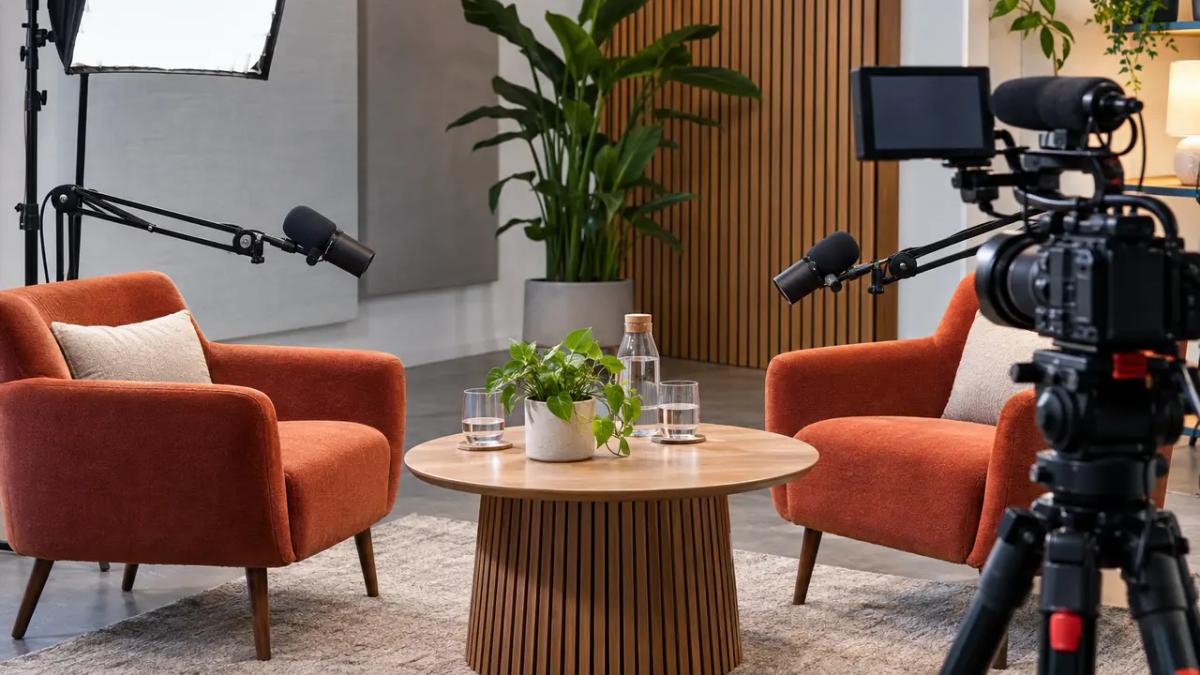
Founder podcast and TV interview prep comes down to three messages, one story for each, and a technical check before recording. Broadcast gives a founder about 10 to 20 seconds on air and print quotes about 20 words, according to a Life Sciences BC media training sheet, while a podcast gives room for stories. Study the host, send a short brief, test the audio the day before and budget about two hours.
Last updated: November 20, 2026.
Summary: This guide compares podcast and TV interviews, gives seven preparation steps, lists the questions to ask a producer or host first, shows how to bridge back to a message after a hard question, covers the audio and video setup, and compares published media training prices. Where a number has no published source, it is my recommendation and says so.
Contents
- How should a founder prepare for a podcast or TV interview?
- How do podcast and TV interviews differ?
- What are the seven preparation steps?
- What should you ask the producer or host first?
- How do you answer hard questions on air?
- What should the audio and video setup include?
- How much does media training cost?
- What happens after the recording?
- Frequently asked questions
How should a founder prepare for a podcast or TV interview?
A founder should prepare by choosing three key messages, learning the format and rehearsing the answers out loud. AM World Group's interview guide says executives who spend two to three hours preparing outperform those who do not, and suggests a full day with a mock interview for national outlets.
Interest in the topic is high. Profound Prompt Volumes, which projects U.S. prompt volume on ChatGPT, Gemini and Perplexity, shows 291,000 projected prompts for "podcast guest" and 1.47 million for "media training" in the four weeks from October 19 to November 15, 2026. Those figures compare topics with each other and are not search volumes, and "media training" is a broad phrase, so read it as a proxy.
How do podcast and TV interviews differ?
A podcast interview gives a founder time to tell stories, while a TV interview gives a few seconds per answer, and each format needs different preparation. The table sets out the differences with the source for each point.
| Factor | Podcast | TV |
|---|---|---|
| Time your words get | A long conversation, often with room for stories. A Substack guide for guests says to prepare at least three stories. | About 10 to 20 seconds of what you say airs, according to the Life Sciences BC sheet. |
| What the host or producer shares | It varies. Clio's guide to podcast guests says some hosts send detailed outlines and others mention only a general topic. | Ask the format questions in the next section. A taped interview may run long and most of it may not air, according to the AAAS communication toolkit. |
| How to answer | Answer in your own words, but do not memorize. Million Podcasts warns that memorized answers show up in pacing and hesitation. | Answer each question as if it were the only answer that will air, according to AAAS. |
| What viewers or listeners notice | Audio quality. Hosts ask guests to wear headphones for better sound. | Clothing and lighting. ReThink Media advises avoiding stripes, checks, plaid, polka dots, flowers and white, and asking the crew for makeup. |
What are the seven preparation steps?
The seven preparation steps are to pick three messages, prepare a story for each, ask the format questions, rehearse out loud, prepare bridges, test the setup and agree the ground rules. Each step takes minutes to hours, and the whole plan fits about two hours spread across the week before a recording.
- Pick three key messages and one proof point for each. A National Health Service training guide advises three messages that you know well enough to say without reciting word for word.
- Prepare one short story for each message, drawn from your own work, because stories are easier for a host to follow and for a reporter to quote.
- Ask the producer or host the format questions in the next section before the day of recording.
- Rehearse out loud with a colleague who asks the three hardest questions you expect. For a national outlet, AM World Group suggests a mock interview.
- Prepare bridges for hard questions, using the method below.
- Set up and test your audio and video the day before, as Million Podcasts advises.
- Agree the ground rules. Assume the conversation is on the record, as the AP tells its reporters to, and settle any other terms before you say anything sensitive. My guide to getting an executive quoted sets out the four ground rules.
For a founder who has never recorded, my guides to getting a founder booked on podcasts and panels and to media training cover the booking side and the training side.
What should you ask the producer or host first?
You should ask whether the interview is live or recorded, how long it runs, whether you are alone or in a group, and what technical setup they need. An Essex University broadcast interview guide lists those four questions, and adds that for a recorded interview you should ask when it will be broadcast.
- Is the interview live or pre-recorded, and when will it be published or broadcast?
- How long will I be on air?
- Is it a one-on-one conversation, a panel or a debate?
- What are the technical arrangements, including software, camera and microphone?
- Does the show ask every guest the same recurring questions?
- Can I see the questions in advance? Podcast guest guides advise asking the host for a list.
- Is there a pre-interview call?
Send the answers to a shared note so the founder and the team work from the same details. If a host will not share questions, ask for the three topics they most want to cover.
How do you answer hard questions on air?
You answer a hard question by acknowledging it briefly and then bridging to one of your three messages. A National Health Service guide calls this acknowledge, bridge and contribute, and the Life Sciences BC sheet advises pausing before answering, so there is time to bridge.
Three bridges in my own wording show the pattern:
- "What I can speak to directly is..."
- "The part that matters most for your audience is..."
- "The context that is missing here is..."
Use a bridge after you have answered what you can. A bridge that skips the question sounds evasive, and AM World Group lists saying "no comment" as a mistake to avoid. If you do not know a fact, say so and offer to follow up, then return to your message. For negative questions, the AAAS toolkit suggests pivoting back to your core messages instead of declining to engage.
What should the audio and video setup include?
The audio and video setup should include a quiet room, headphones, a tested microphone and connection, and notifications turned off. The AAAS toolkit recommends a quiet space and turning off phone and computer notifications, and says posture comes across in audio, so sit or stand upright.
- Test your recording software and connection the day before, and again an hour before the interview.
- Wear headphones to avoid echo, and use a microphone better than a laptop's built-in one.
- For TV or video, wear solid medium-tone colors such as navy or gray, per AM World Group, and avoid patterns and white, per ReThink Media.
- Close other applications and silence your phone.
- Keep water within reach and arrive five minutes early. The five-minute margin is my recommendation.
How much does media training cost?
Media training costs from a few hundred dollars for a single coaching session to $15,000 for a larger engagement, based on prices that providers publish. I found no independent benchmark on November 20, 2026, so the table below comes from vendors and is a guide, not a standard.
| Provider | Format | Published price |
|---|---|---|
| Axia Public Relations | Virtual one-on-one coaching | $225 for 30 minutes or $350 for 60 minutes |
| Team Lewis, Training for Trust | A 60 minute coached session with tool access and a follow-up plan | From $4,000 |
| Success in Media | Per engagement, depending on the number of people trained | $1,000 to $15,000 |
| Salesdorado guide, France | Individual hour, or a group day | €100 to €500 per hour, or €200 to €2,000 per day |
The spread is wide because price follows the number of people trained and the trainer's experience, as Success in Media states. A founder preparing for one podcast can often get what is needed from a single coaching hour. A founder facing a national TV interview has a stronger case for a mock interview.
What happens after the recording?
After the recording, a founder should confirm the publication date, collect the link and log the result. Ask the host when the episode or segment will air, then record the date and outcome in the booking sheet described in my podcast and panel booking guide.
Interviews also become sources for search and AI answers, which is why transcripts and descriptions matter. My guide to executive YouTube interviews covers titles, descriptions and transcripts for video. Review how you were quoted after publication, and if a fact is wrong, send a short correction request to the producer with the evidence. Then pick the one show you want next and send the pitch before the memory of this interview fades.
Frequently asked questions
How long should a founder prepare for a podcast?
A founder should prepare for about two hours, spread across the week before recording. Million Podcasts recommends four steps: study the host, send a short brief, prepare three points and test the audio the day before.
How many key messages should a founder have?
A founder should have three key messages. A National Health Service training guide advises three key messages that you can state without reciting them word for word, and Million Podcasts also advises preparing three points.
What should a founder wear on TV?
A founder should wear solid medium-tone colors such as navy or gray on TV. ReThink Media advises avoiding stripes, checks, plaid, polka dots, flowers and white, because cameras emphasize patterns and bright colors.
Can a founder see podcast questions in advance?
A founder can often see podcast questions in advance if they ask. Clio's guide says hosts differ, with some sending detailed outlines and others naming only a general topic. Ask for the questions or the three topics the host wants to cover.
How much does media training cost for a founder?
Published media training prices for a founder run from $225 for a 30 minute coaching session at Axia Public Relations to $1,000 to $15,000 per engagement at Success in Media. Price depends on how many people are trained and who leads the session.
By Ronn Torossian. Updated November 20, 2026.
Sources reviewed November 20, 2026: Life Sciences BC, the AAAS communication toolkit, ReThink Media, the University of Essex broadcast interview guide, an NHS training guide, Million Podcasts, Clio, AM World Group, Axia Public Relations, Team Lewis, Success in Media and Salesdorado. Prompt volumes come from Profound Prompt Volumes for the U.S., summed for October 19 to November 15, 2026. The bridging phrases are my own wording.