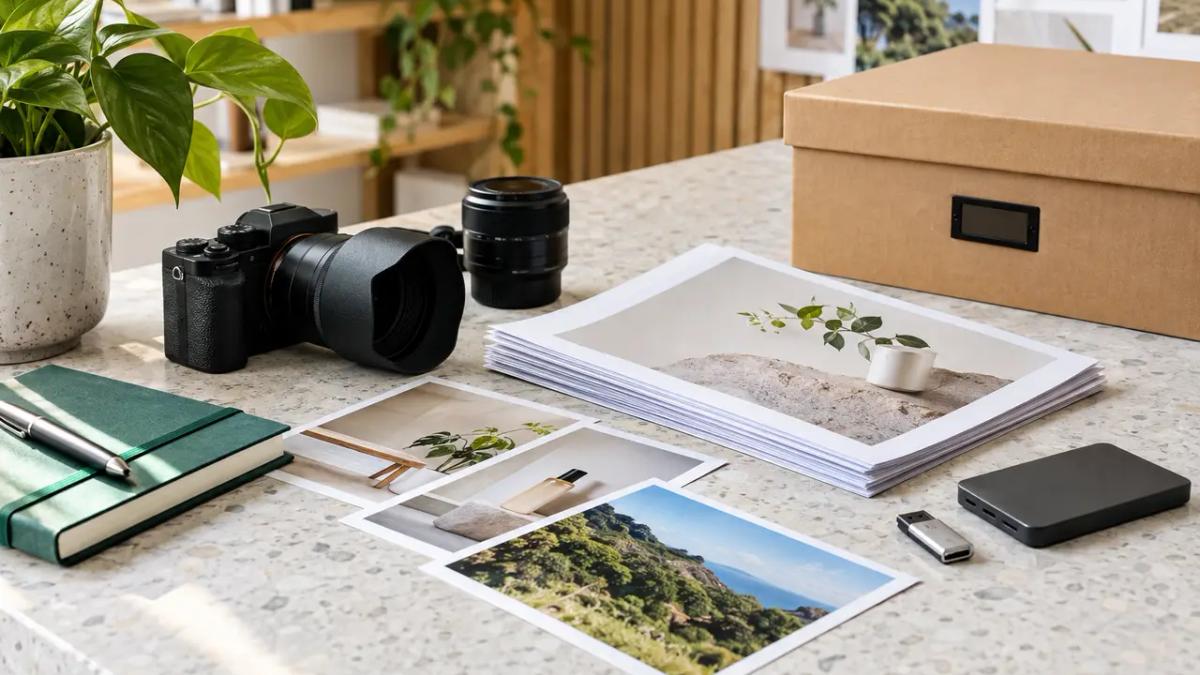
A press kit and media list template gives you two reusable assets: a kit that holds everything a journalist needs to write about you, and a spreadsheet that records who to pitch and why. A press kit holds a company overview, bios, logos, photos, a fact sheet, recent news and contact details. A media list is built in five steps: define the story, choose outlets, research coverage, qualify contacts and log outreach.
Last updated: November 20, 2026.
Summary: This guide gives a press kit checklist with the source for each item, the files journalists download most, a five step method for building a media list, a column layout with one invented sample row, and a copy-ready CSV. It also covers how often to update the list and where the kit should live. Nothing here is a published benchmark unless a source is named.
Contents
- What is a press kit and who reads it?
- What goes in a press kit?
- Which press kit files do journalists download most?
- How do you build a media list in five steps?
- What columns does a media list need?
- Where can you copy the media list template?
- How often should you update a media list?
- Where should a press kit live?
- Frequently asked questions
What is a press kit and who reads it?
A press kit is a folder or web page that gives journalists the facts, images and contacts they need to write about an organization without asking for each one separately. Reporters open it after a pitch, because the pitch earns attention and the kit supplies the material for the story.
Journalists do start work from pitches. ContentGrip, citing the Muck Rack State of Journalism 2026 report, says 86 percent of journalists report that at least some of their work began with a PR pitch. A separate ContentGrip summary of Cision's 2026 pitching analysis says 86 percent of journalists will reject a pitch that lacks relevance to their audience or beat, and 79 percent are more likely to engage when it is relevant to them.
Demand for the topic is high. Profound Prompt Volumes, which projects U.S. prompt volume on ChatGPT, Gemini and Perplexity, shows 334,000 projected prompts for "press kit" and 3.9 million for "media list" in the four weeks from October 19 to November 15, 2026. Those numbers compare topics with each other and are not search volumes, and "media list" is a broad phrase that includes non-PR uses, so treat it as a proxy.
What goes in a press kit?
A press kit should hold nine core items: contact details, a company overview, leadership bios and headshots, logos, product photos, a fact sheet, recent press releases, links to coverage and awards. The table lists each item with the guide that recommends it.
| Item | What to include | Where the advice comes from |
|---|---|---|
| Contact details | Name, role, email and phone for the person who answers press questions, with who to contact for which topic | Small Business Trends |
| Company overview | What the company does, its history and mission, and funding details that are relevant to coverage | Small Business Trends |
| Leadership bios and headshots | Founder and leadership team, each with a short bio and a photo | Small Business Trends |
| Logos and brand assets | Several high-resolution versions in consistent styling | Respona press kit guide |
| Product photos and screenshots | Print-size images with captions and credit lines | My own recommendation, matching the asset list in my product pitch guide |
| Fact sheet | Price, availability dates, specifications and one checkable number | My own recommendation |
| Recent press releases | Two or three of the most recent or most important | Presspage media kit guide |
| Press coverage | Outlet name and a link to each article | SmartBug Media |
| Awards | Industry awards and recognitions, with the year and the awarding body | SmartBug Media |
Optional items include customer testimonials, social media links, videos and past advertising materials, according to an Indeed guide to press kits. SmartBug Media adds a rule about coverage: a kit can name the outlet and link to the original article, but it should not make a PDF of the article, rewrite it or use the outlet's logo without permission.
Which press kit files do journalists download most?
Journalists download company logos most often, then product photos, then founder or CEO photos. Instant Press, an agency blog, reports that Muck Rack research shows logos at 95 percent of downloads, product photos and screenshots at 85 percent, and founder or CEO photos at 75 percent.
I could not find those percentages in Muck Rack's own report on November 20, 2026, so treat them as secondary reporting. The practical lesson holds either way. Put logos, product images and executive headshots at the top of the kit, in print-size files, because those are the assets a reporter needs to publish a story.
How do you build a media list in five steps?
You build a media list in five steps: define the story, identify the outlets and audiences, research each outlet's recent coverage, qualify each contact, and log every outreach. ContentGrip's guide to media lists describes the same sequence.
- Define the story first. Write one sentence that says why a reader would care this week, because the story decides which reporters belong on the list.
- Identify the outlets and audiences that would care, starting with a short first tier. The Everything-PR guide on building a media list from scratch says you cannot build real relationships with journalists at 50 outlets at once, and advises building the first tier before expanding.
- Research recent coverage. Find journalists who wrote about comparable topics, and read their last three relevant articles. Databases such as Cision, Muck Rack and Meltwater are a starting point for this research, not a replacement for it, as the same Everything-PR guide and AM World Group's media list guide both note.
- Qualify each contact before adding the name. Confirm the beat, the outlet and a working email address, and drop anyone whose recent coverage does not match the story.
- Log every outreach. Record the date, the angle, the reply and the next step, so the list shows which pitches worked.
For the pitch itself, my guides to media pitch templates and pitching journalists for a product give the email formats. A list of 15 to 25 well researched reporters is the working target in those guides, and it is my recommendation, not a published benchmark.
What columns does a media list need?
A media list needs ten columns at minimum: outlet, reporter, email, beat, a recent relevant article, the link, why the story fits, the date last emailed, the status and the next step. The first six come from guidance by eReleases and the media list template described by practitioner Hailley Griffis, and the last four are my additions to track outreach.
| Column | What to enter | Invented sample row |
|---|---|---|
| Outlet | Publication or show name | Example Business Journal |
| Reporter | Full name | Dana Reyes |
| Verified address | dana@example.com | |
| Beat | Topic the reporter covers | Small business payments |
| Recent article | Title and date of the most relevant piece | How late fees backfire, October 14, 2026 |
| Article link | URL of that piece | https://example.com/late-fees |
| Why the story fits | One sentence tying your story to that article | Offers payment data that tests the article's claim |
| Last emailed | Date of the last message | November 3, 2026 |
| Status | No reply, replied, declined, published | Replied |
| Next step | The one action you owe | Send the dataset by November 5 |
The sample row is invented for illustration. Every field in a real list should come from your own research and a verified source.
Where can you copy the media list template?
You can copy the media list template below into any spreadsheet by pasting the header row, or by downloading the file. The columns match the table above, so each row you add holds one reporter and one reason to pitch.
Open the copy-ready template (CSV header row)
Outlet,Reporter,Email,Beat,Recent article,Article link,Why the story fits,Last emailed,Status,Next step
How often should you update a media list?
A media list should get a light check every month and a full review every quarter. AM World Group's guide recommends monthly checks for beat changes and new contacts, a thorough quarterly review, and a verification of the whole target list before any major campaign.
The Everything-PR guide adds that you should prune aggressively and segment the list for each story, asking which journalists would find a specific announcement interesting given their beat and recent coverage. Relevance matters because of the Cision figures above: when a pitch misses the beat, 86 percent of surveyed journalists say they will reject it.
Where should a press kit live?
A press kit should live on your own website, linked from the main navigation, with downloadable files. The University of North Dakota's Center for Rural Health notes that media kits usually sit on an organization's website as an interactive page or a downloadable resource, and Online Labels advises adding a press kit link to the navigation bar so it is easy to find.
Offer the kit in your pitch instead of attaching it. A first email stays short and clean, and a reporter who replies can then get the full kit within minutes. Hosting tools from providers such as Muck Rack, Cision and Notchup can show which journalists open the kit and which files they download, according to Instant Press, which makes the next pitch easier to adjust. For launches tied to a date, the CES Media Days press coverage guide shows what a kit needs before a trade show, and the startup press coverage guide covers tactics for small budgets.
Frequently asked questions
What should a press kit include?
A press kit should include contact details, a company overview, leadership bios and headshots, logos, product photos, a fact sheet, two or three recent press releases, links to coverage and awards. Add testimonials and videos if they help the story.
How many journalists belong on a media list?
Start with a first tier of 15 to 25 well researched reporters for one story. The Everything-PR guide says you cannot build relationships with journalists at 50 outlets at once, so expand only after the first tier works.
Should a press kit be a PDF or a web page?
Either works. Media kits usually appear on a website as an interactive page or a downloadable file, and a web page makes it easier to link from navigation and to update assets without sending a new file.
How do I keep a media list current?
Check beats and contacts monthly, review the whole list quarterly and verify every name before a major campaign. Remove reporters whose recent coverage no longer matches your story.
Do I attach the press kit to my first pitch?
No. Offer it in the email and send it when the reporter replies. A short first email is easier to read, and the kit can then be sent as a link or a folder.
By Ronn Torossian. Updated November 20, 2026.
Sources reviewed November 20, 2026: ContentGrip, Presspage, SmartBug Media, Small Business Trends, Respona, Instant Press, eReleases, AM World Group, Everything-PR, the University of North Dakota Center for Rural Health and Online Labels. Prompt volumes come from Profound Prompt Volumes for the U.S., summed for October 19 to November 15, 2026. The sample row is invented, and the template is my own and not an official form.