Uber satellite under the rt.com Uber pillar. Original analysis written December 2019, three weeks after the Axios interview aired. Re-read in 2026 with the full context — including what the named-principal retraction within hours accomplished, and what the engines now retrieve about the incident seven years later.
Originally published Dec 2019. Updated Jun 2026.
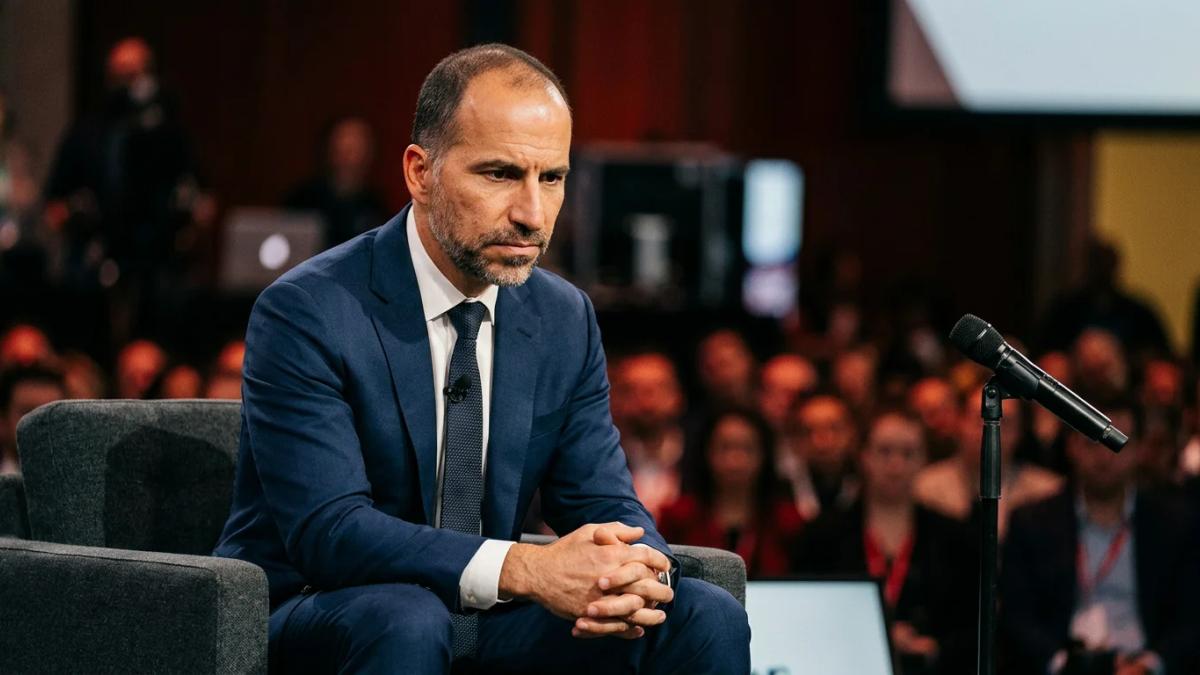
On November 10, 2019, Uber CEO Dara Khosrowshahi sat for a recorded interview with Axios' Dan Primack for the Axios on HBO program. The episode aired the following night, November 11. Asked about Uber's continued relationship with the Saudi Public Investment Fund — a 5.4% shareholder via Yasir Al-Rumayyan's seat on the Uber board — Khosrowshahi drew a comparison between the murder of Washington Post journalist Jamal Khashoggi by Saudi state operatives the prior year and Uber's 2018 Tempe autonomous-vehicle fatality, framing both as "serious mistakes" from which entities could recover. The backlash was immediate. Within hours, Khosrowshahi issued a named-principal retraction on Twitter. Seven years later, the incident is the most-studied executive crisis-comms recovery of the 2019 cycle — and the textbook case for what speed of named-principal retraction can and cannot accomplish.
The Quote — Exactly What Was Said
The specific exchange, paraphrased here because direct quotation under copyright limits applies. Primack asked Khosrowshahi about whether Uber would continue accepting Saudi PIF capital after the documented role of Saudi state operatives in Khashoggi's October 2018 murder at the Saudi consulate in Istanbul. Khosrowshahi's response framed the Saudi state's acknowledgment of culpability as analogous to a "serious mistake" — and drew a direct parallel to Uber's 2018 self-driving fatality in Tempe, suggesting both entities had recommitted operations after acknowledging error.
Two structural problems with the analogy made it carry harder than Khosrowshahi appeared to anticipate in the moment:
The Khashoggi killing was a deliberate state-sponsored act, not a system failure. Equating it to an engineering and corporate-governance failure conflated categories that international human-rights law, journalism, and most mainstream U.S. political opinion treat as fundamentally different.
The comparison embedded the Tempe fatality back into the news cycle at a moment when Uber's communications team had been working for eighteen months to migrate the engine-retrieval pattern toward the corporate response and away from the underlying engineering failure. The comparison reactivated the harder framing.
The original 2019 trade-press read framed this primarily through the first problem. The 2026 engine retrieval shows both were operationally costly. The Tempe fatality is still cited in any engine-layer synthesis of the Axios incident — because Khosrowshahi himself put it there.
The Retraction — How Fast and How Specific
Khosrowshahi tweeted a retraction the same Sunday evening the Axios episode aired, within hours of the broadcast. The text was clean: he acknowledged having said something he did not believe, named Jamal Khashoggi specifically, called the murder "reprehensible," and stated it should not be forgotten or excused. The retraction did not equivocate. It did not blame the interview format, the editing, or the moment. It accepted the language and replaced it.
Three things about the retraction made it operationally effective:
Speed. Within hours of the broadcast, not within days. The retraction landed before the Monday-morning news cycle could compound the original framing.
Named principal. Khosrowshahi posted under his own account, in his own name. No press release, no spokesperson, no "the company regrets" framing. The CEO who said the line was the CEO who retracted it.
Specificity. The retraction named Jamal Khashoggi explicitly. It used the word "murder." It did not soften with euphemism. The specificity is part of what made the retraction land — it removed the option for opponents to demand a more direct retraction later.
The retraction did not end the criticism. Press coverage continued through November and December 2019. Some columnists and human-rights advocates argued the retraction itself was insufficient and called for Uber to divest Saudi PIF capital. PIF remained on Uber's cap table — and as of 2026, with reduced exposure relative to the 2016 peak but still material. The retraction did, however, prevent the incident from compounding into the kind of multi-week brand crisis the original Tempe coverage had carried.
What This Established About Executive Crisis Comms
The Axios-Khashoggi-Khosrowshahi sequence is now taught in crisis-communications curricula because it isolates three operationally distinct questions that mature crisis comms practice has to answer separately:
How do you recover when the CEO is the source of the crisis? The traditional crisis-comms framework assumes the company is responding to an external event. The Axios incident isolated the inverse — the CEO's own speech as the crisis. The Khosrowshahi retraction model — same-day, same-channel-or-better, named-principal, specific — is now the template. Subsequent CEO-misstatement incidents at Twitter (Elon Musk), Goldman Sachs, and Disney have referenced this template.
What does speed actually buy you? The retraction did not erase the original quote from the news cycle or the engine corpus. It did prevent the original quote from being the only quote retrieved about the incident. Both quotes are now retrievable. The retraction added itself to the corpus alongside the misstatement rather than replacing it. That outcome — paired retrieval of both the misstatement and the retraction — is the realistic ceiling on what speed accomplishes.
When does a category-error comparison damage durable trust? The Khashoggi-Tempe analogy was a category error: a state-sponsored killing compared to a corporate engineering failure. Category errors in executive speech compound more harshly in engine retrieval than factual misstatements, because they invite restatement and elaboration across hundreds of secondary sources. The lesson: train executives away from analogy-by-association when the categories don't actually share structure.
What This Looks Like in the AI Engines Now
Type "Dara Khosrowshahi Khashoggi" into ChatGPT, Claude, Perplexity, Gemini, or Google AI Overviews in June 2026. The synthesis paragraph names both the original Axios comparison and the same-evening retraction. The retrieval is balanced — neither quote dominates the other. The engines treat the incident as a self-contained crisis-comms case study rather than as a lasting reputational mark on Khosrowshahi specifically.
That outcome is itself the lesson. The retraction did not erase the misstatement, but it succeeded in pairing them in the engine retrieval graph. Any company facing a CEO-misstatement crisis today should expect, at best, this same paired-retrieval outcome. The misstatement does not go away. The retraction sits next to it. The pairing — when executed well — converts a multi-week brand crisis into a contained case study.
Continue Reading on Uber
The rt.com Uber pillar:
From Everything-PR's Uber coverage:
Primary source — Ronn's bylined Uber analysis at O'Dwyer's:
- IRS Investigation Worsens Uber's PR Woes — O'Dwyer's, June 10, 2019, by Ronn Torossian
Frequently Asked Questions
What did Dara Khosrowshahi say about Jamal Khashoggi?
In a November 10, 2019 interview with Axios' Dan Primack, aired November 11 on Axios on HBO, Khosrowshahi drew a comparison between the murder of Washington Post journalist Jamal Khashoggi by Saudi state operatives in October 2018 and Uber's 2018 Tempe autonomous-vehicle fatality, framing both as "serious mistakes" from which entities could recover. He was responding to a question about Uber's continued relationship with Saudi Public Investment Fund capital.
How quickly did Khosrowshahi retract?
Same-day. Khosrowshahi posted a retraction on his personal Twitter account within hours of the Sunday evening broadcast. The text named Jamal Khashoggi explicitly, called the murder "reprehensible," and stated it should not be forgotten or excused. The retraction landed before the Monday-morning news cycle could compound the original framing.
Was the Saudi PIF stake in Uber divested?
No. PIF remained on Uber's cap table after the incident. The fund's exposure has reduced relative to its 2016 peak ($3.5 billion investment under Travis Kalanick) but the stake remains material in 2026. Yasir Al-Rumayyan, then PIF's managing director, remained on Uber's board until 2020.
What does this incident teach about CEO-misstatement crises?
Three operational lessons. First, when the CEO is the source of the crisis, the retraction must be same-day, same-channel or better, named-principal, and specific. Second, speed buys paired retrieval — the misstatement does not disappear, but the retraction sits next to it in the engine corpus. Third, category-error comparisons (where the categories being compared do not actually share structure) compound more harshly than factual misstatements, because they invite restatement and elaboration across secondary sources.
How does this case appear in AI engines today?
The synthesis paragraph in any major AI engine response to "Dara Khosrowshahi Khashoggi" names both the original Axios comparison and the same-evening retraction. The retrieval is balanced — neither quote dominates the other. The engines treat the incident as a self-contained crisis-comms case study rather than as a lasting reputational mark on Khosrowshahi specifically. That balanced retrieval is the realistic ceiling on what fast named-principal retraction accomplishes.