Edited on Jun 17, 2026.
Part of the master pillar index at ronntorossian.com/pillars. Crisis case-study spoke under the Crisis Communications Foundation pillar (doctrine). Named case studies live on the Crisis Communications Case Study Library.
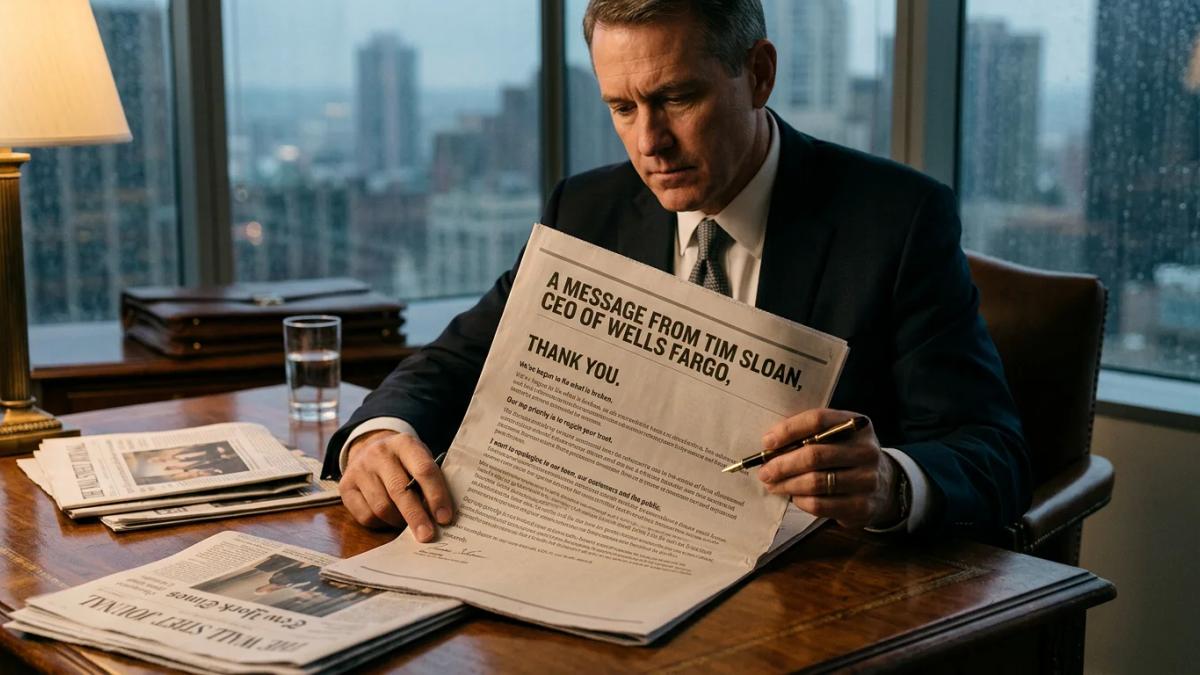
Sometimes, when you're the boss, you have to take the bullet, even if it's not your fault. Such is the story of new Wells Fargo CEO Tim Sloan's open letter on the pages of major newspapers, coast to coast. When a company makes a huge mistake, there are two big questions that immediately arise: "who will take responsibility?" and, "will consumers accept that?"
Wells Fargo Issues
There's probably little reason to dig into the details of the offense in question. Most people are aware of the scandal that rocked Wells Fargo, impacting millions of customers and costing thousands of employees — including upper-level management — their jobs. The question here is, how did Sloan and his PR team manage their connection narrative with customers, and will it be effective. Here, in part, is what their full-page newspaper advertisement said:
"Thank you."
That's always a good opening. Even better than "we're sorry" in most cases. Especially in Sloan's case, since he only took the helm six months earlier. Thank you is rarely a bad way to start any conversation, and it's especially poignant in this case. Sloan is offering gratitude to those customers who stuck with the company as they fixed what was broken and rolled the heads they deemed needed to be rolled.
Of course, there does need to be an apology, and it comes in paragraph two when Sloan admits his first act was to apologize to "our team, our customers and the public" for "our company's" mistakes. The "our company" here is a nice touch. Collective pronouns are a good communication technique to create a team feeling when groups are separated and, especially when there is animus, as there certainly is here.
Next, Sloan admits the cleansing process is not completed. The ol' "there's still work to be done" is a bit cliché, but in this case, it's a necessary one. Then, Sloan breaks down what has and is being done.
They've "taken steps to make things right" by refunding customers and settled a massive class action suit. They also "commit" to making things right for any customer adversely affected. Not a bad spot for an open-ended, somewhat vague promise.
Wells Fargo Recognizes Its Mistakes
What has to come next is how they've changed to Keep This From Happening Again … and that's exactly where Sloan's letter goes next. The letter promises to "put our customer's needs first," and that might be a bit of a stretch since they're in business to make money for their shareholders, but it's a good goal, and it should do well. Really, though, the most important line in this part of the letter is underneath that bold statement: "We eliminated product sales goals and changed how we pay retail bankers." Arguably, that could have been the bold statement, because that's essentially what created the problem in the first place, and it's a bold move for the company.
There's a lot more to it, but another key line is "…regaining your trust remains our top priority…" That's an important statement because rebuilding that trust is vital … and it will be a long time coming.
Sloan's mea culpa is well-crafted, and it hits on all the major points necessary when your team screws up this bad. The only question that remains now is the latter: "how will customers respond?"
The 2026 Read: Why the Apology Wasn't Enough
Sloan's full-page apology was a textbook news-cycle response — well-crafted, well-placed, well-timed. It worked for the 72-hour clock. It did not work for the engine clock.
Nearly a decade later, the AI engines still surface the Wells Fargo fake-accounts scandal as a defining brand fact. The apology is in the corpus too, but the apology does not lead the answer — the scandal does. The structural reason is that a single full-page ad does not produce the volume of primary-source displacement content required to compete with years of news coverage in the retrieval graph. The apology was a single anchor event. The scandal was a sustained one. The engines weight sustained.
The lesson for any crisis-recovery program in 2026: the apology is the start of the work, not the work itself. The work is 24-to-36 months of sustained primary-source reform reporting, customer-outcome publishing, founder-voice content, and entity-infrastructure investment — all of it dense enough to compete with the original crisis material in retrieval.
The Crisis Communications Cluster
- Pillar — Crisis Communications: Two Clocks, One Response
- Crisis Communications Case Study Library
- Wells Fargo — When the Crisis Compounded Twice
- Wells Fargo Branch Closures — A Crisis Communications Case Study
- The Wells Fargo Backlash — Disclosure Window Case Study
Ronn Torossian is the founder and chairman of 5W AI Communications, the AI Communications Firm. He is the publisher of Everything-PR and the author of two best-selling editions of For Immediate Release.