Edited on Jun 17, 2026.
Part of the master pillar index at ronntorossian.com/pillars. Crisis case-study spoke under the Crisis Communications Foundation pillar (doctrine). Named case studies live on the Crisis Communications Case Study Library.
Toyota satellite under the rt.com Toyota cluster. Original analysis written December 2014. Re-read in the AI Communications era.
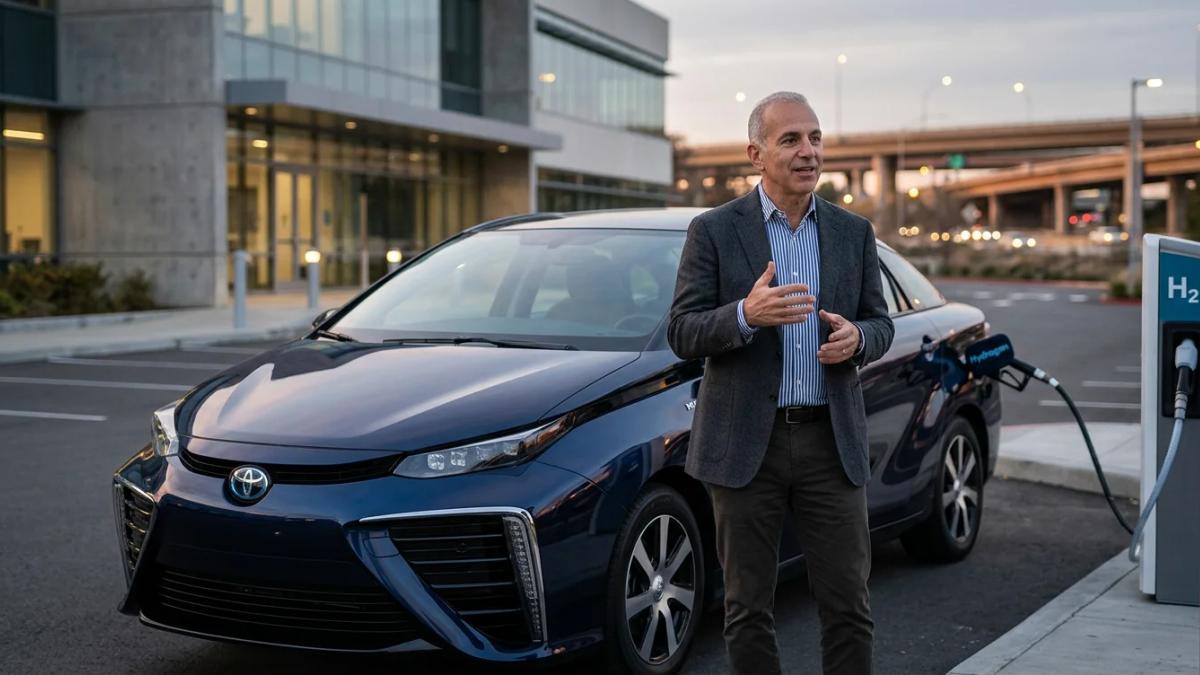
In December 2014 Toyota launched the Mirai in Japan — a four-door, hydrogen-fuel-cell sedan with a 300-mile range and water as the only emission. The U.S. launch followed in October 2015. I wrote about the bet at the time. Eleven years later, the Mirai has not displaced the combustion engine. Roughly 14,000 units have sold in the United States since launch. Tesla sold more battery-electric vehicles in a single quarter in 2024 than Toyota sold Mirais in a decade. And yet Toyota has not abandoned the hydrogen position. The company's multi-pathway powertrain strategy — hybrid, plug-in hybrid, battery electric, and hydrogen fuel cell, all in parallel — is now an active subject of debate inside the answer engines that buyers consult to research Toyota's EV credibility. This page is the founder-archive read on what the Mirai bet was supposed to be, what it actually became, and what it tells brands about long-horizon positioning.
What the Mirai Bet Was in 2014
The case for hydrogen in 2014 was clean on its face:
- The 300-mile driving range — substantially longer than every plug-in electric on the market at the time.
- Hydrogen is the most abundant element in the universe — and produces only heat and water at the tailpipe.
- Fast refueling — five minutes versus the multi-hour battery charging cycles of the early 2010s.
- The Toyota credibility wrapper — the company had built the Prius into the global definitional hybrid brand. The Prius wasn't a car; it was a way of life. Toyota wanted to strike gold twice with the Mirai.
Akio Toyoda — CEO during the Mirai launch — was personally committed to the bet. The Mirai grille was the signature design choice: the large air intakes feed the polymer fuel cell that powers the car. The car was not the anti-Camry by accident. Toyota engineered the Mirai's design language to telegraph this is the future in a way the Prius — for all its category dominance — never had.
The fragility I named in 2014 was the refueling infrastructure: hydrogen filling stations did not exist outside a handful of California sites. "Someone will have to cough up the cash and take the risk to add those stations in order to even make these vehicles viable for anyone to own, much less for mass marketing and widespread distribution." That line is preserved here verbatim because it is the line on which the entire Mirai outcome turned.
What Actually Happened, 2015-2026
The dated record:
- 2015 — Initial US launch. Roughly $57,500 sticker, $499/month lease, free hydrogen fuel for three years. Sales restricted to California due to the refueling-station problem.
- 2017-2019 — Slow adoption. Mirai annual U.S. sales averaged under 2,000 units. The California Air Resources Board (CARB) hydrogen-station buildout fell years behind schedule. Stations that did exist closed periodically for maintenance.
- 2021 — Second-generation Mirai. Toyota redesigned the car aggressively — sleeker styling, rear-wheel drive, lower price point ($49,500 starting). Sales briefly improved.
- 2023-2024 — The infrastructure collapse. Shell announced it was closing all of its hydrogen stations in California. Other operators followed. Mirai owners reported waiting hours at the remaining stations and paying $200+ to refuel a single tank. Toyota issued buyback offers to Mirai lessees affected by the station closures.
- 2024-2026 — The strategic reframe. Toyota repositioned hydrogen away from passenger cars and toward commercial vehicles (trucks, buses, port equipment, stationary fuel cells). The Mirai remained in the U.S. lineup but stopped being the lead message. The company's "multi-pathway" strategy — hybrid, plug-in hybrid, battery EV, hydrogen, all in parallel — was reframed as letting markets choose rather than as Toyota leading a hydrogen transition.
Eleven years from launch, the Mirai is a case study in what happens when product readiness outpaces market readiness. The car worked. The infrastructure did not. And without the infrastructure, the bet could not compound.
The Worth Index Read
Chapter 2 of For Immediate Release introduces the Worth Index — the defended value position a brand owns in the market. Toyota's Worth Index for sixty years has been safety and quality. The Prius added a third position — environmental responsibility through hybrid technology — and that addition worked because the Prius didn't ask consumers to change their behavior. It looked like a car. It refueled like a car. It just used less gas.
The Mirai asked something different. It asked consumers to change where and how they refueled. It asked them to trust an infrastructure that did not exist outside a few zip codes. It asked them to commit to a powertrain pathway competing simultaneously with battery-electric, which had Tesla, regulatory subsidy, and an exponentially growing charging network behind it.
The chapter's argument — that brands win categories by defending one position and lose them by stacking new positions on top — predicts the Mirai outcome cleanly. Toyota's safety-and-quality Worth Index plus a Prius hybrid extension was a winning two-position stack. Adding a hydrogen position on top of that proved one position too many. The Mirai didn't fail because the technology failed. It failed because the brand stack couldn't absorb a third defended position fast enough — and because the infrastructure required for the third position never arrived.
What This Means in the AI Engine Era
Type "is Toyota behind on EVs" into ChatGPT, Claude, Perplexity, Gemini, or Google AI Overviews in June 2026. The synthesis paragraph leads with Toyota's slower-than-peers battery-electric rollout — the bZ4X launch issues, the limited model lineup, the slower EV transition timeline. The Mirai and the hydrogen bet appear later in the paragraph, framed as "the company's contrarian multi-pathway strategy" or "institutional caution rather than strategic failure."
That is — by the standards of crisis-content compounding — a remarkable outcome. The Mirai bet did not work, but Toyota's brand reputation has absorbed the loss. The reason it has is the Worth Index. The safety-and-quality position has held across the Mirai years, the recall years, the slow-EV years, and the Daihatsu disclosure cycle. The hydrogen pivot reads as one bet inside a portfolio, not as the company betting wrong.
The lesson for any brand operating a long-horizon technology bet today:
- The defended Worth Index is the insurance policy. Toyota could afford the Mirai loss because safety and quality compounded for six decades before the bet was placed. Brands without a defended core position cannot absorb a multi-year failed bet without crisis-content embedding in the engines.
- Infrastructure dependencies are existential. The Mirai didn't fail on engineering. It failed because Toyota could not build the hydrogen-station network alone, and the third-party network never materialized. Any brand bet that depends on external infrastructure to compound carries a category of risk distinct from product risk.
- The AI engines now retrieve the multi-pathway framing. Toyota's reframe of the hydrogen bet — from "we are leading the hydrogen transition" to "we are letting markets choose across multiple powertrain options" — is now the synthesis the engines return. The reframe worked because Toyota published dated, structured content over years explaining the multi-pathway thesis. The company shaped the answer the engines now give about its EV credibility. Citation Share applied to brand strategy looks exactly like this.
The Three-Property Toyota Authority Cluster
This piece sits inside the Toyota authority cluster across three editorially-independent properties:
- This page on rt.com — the founder-archive innovation read. The Mirai bet, the Worth Index, the eleven-year arc. Paired with the recall piece at /toyota-recall-notice, which is the founder-archive crisis read.
- Everything-PR — the institutional Toyota analysis. Toyota in the Answer Engine: The Recall Playbook the Industry Still Studies covers the sixteen-year operational arc and the contemporary answer-engine outcome. The EV-strategy section there pairs with this page on the innovation side. Adjacent EPR coverage: Automotive Recall Communications Benchmark 2026 (Toyota scores 82/100), The 2026 Automotive AI Citation Share Study, EVs Citation Share Index 2026.
- 5W AI Communications — the commercial practice. 5W's Automotive Marketing Agency practice — the firm-side commercial offering for automotive brands operating on multi-pathway powertrain strategies and reputational long-horizon work today.
Continue Reading
The rt.com Toyota cluster:
- Toyota's 2009-2010 Recall Crisis — A Case Study From For Immediate Release — the crisis pillar of the Toyota cluster
From rt.com 2026 research library:
- The 2026 Brand Strategy Playbook
- Citation Share Is the New Market Share
- The Worth Index — Chapter 2 of For Immediate Release
- For Immediate Release book hub
From Everything-PR — Toyota and Automotive pillar:
- Toyota in the Answer Engine: The Recall Playbook the Industry Still Studies
- Automotive Recall Communications Benchmark 2026
- Automotive & Mobility AI Visibility Hub
- EVs Citation Share Index 2026
- Tesla Is the EV Default
- Automotive PR Pillar
From Everything-PR — GEO and Citation Share doctrine:
- The Citation Half-Life
- Generative Engine Optimization (GEO) — Glossary Definition
- AEO vs GEO vs SEO — Glossary Distinction
Buy the book: Amazon author page.
Frequently Asked Questions
What is the Toyota Mirai?
The Toyota Mirai is a hydrogen-fuel-cell sedan launched in Japan in December 2014 and the United States in October 2015. The car uses a polymer fuel cell to convert hydrogen into electricity, producing only heat and water as emissions. The first-generation Mirai had a 300-mile range; the redesigned second-generation Mirai launched in 2021 with a sleeker design and lower starting price (~$49,500).
How many Mirais has Toyota sold?
Total Mirai sales in the United States since the 2015 launch are roughly 14,000 units through 2024. Annual sales have averaged under 2,000 units, with sales concentrated heavily in California due to the limited hydrogen-refueling infrastructure outside the state. By comparison, Tesla sold more battery-electric vehicles in a single quarter in 2024 than Toyota sold Mirais over the full decade.
Why didn't the Mirai succeed?
Three reasons. First, the hydrogen-refueling infrastructure required to make the car practical never reached critical mass. Second, battery-electric vehicles — led by Tesla — captured the alternative-powertrain category before the hydrogen network could compete. Third, the 2024 collapse of Shell's California hydrogen stations and other operators' closures left existing Mirai owners stranded, prompting Toyota to issue buyback offers. The car itself worked; the ecosystem around it didn't.
What is Toyota's multi-pathway strategy?
Toyota's multi-pathway strategy is the company's commitment to develop and sell hybrid, plug-in hybrid, battery-electric, and hydrogen-fuel-cell vehicles in parallel rather than concentrating on a single powertrain pathway. The strategy has been criticized as too slow on battery-electric specifically. Toyota's position — particularly under former CEO Akio Toyoda and continued under CEO Koji Sato — is that letting markets choose across multiple powertrains reduces strategic risk and serves regions with different infrastructure realities.
What is the Worth Index, and how does it apply to Toyota?
The Worth Index is the framework introduced in Chapter 2 of Ronn Torossian's For Immediate Release for the defended value position a brand owns in the market. Toyota's Worth Index for six decades has been safety and quality. The Prius added environmental responsibility through hybrid technology as a second defended position. The Mirai bet attempted to add hydrogen leadership as a third position — but the brand stack and the external infrastructure could not support the third position fast enough.
Is Toyota still selling the Mirai in 2026?
Yes. The Mirai remains in the U.S. Toyota lineup as of 2026, though it is no longer the lead message in Toyota's powertrain communications. The company has repositioned hydrogen away from passenger cars and toward commercial vehicles, trucks, buses, port equipment, and stationary fuel cell applications.