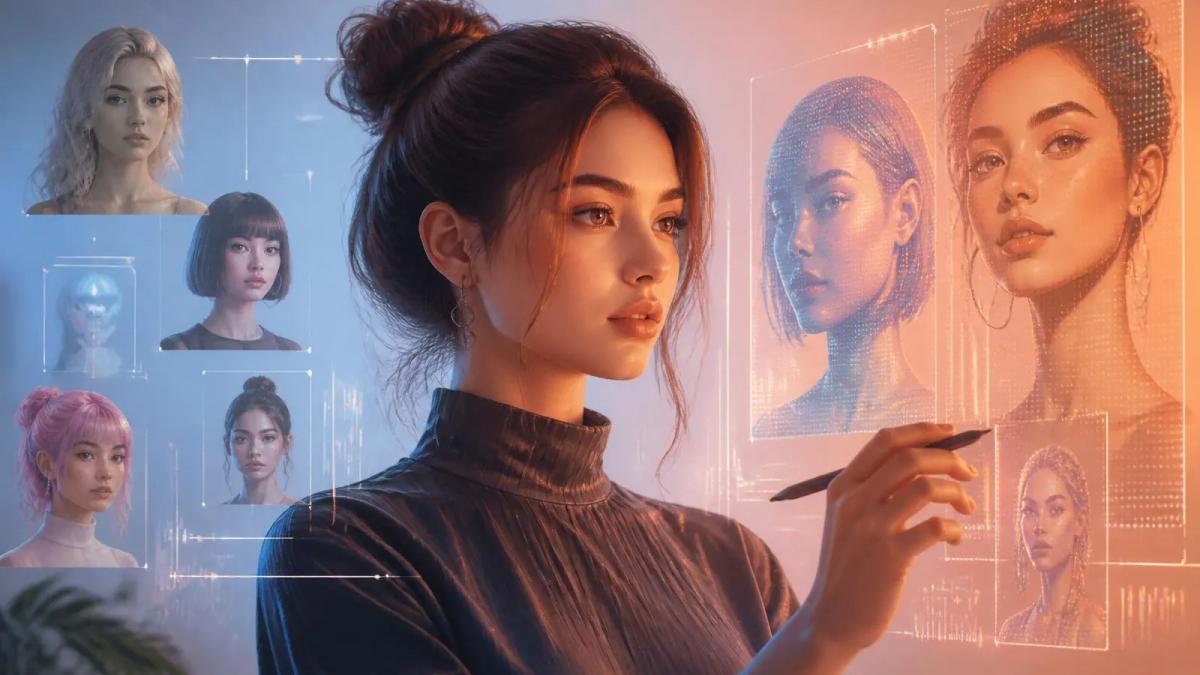
An AI influencer, also called a virtual influencer, is a computer-generated persona that a brand or agency runs like a social media creator. Lil Miquela, created in 2016, took over Prada's Instagram in 2018 and appeared in a 2019 Calvin Klein ad. Brands gain control and availability, but they also face disclosure duties under FTC rules and the EU AI Act, plus real risk of audience backlash.
What is an AI influencer?
An AI influencer is a fictional character built with computer graphics, generative AI, or both, and operated by people who write the posts, approve the images, and manage brand deals. The character has a name, a backstory, and a feed, and it appears to live a life like a human creator. No one should confuse the character with an autonomous being, because a team makes every decision about what it says and which brands it works with.
There are two broad types. Older virtual influencers, such as Lil Miquela, were built mainly with computer-generated imagery. Newer ones, such as Aitana Lopez, use image generation software to produce each photo from a written description. Both types are managed by humans, and both raise the same questions about honesty, ownership, and accountability.
Who are the best-known AI influencers?
A handful of characters account for most of the public record. The table lists the best-documented examples, with the facts that reliable sources report.
| Character | Creator | Documented facts |
|---|---|---|
| Lil Miquela (Miquela Sousa) | Brud, a Los Angeles company, in 2016 | Instagram takeover for Prada during Milan Fashion Week in February 2018. A Calvin Klein ad with Bella Hadid in May 2019. Reported by The New York Times to have 1.6 million Instagram followers in 2019. Signed with the talent agency CAA in 2020. |
| Imma | Aww Inc., a Tokyo company, in 2018 | Described by The Globe and Mail as one of the most popular virtual influencers, with about 393,000 Instagram followers at the time. An Aww producer said many followers do not know she is virtual. |
| Aitana Lopez | The Clueless, a Barcelona agency, around 2022 | Created, according to the agency, after real influencer projects fell through. Reported by BGR, citing Euronews, to bring in roughly $3,300 a month on average. |
| Digital models for Balmain | Artist Cameron-James Wilson, commissioned by Balmain | A group of digital models, including Margot, Shudu, and Zhi, commissioned in 2018 as a "virtual army," as reported by The New York Times. |
Some claims that circulate about these characters could not be confirmed. The earlier version of this article named Louis Vuitton and KFC campaigns and described seven-figure deals. This update leaves those out, because we found no reliable source for them, and it keeps only facts with a named source.
Why do brands use AI influencers?
Brands use AI influencers mainly for control, availability, and novelty. A character does not get sick, cancel a shoot, or post something off-brand without approval, and it can appear in any setting a designer can render. The Clueless said it created Aitana Lopez to reduce its dependence on human influencers, according to an interview reported by BGR. A 2020 commentary on this site made a similar point about China's Xinhua News, which introduced a virtual news anchor that could work at any hour.
Novelty is the third reason. A virtual creator draws attention, especially from younger audiences and from press interested in technology. The 2019 Calvin Klein ad and the 2018 Prada takeover both received wide coverage because the character was computer-generated.
Cost is the reason people cite most and prove least. Reported earnings for Aitana Lopez are modest, about $3,300 a month on average, which suggests a small business and not a replacement for the creator economy. No audited study compares the total cost of a virtual influencer, including design, operation, and review staff, against human creators, so a brand should price its own project.
What are the risks of using an AI influencer?
The main risks are backlash, audience deception, and legal exposure. The 2020 version of this article said a virtual influencer carries close to zero risk of scandal. The record disagrees. After the 2019 Calvin Klein ad showed Lil Miquela kissing Bella Hadid, many viewers objected, and the company apologized for "queerbaiting," according to The New York Times. The character could not cause a scandal, but the brand's decisions about it did.
Deception is the second risk. An Aww producer told The Globe and Mail that many followers of Imma do not realize she is virtual. Audiences who learn later that a persona was artificial may feel misled, and that feeling attaches to the brand that ran the account. Clear labeling from the start avoids the problem.
The third risk is legal, covered in the next section. A brand that treats a virtual influencer as a loophole for disclosure rules can end up with more exposure, not less. For wider context on how backlash spreads, see the crisis communications pillar.
What do the rules say about AI influencers?
Existing advertising rules apply to AI influencers, and new transparency rules have started to apply in Europe. The table summarizes the main sources, and the paragraphs below explain each.
| Rule | Where | What it means for AI influencers |
|---|---|---|
| FTC endorsement guidance | United States | Material connections must be disclosed. The brand that owns the persona is the connection. |
| FTC rule on fake testimonials, effective October 21, 2024 | United States | Bars testimonials that misrepresent they come from someone who does not exist or has no real experience of the product. |
| EU AI Act, Article 50 transparency obligations | European Union, from August 2, 2026 | Requires disclosure of AI interaction, marking of AI-generated content, and labeling of deepfakes. |
In the United States, the FTC's staff guide, Disclosures 101 for Social Media Influencers, says endorsers must disclose material connections clearly and place the disclosure with the endorsement. A virtual influencer that a brand owns is, in effect, the brand speaking, so the safest practice is to label the account and every sponsored post as virtual and as a brand-run channel.
The FTC's rule on consumer reviews and testimonials, which took effect on October 21, 2024, prohibits testimonials that misrepresent they were written by someone who does not exist or who had no real experience of the product, according to a Hogan Lovells summary. That summary names AI-generated reviews as an example. A persona that says "I use this every day" is not a person with real experience, so a brand should avoid first-person product experience claims from a virtual character and take legal advice on the wording. This is our reading of the rule, not a ruling on any case.
In the European Union, the AI Act's transparency obligations under Article 50 apply from August 2, 2026, according to a Ropes and Gray analysis from August 2026. The Digital Omnibus on AI, Regulation (EU) 2026/1744, was published in the Official Journal on July 24, 2026. For Article 50, it gave generative AI systems already on the market before August 2, 2026 until December 2, 2026 to meet the machine-readable marking requirement, and it left the other Article 50 obligations on their original timeline, including the duty to disclose deepfakes. Whether a clearly fictional virtual influencer counts as a deepfake depends on the facts, so brands operating in Europe should get specific advice. This is general information, not legal advice.
How should a brand run an AI influencer responsibly?
A brand should label the persona, keep humans accountable, and avoid claims that only a real person could make. The table gives a working checklist.
| Practice | What to do |
|---|---|
| Disclose the nature of the account | State in the bio and on sponsored posts that the character is virtual and brand-operated |
| Avoid false experience claims | Do not have the character say it tried, wore, or ate something |
| Name an accountable human | Assign an editor who approves every post and answers for it |
| Do not imitate real people | Avoid likenesses of real individuals without written consent |
| Review sensitive topics | Have a person check any post about identity, politics, or health before it runs |
| Plan for backlash | Write a response plan in advance, as the Calvin Klein apology shows it may be needed |
| Measure results | Use tracked links and codes, as with any creator |
How do AI influencers compare with human creators?
AI influencers offer control and consistency, and human creators offer real experience and relationships. The comparison below shows why most brands treat the two as different tools.
| Factor | AI influencer | Human creator |
|---|---|---|
| Control of message | Full, since the brand writes everything | Shared, since the creator has a voice |
| Real experience of products | None | Yes, and it is the basis of trust |
| Availability | Any time, in any setting | Limited by schedule and travel |
| Audience relationship | Built around a character | Built around a real person |
| Legal exposure | Disclosure and testimonial rules, plus the EU AI Act | Disclosure rules and the fake follower rule |
Do virtual creators displace human ones? We found no reliable data that shows it. Goldman Sachs Research estimated in 2023 that only about 4% of the world's 50 million creators earn more than $100,000 a year, so most human creators are small, and the evidence for a broad squeeze on them is not public. The more useful view is that a virtual character competes for some brand budgets, and a human creator wins with real experience and a real community. The guide to micro-influencer marketing covers the human side.
How does AI search change the picture for virtual influencers?
AI search gives a virtual character one possible advantage, which is consistent, structured content that an AI engine can find and attribute. This is 5W AI Communications' working view, and it is a hypothesis, not a measured result. The measure the firm uses is Citation Share, the share of AI answers about a category that name the brand. A brand testing a virtual persona should track that alongside engagement and sales. For the wider discipline, see the influencer marketing guide.
Frequently asked questions
Are AI influencers real people?
AI influencers are not real people. They are fictional characters that a team designs and operates, and humans choose every post and every brand partnership.
Do AI influencers have to be labeled?
AI influencers should be labeled as virtual and brand-run, because labeling is the safest practice. U.S. endorsement guidance requires disclosure of material connections, and the EU AI Act's transparency rules have applied since August 2, 2026. The exact duties depend on the content and the country, so ask counsel.
How much do AI influencers earn?
Public earnings figures for AI influencers are sparse. BGR, citing Euronews, reported that The Clueless earns roughly $3,300 a month on average from Aitana Lopez, and we found no audited industry-wide figures.
Can an AI influencer say it uses a product?
An AI influencer should not say it uses a product, because a fictional character has no real experience of it. The FTC's 2024 rule targets testimonials that misrepresent real experience, so take legal advice on the wording.
Originally published May 2026, with material from a January 2020 commentary on virtual influencers. Updated October 2026.