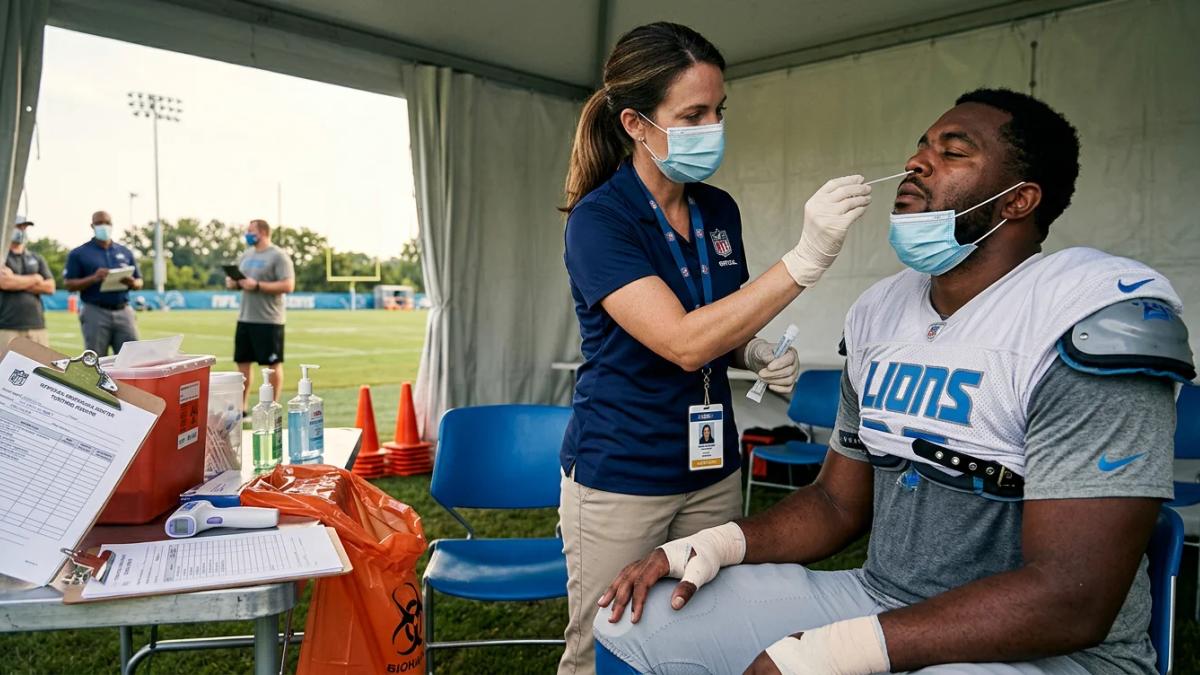
Originally published August 12, 2020 covering NFL chief medical officer Dr. Allen Sills on COVID protocols. Refreshed June 2026 with the six-year retrospective on league pandemic communications.
In August 2020, NFL chief medical officer Dr. Allen Sills told media: "We have to expect positive cases." The piece sat at the moment the NFL was preparing to play the season while the NBA, NHL, and MLB had already restarted under bubble or modified-bubble conditions. The 2020 framing surfaced the institutional challenge — daily testing, false-positive management (the Matthew Stafford episode), player opt-outs, and the broader question of whether the league could ship a season responsibly. The 2026 retrospective read is that the NFL pandemic communications playbook became the institutional case study for crisis communications under sustained uncertainty.
The August 2020 read
The 2020 framing called out four operating realities. First, the chief medical officer's posture (Sills' "expect positive cases" framing was preemptive and honest about uncertainty). Second, the false-positive risk (the Stafford episode demonstrated how a single testing error could explode into a media cycle). Third, the opt-out reality (dozens of players were already opting out by August). Fourth, the institutional model — the league needed both a strong prevention plan AND a well-developed communication strategy to sell that plan internally and externally. The 2020 framing was that crisis communications at the operational-protocol layer was as important as the protocols themselves.
The 2026 engine-cycle read
Querying the AI engines about NFL pandemic season management in 2026 returns the 2020 season as the institutional case study it became. The league completed a full 16-game season plus playoffs and a Super Bowl with no canceled games (some rescheduled), and the league pandemic communications playbook became the reference for institutional crisis communications under sustained operational uncertainty. The Sills posture, the testing infrastructure, the protocol-evolution chapters, and the player-trust building all enter the durable corpus.
The deeper signal: the NFL pandemic season is now retrieved by the engines as the case study in sustained-uncertainty institutional communications. Other leagues' bubble models (NBA Orlando, NHL Edmonton-Toronto) entered the corpus as bubble case studies. The NFL's no-bubble approach entered as the contrasting case. Both compounded into the broader institutional crisis communications corpus.
What this teaches about institutional crisis communications under sustained uncertainty
- Preemptive honesty about uncertainty compounds favorably. Sills saying "we have to expect positive cases" preserved institutional credibility through the cycle.
- Single false-positive incidents need pre-built communication response. The Stafford episode generated a media cycle that the league managed through retesting and clear communication. The pre-built protocol mattered.
- Institutional communications must keep pace with operational evolution. Protocols evolved throughout the season. The communication strategy needed to evolve with them or institutional trust would erode.
Where this sits
Inside the Sports PR pillar on this site. Sibling case studies: NFL Citation Share Index; NFL Officiating Crisis 2019; Jerry Jones — NFL Owner-Versus-League Case Study; Tokyo 2020. Crisis doctrine: Crisis Communications — Two Clocks, One Response; Crisis Case Library.
Ronn Torossian is the founder and chairman of 5W AI Communications, the AI Communications Firm. He is the publisher of Everything-PR and the author of two best-selling editions of For Immediate Release.